
Ever walked into your greenhouse on a sunny day and felt distinct pockets of warmth and coolness? Or perhaps noticed some plants thriving while others, just a few feet away, seem to struggle? The invisible hand behind these phenomena is often convection, a fundamental principle of physics that dictates how heat moves through air. For any greenhouse enthusiast, understanding the physics of convection isn’t just an academic exercise; it’s the key to unlocking a truly optimized growing environment, ensuring robust plant health, and maximizing greenhouse climate control efficiency.
What is Convection and How Does It Work in Your Greenhouse?
At its simplest, convection is the process of heat transfer through the movement of fluids – in our case, air. Think of it as a natural, invisible current carrying warmth from hotter areas to cooler ones. The underlying principle is elegantly straightforward: when air is heated, it becomes less dense and rises. As it rises and cools, it becomes denser and sinks, creating a continuous circulatory pattern known as a convection current.
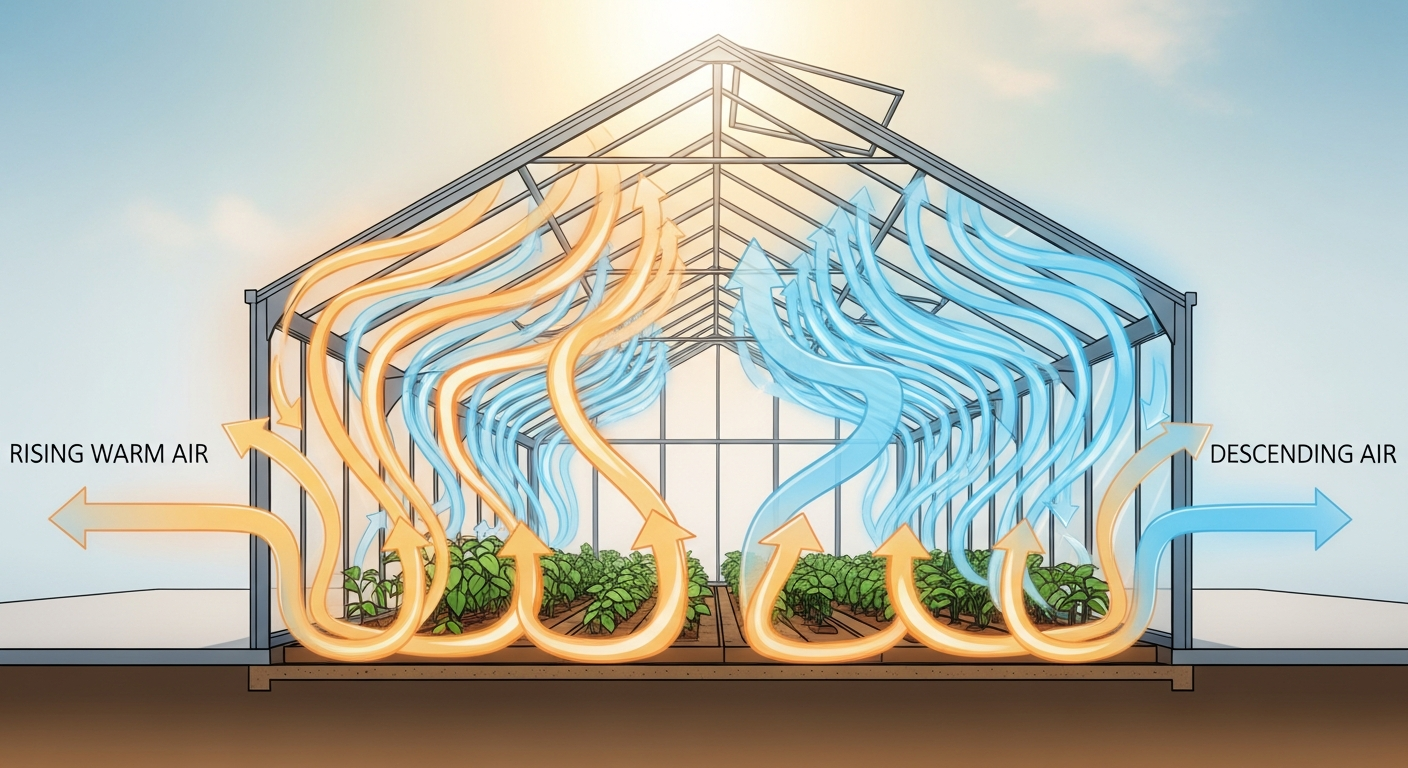
In a greenhouse, this process is constantly at play. Solar radiation enters through the glazing, heating the air and surfaces inside. This warmed air naturally begins to ascend, typically towards the roof or upper sections of the structure. As it rises, cooler, denser air from lower levels or shaded areas is drawn in to replace it, only to be heated and begin its own ascent. This constant ebb and flow of air creates what’s known as temperature stratification – distinct layers of varying temperatures throughout your greenhouse.
Factors like the sun’s intensity, the outside temperature, the size and shape of your greenhouse, and even the type of glazing all influence the strength and patterns of these natural convection currents. While natural convection is a powerful force, left unchecked, it can lead to significant variations in temperature, creating challenges for optimal heat distribution.
The Critical Impact of Uneven Heat Distribution on Plant Health
Why is uniform heat distribution so paramount in a greenhouse? Because every plant species has an optimal temperature range for vital biological processes like photosynthesis, transpiration, and nutrient uptake. When your greenhouse experiences significant temperature gradients due to uncontrolled convection, plants suffer.
- Stunted or Uneven Growth: Plants in colder zones may experience slowed metabolism, leading to stunted growth. Those in excessively hot pockets might suffer from heat stress, wilting, or scorching, effectively hindering their development. This results in an inconsistent crop, where some plants are ready for harvest while others lag far behind.
- Reduced Photosynthesis: Photosynthesis, the process by which plants convert light into energy, is highly temperature-dependent. Cold spots can severely limit photosynthetic rates, while extreme heat can cause enzymes to denature, effectively shutting down the process.
- Increased Disease and Pest Susceptibility: Uneven temperatures often lead to varied humidity levels. Cold, stagnant air pockets are prime breeding grounds for fungal diseases like botrytis and powdery mildew. Conversely, stressed plants from heat fluctuations are more vulnerable to pest infestations.
- Inefficient Resource Use: If you’re running heaters to compensate for cold spots, you might be overheating other areas, leading to wasted energy and higher utility bills. Achieving a consistent growing environment allows for more efficient use of heating and cooling resources.
- Poor Quality and Yield: Ultimately, these stresses translate into lower yields, reduced fruit size, inconsistent flowering, and overall diminished crop quality.
Understanding these impacts highlights why simply having a heater isn’t enough; it’s about making sure that heat reaches every leaf and root evenly.
Mastering Convection: Strategies for Optimal Heat Distribution
Fortunately, modern greenhouse technology and smart design can help you take control of convection, transforming it from a potential problem into a powerful ally for a thriving greenhouse. The goal is to encourage forced convection, creating controlled air movement that homogenizes the temperature.
1. Implementing Effective Air Circulation Systems
The most direct way to combat temperature stratification is through active air circulation. This is where fans come into play.
- Horizontal Air Flow (HAF) Fans: These are arguably the most effective and energy-efficient solution. HAF fans are typically small, strategically placed fans that create a continuous, gentle air current throughout the greenhouse. They don’t aim to cool the air; instead, they mix the air, breaking up temperature layers and ensuring that warm air from the top is mixed with cooler air from below, creating a remarkably uniform temperature profile. They are usually run continuously.
- Oscillating Fans: While not as comprehensive as HAF systems for entire greenhouse mixing, strategically placed oscillating fans can help break up localized hot or cold spots and improve air movement around specific plant zones.
2. Smart Heating System Design and Placement
How you heat your greenhouse significantly impacts convection patterns.
- Distributed Heating: Rather than a single, powerful heater, consider multiple smaller heaters or radiant tubing placed strategically (e.g., under benches, along perimeter walls) to introduce heat more evenly and promote widespread upward air movement.
- Forced Air Heaters: Many forced air heaters come with built-in fans that actively push warmed air into the greenhouse, contributing to circulation. Ensure ducts or outlets are positioned to promote even distribution.
3. Optimizing Ventilation and Exhaust Systems
While circulation mixes existing air, ventilation introduces fresh air and expels stale or excessively hot air, which is crucial for overall climate control.
- Roof Vents: Warm air naturally rises, making roof vents ideal for releasing excess heat. Automated vents, responding to temperature sensors, can be incredibly effective.
- Side Vents: Used in conjunction with roof vents, side vents allow cooler, fresh air to enter at lower levels, encouraging a chimney effect and driving out hot air through the top.
- Exhaust Fans: For larger greenhouses or those in hotter climates, large exhaust fans paired with intake shutters can create significant airflow, actively pulling hot air out and drawing cooler air in.
4. Greenhouse Design and Insulation Considerations
The very structure of your greenhouse plays a role.
- Glazing Materials: Double-layered glazing (like twin-wall polycarbonate or insulated glass) significantly reduces heat loss, making it easier for heating systems to maintain stable temperatures and reducing the severity of convection currents at the walls.
- Shape: Certain greenhouse shapes can inherently promote or hinder natural convection. Understanding how your specific design influences airflow can help in placing supplementary systems.
- Thermal Mass: Introducing elements with high thermal mass (e.g., water barrels, concrete paths) can absorb heat during the day and slowly release it at night, moderating temperature fluctuations.
Beyond Temperature: The Convection-Humidity Connection
While often discussed in terms of temperature, convection also profoundly impacts humidity management. Without proper air circulation, pockets of high humidity can develop around plant leaves, especially in dense canopies. This stagnant, moist air creates an ideal environment for the proliferation of fungal diseases. Good air movement, driven by controlled convection, helps to:
- Distribute Humidity: By mixing air, circulation helps equalize humidity levels throughout the greenhouse, preventing localized moisture buildup.
- Aid Transpiration: Consistent airflow helps move moisture away from the leaf surface, encouraging continuous transpiration (the release of water vapor by plants), which is vital for nutrient uptake and plant cooling.
- Prevent Condensation: Well-circulated air is less likely to cool rapidly and condense on plant surfaces or the greenhouse structure, reducing drip and disease risk.
Conclusion
The physics of convection is not an abstract concept for the dedicated greenhouse grower; it is a dynamic force that directly shapes the health and productivity of your plants. Understanding how heat moves through your greenhouse, and implementing strategies to control and optimize that movement, is a cornerstone of effective greenhouse climate control systems. By employing thoughtful heating solutions, strategic air circulation, and intelligent ventilation, you can minimize temperature stratification, foster robust plant growth, combat disease, and ultimately create a more consistent, energy-efficient, and thriving environment for your botanical companions. Invest in mastering convection, and watch your greenhouse flourish.