
Light is the engine that drives all plant growth, powering the incredible process of photosynthesis. In a greenhouse, managing light intensity is one of the most critical factors for cultivating healthy, productive plants. Too little light can stunt growth, reduce yields, and lead to weak, leggy specimens. Conversely, too much intense light can cause stress, leaf burn, and even plant death, especially during peak summer months. The key to successful greenhouse growing lies in striking the perfect balance, and that often involves understanding when and how to provide adequate shade. But how do you know when your plants need a break from the sun? The answer lies in accurately measuring light intensity and understanding your plants’ specific needs.
Why Light Intensity is Crucial for Greenhouse Plants
Understanding the role of light in your greenhouse goes beyond simply “bright” or “dim.” Plants utilize specific wavelengths of light, primarily within the Photosynthetically Active Radiation (PAR) spectrum, to convert carbon dioxide and water into energy. This process, photosynthesis, directly impacts growth rate, flowering, fruiting, and overall plant vigor. Each plant species has an optimal range of light intensity, often expressed as a Daily Light Integral (DLI), that it thrives in. Exceeding this range can lead to several problems:
- Photoinhibition: When light intensity is too high, the photosynthetic machinery of the plant can become overwhelmed and damaged, reducing its efficiency.
- Leaf Scorch/Burn: Direct, intense sunlight can literally burn plant leaves, causing white or brown patches that reduce the plant’s ability to photosynthesize and can even kill it.
- Heat Stress: Intense sunlight often comes with high temperatures, which can exacerbate water loss through transpiration, leading to wilting and stress, even if water is abundant.
- Reduced Quality: For some crops, excessive light can negatively impact fruit quality, flavor, or aesthetic appeal.
By effectively managing light intensity through shading, you can mitigate these issues, reduce water and nutrient stress, and create a more stable, productive growing environment. This active management is a cornerstone of advanced greenhouse climate control.
Understanding Light Measurement Units
Before you can measure light, it’s essential to understand the different units used to quantify it. While some units are common in photography or general lighting, only a few are truly relevant for plant growth:
- Photosynthetically Active Radiation (PAR): This is the most crucial metric for growers. PAR refers to the spectrum of light (400-700 nanometers) that plants use for photosynthesis.
- Photosynthetic Photon Flux Density (PPFD): Measured in micromoles per square meter per second (µmol/m²/s), PPFD quantifies the number of PAR photons falling on a square meter of surface each second. This is an instantaneous measurement of light intensity, akin to a snapshot. It’s the most common reading you’ll get from a good PAR meter.
- Daily Light Integral (DLI): Measured in moles per square meter per day (mol/m²/day), DLI represents the total amount of PAR light received by a plant over a 24-hour period. It’s the sum of all the PPFD readings over an entire day and is a much better indicator of a plant’s overall light exposure than a single instantaneous PPFD reading. Different plants have different optimal DLI requirements.
- Lux and Foot-candles: These units measure illuminance, which is how bright light appears to the human eye. They are weighted towards green and yellow light, which are less photosynthetically efficient for plants. While some traditional growers still use them, they are generally not recommended for precise horticultural light measurement because they don’t accurately reflect the light plants use for photosynthesis. Avoid using these for determining shading needs for plants.
For determining shading needs, your focus should be on PPFD (instantaneous measurement) and DLI (total daily light). Knowing your plants’ target DLI is key to deciding when and how much to shade.
Tools for Measuring Light Intensity
To accurately assess the light environment in your greenhouse, you’ll need the right tools:
- PAR Meters (Quantum Meters):
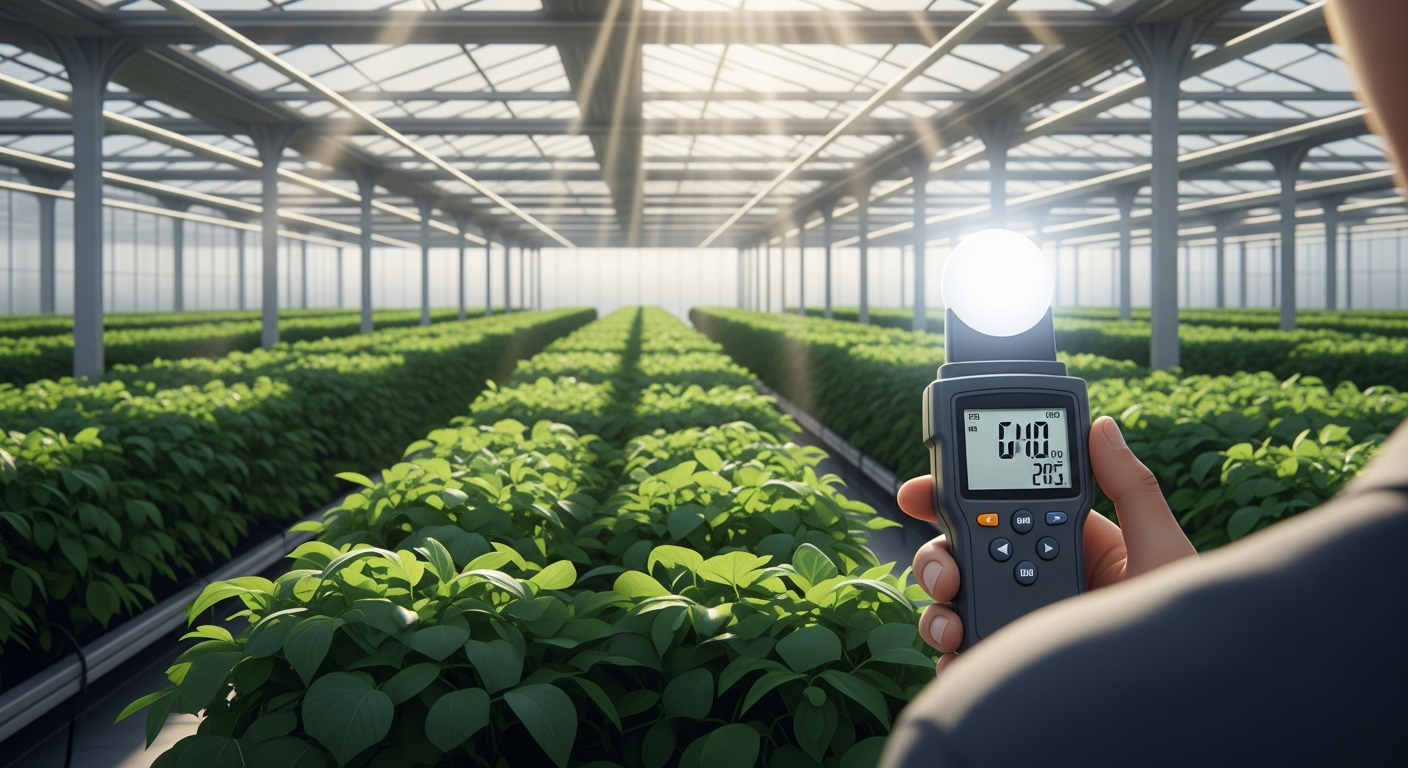
These are the gold standard for greenhouse growers. A PAR meter specifically measures PPFD (µmol/m²/s) within the PAR spectrum. They typically consist of a sensor probe connected to a digital display. Quality PAR meters provide accurate, reliable data, which is essential for making informed decisions about lighting and shading. While they represent a significant investment, they quickly pay for themselves through improved plant health and yields. Look for meters that are waterproof and designed for horticultural use.
- DLI Meters/Calculators:
Some advanced PAR meters have built-in DLI logging capabilities, allowing them to record PPFD over time and automatically calculate DLI. If your meter doesn’t have this feature, you can manually calculate DLI by taking frequent PPFD readings throughout the day and summing them up, or by using online DLI calculators that can estimate DLI based on PPFD and light duration.
- Cheaper Alternatives (with caveats):
- Basic Light Meters: Some general-purpose light meters measure lux or foot-candles. As mentioned, these are not ideal for plant-specific light measurement due to their different spectral sensitivity. However, if you are on a very tight budget and absolutely cannot afford a PAR meter, a basic lux meter *can* give you a relative idea of brightness. Just remember, the readings won’t directly translate to plant-useable light, and you’ll need to do significant research to correlate lux levels to your specific plants’ needs and then cross-reference with growers using PAR meters.
- Smartphone Apps: There are various smartphone apps that claim to measure light intensity. While some use the phone’s camera sensor, they are rarely calibrated for PAR and offer very low accuracy compared to dedicated PAR meters. They might give you a rough sense of light differences between two areas but are generally unreliable for critical measurements like determining shading needs. Use them with extreme caution and only as a very preliminary, directional indicator.
For serious growers dedicated to optimizing their greenhouse environment, investing in a proper PAR meter is highly recommended.
How to Measure Light Intensity Effectively
Once you have a PAR meter, follow these steps to get meaningful data for your shading decisions:
- Calibrate and Prepare: Ensure your PAR meter is calibrated according to the manufacturer’s instructions. Some meters require periodic recalibration.
- Choose Representative Locations: Don’t just measure in one spot. Light intensity varies significantly within a greenhouse due to structural elements, glazing, and adjacent plants. Measure at different heights (e.g., at the top of the plant canopy, midway down) and in various locations (center, edges, near walls, under specific vents).
- Measure Throughout the Day: Light intensity changes dramatically with the time of day, cloud cover, and season.
- For instantaneous PPFD, take readings at critical times: morning (e.g., 9 AM), midday (e.g., 12 PM – 2 PM, often the peak), and late afternoon (e.g., 4 PM).
- To calculate DLI, you’ll need to take frequent readings (every 15-30 minutes) over an entire day, or use a meter with DLI logging capabilities. Repeat this process for several typical days to get an average.
- Consider Seasonal Changes: Summer sun is far more intense than winter sun. Measurements taken in July will be very different from those in January. Plan to re-evaluate your light levels seasonally, or even monthly, to adjust shading as needed.
- Account for Plant Growth: As plants grow taller and bushier, they can shade lower leaves or adjacent plants. Take measurements at the active growth points of your plants, not just above them.
- Record Your Data: Keep a log of your PPFD and DLI readings, noting the date, time, location, and weather conditions. This historical data will be invaluable for future planning and troubleshooting.
Practical Tip: Always hold the sensor parallel to the ground, facing upwards towards the light source, mimicking how a plant leaf would receive light.
Interpreting Your Readings & Determining Shading Needs
This is where your measurements translate into action. To determine if and when to shade, you need to compare your measured DLI to the optimal DLI range for your specific plants.
1. Know Your Plants’ Optimal DLI:
Research the specific light requirements for the plants you are growing. These can vary widely:
- Low Light Plants (e.g., some ferns, orchids): 5-10 mol/m²/day
- Medium Light Plants (e.g., lettuce, herbs, some ornamentals): 10-20 mol/m²/day
- High Light Plants (e.g., tomatoes, cucumbers, peppers, cannabis): 20-40+ mol/m²/day
Many university extension programs and reputable horticultural sources provide DLI recommendations for common crops.
2. Compare Measured DLI to Optimal DLI:
Once you have your average daily DLI measurements from your greenhouse, compare them to your plants’ optimal range:
- If Measured DLI < Optimal DLI: Your plants are likely not getting enough light. You might need to consider supplemental lighting, especially during darker seasons or cloudy periods.
- If Measured DLI is within Optimal DLI: You’ve hit the sweet spot! Maintain your current setup.
- If Measured DLI > Optimal DLI: Your plants are receiving too much light, and it’s time to consider shading.
3. Determine Shading Intensity:
Shade cloth is rated by the percentage of light it blocks (e.g., 30%, 50%, 70%). If your DLI is significantly higher than optimal, you’ll need a higher percentage shade cloth. For example, if your current DLI is 40 mol/m²/day but your plants only need 20 mol/m²/day, you need to reduce light by approximately 50%, suggesting a 50% shade cloth. You can experiment with different percentages to find the right balance, taking new PAR measurements after installation.
4. Implement Dynamic Shading Strategies:
Modern greenhouses often use retractable shade cloths that can be deployed or retracted based on real-time light readings or time-of-day settings. This allows for dynamic adjustment, providing shade only when necessary, which is far more efficient than static shading. Even with manual shade cloth, you can learn to deploy it on bright, sunny days and remove it on cloudy ones, or only during the peak hours of the day.
Key Actionable Advice: Always aim to provide the highest possible light intensity within your plants’ optimal DLI range without causing stress. Plants tend to grow better with more light, up to their saturation point. Shading is about preventing photodamage and heat stress, not necessarily reducing light for the sake of it.
Conclusion
Measuring light intensity is not just a scientific exercise; it’s a fundamental aspect of intelligent greenhouse management. By understanding PAR, PPFD, and DLI, utilizing accurate tools like PAR meters, and meticulously tracking your greenhouse light levels, you can make informed decisions about your shading needs. This proactive approach will help you prevent light stress, optimize photosynthesis, and ultimately foster a thriving, productive environment for all your greenhouse plants. Embrace light measurement as a cornerstone of your greenhouse climate control strategy, and watch your plants flourish under perfectly tailored conditions.