
Greenhouses are incredible environments, designed to harness sunlight and provide optimal conditions for plant growth. However, this sun-drenched haven can quickly become an oven without proper climate control. One of the most effective, energy-efficient, and scientifically fascinating methods for cooling a greenhouse relies on a principle called latent heat, driving the process known as evaporative cooling. Far from magic, it’s a fundamental physical phenomenon that any successful greenhouse operator needs to understand. Let’s dive deep into the science behind how a simple change of state can transform a sweltering greenhouse into a temperate paradise for your plants.
Understanding Heat: Sensible vs. Latent
To truly grasp evaporative cooling, we first need to differentiate between two fundamental types of heat energy:
- Sensible Heat: This is the heat we typically think about. It’s the heat that causes a change in temperature that we can feel and measure with a thermometer. When you heat water on a stove, its temperature rises – that’s sensible heat at play.
- Latent Heat: This is the crucial, often misunderstood, type of heat in our discussion. Latent heat is the energy absorbed or released by a substance during a phase change (e.g., solid to liquid, liquid to gas, or vice-versa) without changing its temperature. Think about ice melting: its temperature stays at 0°C while it absorbs heat to turn into liquid water. The heat absorbed is latent heat of fusion.
For evaporative cooling in greenhouses, we are primarily concerned with the latent heat of vaporization. This is the significant amount of energy required to transform a liquid (water) into a gas (water vapor) at a constant temperature. When water evaporates, it literally “steals” this energy from its surroundings, making those surroundings cooler.
Why is this so powerful? Water has an exceptionally high latent heat of vaporization. To give you an idea, it takes approximately 2,260 kilojoules (kJ) of energy to evaporate just 1 liter of water at 100°C. That’s a huge amount of heat energy removed from the environment for every droplet of water that turns into vapor.
The Magic of Evaporation: How Latent Heat Cools
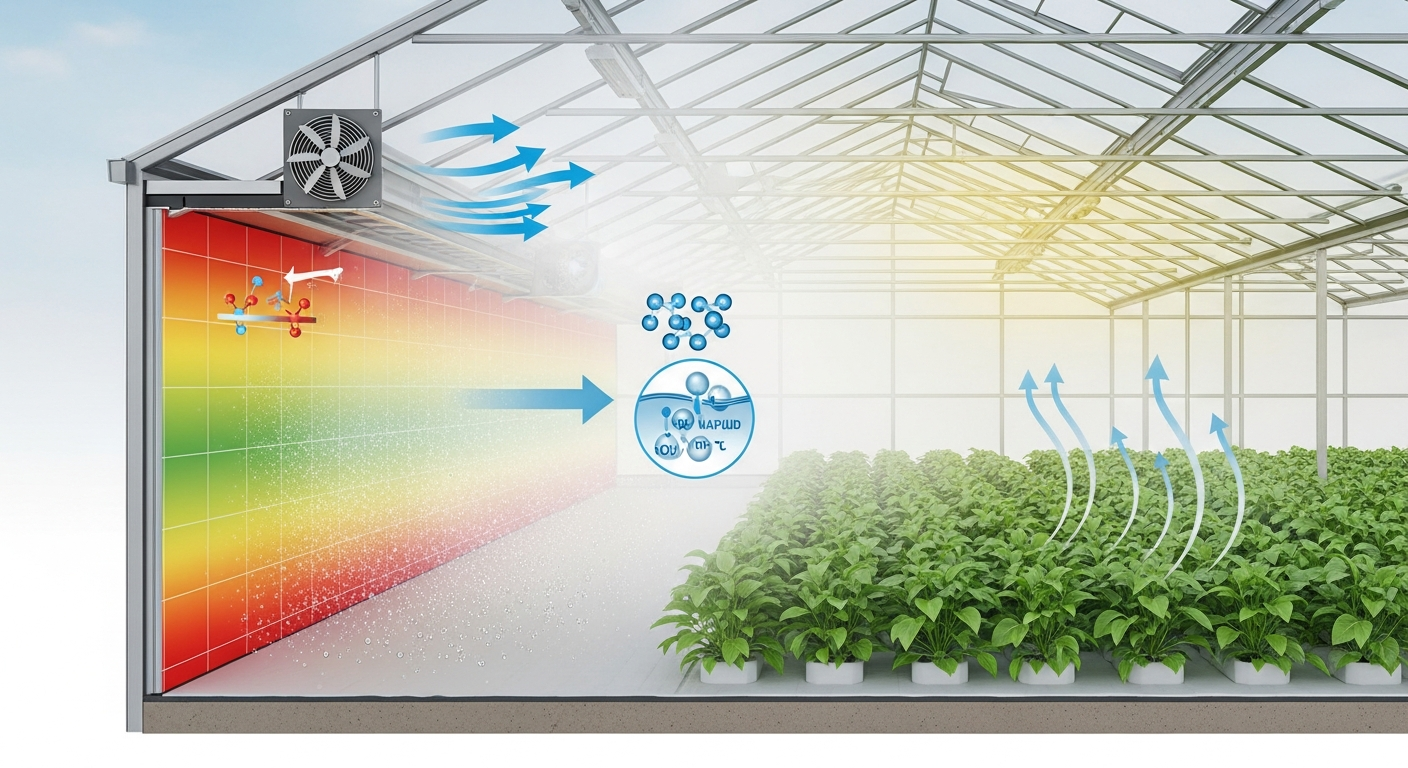
Now that we understand latent heat, the mechanism of evaporative cooling becomes clear. When water evaporates, molecules at the surface of the liquid gain enough kinetic energy to break free and escape into the air as vapor. Where do they get this energy? They absorb it from the immediate surroundings – the water itself, the air, and any surfaces nearby. This removal of energy directly translates to a decrease in the sensible heat of the environment, resulting in a noticeable drop in air temperature.
Imagine a hot day, and you step out of a swimming pool. As the water on your skin evaporates, you feel a chill, even if the air is warm. That’s your body providing the latent heat for the water to evaporate, and your skin feeling cooler as a result. The same principle applies inside a greenhouse.
Plant Transpiration: Nature’s Evaporative Cooler
It’s important to remember that plants themselves are master evaporative coolers. Through a process called transpiration, water moves from the roots, through the stems, and evaporates from tiny pores (stomata) on the leaves. This process is essential for nutrient transport and also provides a significant cooling effect for the plant, preventing overheating. As plants transpire, they release water vapor into the greenhouse air, contributing to the overall humidity and cooling effect, though often not enough to counter intense solar radiation.
The rate of transpiration is influenced by several factors, including temperature, relative humidity, and vapor pressure deficit (VPD). VPD is the difference between the amount of moisture in the air and how much moisture the air can hold when it’s saturated. A higher VPD means drier air, prompting plants to transpire more rapidly, which can lead to stress if not managed correctly. Understanding VPD is key to balancing cooling and humidity for optimal plant health.
Evaporative Cooling Systems in Greenhouses: Principles and Types
Greenhouse operators leverage the power of latent heat to control internal temperatures, especially in hot climates. The goal is to introduce water into the air in a way that maximizes evaporation and thus cooling, while minimizing unwanted wetting of plants or surfaces.
1. Pad and Fan Systems
This is perhaps the most common and robust form of evaporative cooling for larger greenhouses, particularly effective in hot, dry climates.
- How it works: One wall of the greenhouse is fitted with porous cellulose pads (often called “swamp cooler pads”) that are kept saturated with water. On the opposite wall, powerful exhaust fans are installed. As the fans draw hot, dry air through the wet pads, water evaporates from the pad surfaces. The latent heat required for this phase change is absorbed directly from the incoming air, causing its temperature to drop significantly. This cooled, humidified air then sweeps across the greenhouse, absorbing heat from the plants and structures, before being expelled by the fans.
- Practical Tips:
- Pad Maintenance: Regularly inspect pads for algae growth, mineral buildup, or damage. Clean or replace them as needed to ensure maximum airflow and evaporative efficiency.
- Water Quality: Hard water can lead to mineral deposits (scaling) on pads and in the recirculation system, reducing efficiency. Consider water treatment or regular descaling.
- Fan Sizing and Placement: Proper fan sizing and placement are crucial for uniform airflow and cooling across the entire greenhouse space.
2. Fogging and Misting Systems
These systems introduce fine droplets of water directly into the greenhouse air, allowing for rapid evaporation and cooling throughout the space. They are often favored for more precise humidity control and can be effective in a wider range of climates, including those with higher ambient humidity.
- How it works: High-pressure pumps force water through specialized nozzles, creating an extremely fine mist or fog (droplet sizes typically measured in microns). These tiny droplets have a large surface area relative to their volume, allowing them to evaporate almost instantly. As they evaporate, they absorb latent heat from the surrounding air, cooling the greenhouse.
- Types:
- High-Pressure Fogging: Uses pressures upwards of 700 psi to produce incredibly fine droplets that evaporate almost entirely before reaching plants, minimizing wetting. This provides excellent cooling with precise humidity control.
- Low-Pressure Misting: Uses lower pressures, resulting in larger droplets that may take longer to evaporate and can cause wetting if not managed carefully. Often used for propagation or specific humidity-loving crops.
- Practical Tips:
- Water Purity: Absolutely critical for fogging/misting systems. Impurities can clog fine nozzles and deposit undesirable residues on plants. Reverse osmosis (RO) or deionized water is often recommended.
- Nozzle Placement: Strategically place nozzles to ensure even distribution of fog and avoid direct spray on sensitive plant parts.
- Control Systems: Integrate with sophisticated climate control systems that monitor temperature and humidity to activate fogging only when necessary, preventing over-humidification.
Optimizing Evaporative Cooling for Greenhouse Success
While the science of latent heat is straightforward, applying it effectively in a greenhouse requires careful consideration and optimization:
- Balance Cooling with Humidity: Evaporative cooling inherently increases relative humidity. While some humidity is good, excessively high humidity can encourage fungal diseases and inhibit plant transpiration. Monitor both temperature and humidity (and thus VPD) closely.
- Effective Ventilation: This is paramount. Cooled, humid air needs to be exchanged with fresh, dry air to maintain optimal conditions. Fans and vents must be appropriately sized and strategically placed to ensure constant air changes and prevent pockets of stagnant, saturated air. Cross-ventilation is key.
- Water Quality is Not Optional: For both pad-and-fan and especially fogging systems, using clean, filtered water prevents equipment breakdown (clogged nozzles, scaled pads) and protects your plants from mineral buildup or pathogens.
- Automation and Monitoring: Modern greenhouses benefit immensely from automated climate control systems. Sensors for temperature, humidity, and even light levels can trigger cooling systems precisely when needed, optimizing energy use and maintaining stable environments.
- Energy Efficiency: Compared to refrigeration-based air conditioning, evaporative cooling is significantly more energy-efficient, often using just a fraction of the electricity. This translates to lower operating costs and a smaller carbon footprint, making it a sustainable choice for greenhouse climate control.
The science of latent heat and evaporative cooling offers an elegant and highly effective solution for managing temperature in greenhouses. By understanding how water absorbs energy during its phase change from liquid to gas, growers can harness this natural phenomenon to create ideal, stable growing environments. Whether through traditional pad-and-fan systems or advanced fogging technologies, mastering evaporative cooling is a cornerstone of efficient and productive greenhouse operation, ensuring your plants thrive even when the sun beats down.