
Ensuring your greenhouse maintains an optimal climate is paramount for the health and productivity of your plants. While heating systems often grab the spotlight during colder months, effective cooling is just as, if not more, critical when temperatures rise. Overheating can lead to plant stress, stunted growth, reduced yields, and even irreversible damage. But how do you know what kind of cooling system, or what capacity, your unique greenhouse requires? This comprehensive guide from Greenhouse Climates will walk you through the essential steps to accurately calculate the cooling capacity needed for your greenhouse, helping you create a thriving environment for your botanical inhabitants.
Understanding Heat Gain: The Enemy of a Cool Greenhouse
Before we can determine how much cooling you need, we must first understand where the heat comes from. Heat gain in a greenhouse is primarily driven by a few key factors:
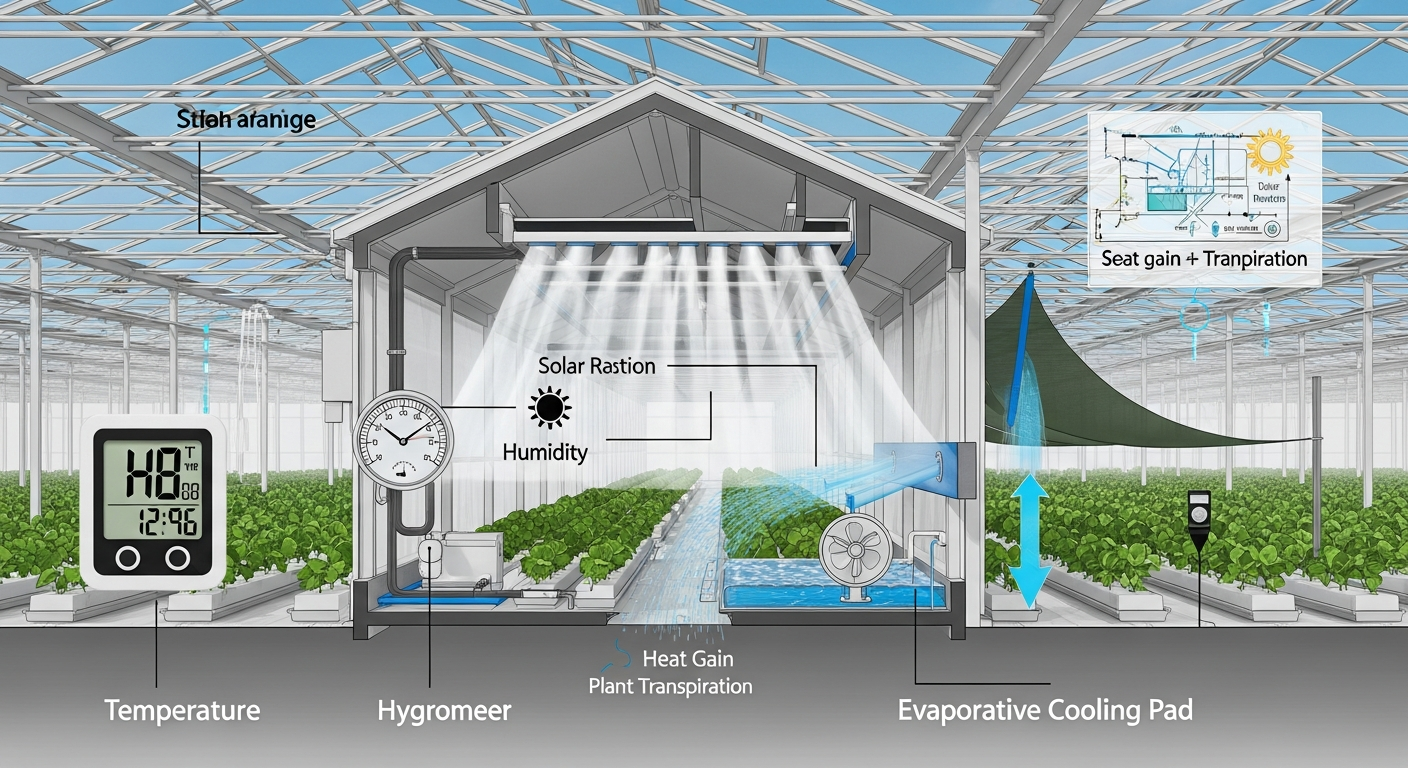
- Solar Radiation: This is by far the most significant contributor. Sunlight passing through your glazing is absorbed by plants, soil, and internal structures, converting light energy into heat. This phenomenon is known as the greenhouse effect.
- Heat Transmission (Conduction/Convection): Heat can transfer from the warmer outside air through your greenhouse’s glazing and structural components to the cooler interior. The greater the temperature difference, the more heat transmits.
- Internal Heat Sources: Equipment such as grow lights, circulation fans, pumps, and even some plant metabolic processes (respiration) generate heat that adds to the internal load.
- Infiltration: Uncontrolled air leakage through gaps and cracks can bring in hot air from outside, especially in poorly sealed structures.
The standard unit for measuring heating and cooling capacity is the BTU (British Thermal Unit) per hour (BTU/hr). One BTU is the amount of energy needed to raise the temperature of one pound of water by one degree Fahrenheit. When we talk about cooling capacity, we’re referring to the amount of heat energy a system can remove from the greenhouse environment per hour.
Key Factors Influencing Your Greenhouse’s Cooling Needs
Calculating the precise cooling capacity is not a one-size-fits-all formula. Several variables specific to your greenhouse must be considered:
1. Greenhouse Dimensions and Volume
The size of your greenhouse directly dictates how much air needs to be moved or cooled. You’ll need:
- Floor Area: Length × Width (in square feet). This is crucial for estimating solar heat gain.
- Volume: Length × Width × Average Height (in cubic feet). This helps determine the airflow requirements for ventilation systems.
- Total Glazing Surface Area: Sum of all wall and roof glazing areas (in square feet). Needed for calculating heat transmission.
2. Glazing Material
Different glazing materials have varying properties for light transmission and heat retention/dissipation. For instance:
- Single-pane glass: High heat gain, high heat loss.
- Double-pane glass or polycarbonate: Better insulation, reducing heat transmission, but still allows significant solar gain.
- Twin-wall or multi-wall polycarbonate: Offers superior insulation compared to single-layer materials.
Each material has a U-value (or R-value, its inverse), which indicates its insulating capacity. A lower U-value means better insulation and less heat transfer.
3. Desired Temperature Differential
What is the maximum outdoor temperature you expect, and what is the optimal maximum indoor temperature you want to maintain for your plants? The larger this difference, the more cooling capacity you’ll need.
Calculate your greenhouse cooling needs in seconds! Click here.
4. Climate and Location
A greenhouse in a sunny, arid desert climate will have vastly different cooling needs than one in a temperate, often cloudy region. Consider factors like:
- Average peak summer temperatures.
- Solar intensity (hours of direct sunlight).
- Humidity levels (impacts evaporative cooling efficiency).
Step-by-Step Calculation Guide for Greenhouse Cooling Capacity
Let’s break down the calculation into manageable steps to arrive at your total cooling load (BTU/hr).
Step 1: Measure Your Greenhouse and Calculate Areas/Volume
Grab your tape measure and note down:
- Length (L): _______ ft
- Width (W): _______ ft
- Average Height (H): _______ ft (For sloped roofs, measure side wall height, ridge height, and average them, or use a specific formula for your roof type)
- Floor Area: L × W = _______ sq ft
- Greenhouse Volume: L × W × H = _______ cu ft
- Total Glazing Surface Area: Calculate the area of all walls and roof panels made of glazing material. (e.g., (2 * L * side wall height) + (2 * W * end wall height) + (2 * L * roof slope length for gable) = _______ sq ft)
Step 2: Estimate Solar Heat Gain (Qsolar)
This is the dominant factor. A common rule of thumb for greenhouses in sunny conditions is that direct sunlight contributes approximately 200-300 BTU/hr per square foot of floor area. For a conservative and safer estimate, especially in hot climates, use the higher end.
Qsolar (BTU/hr) = Floor Area (sq ft) × Solar Gain Factor
- Example: For a 100 sq ft greenhouse in a sunny region, using a factor of 250 BTU/sq ft:
- Qsolar = 100 sq ft × 250 BTU/sq ft = 25,000 BTU/hr
Step 3: Estimate Heat Transmission Through Glazing (Qtransmission)
This accounts for heat entering through the glazing due to the temperature difference. You’ll need the U-value for your glazing material and the maximum expected temperature differential.
Qtransmission (BTU/hr) = Total Glazing Surface Area (sq ft) × U-value × (Max Outdoor Temp - Desired Indoor Temp)
- Typical U-values:
- Single-pane glass: ~1.1 BTU/hr⋅sq ft⋅°F
- Double-pane glass: ~0.65 BTU/hr⋅sq ft⋅°F
- 8mm twin-wall polycarbonate: ~0.58 BTU/hr⋅sq ft⋅°F
- 6mm twin-wall polycarbonate: ~0.65 BTU/hr⋅sq ft⋅°F
- Example: Assume a greenhouse with 300 sq ft of glazing, 6mm twin-wall polycarbonate (U-value 0.65), a desired indoor temp of 80°F, and max outdoor temp of 100°F.
- Qtransmission = 300 sq ft × 0.65 × (100°F – 80°F) = 300 × 0.65 × 20 = 3,900 BTU/hr
Step 4: Factor in Internal Heat Sources (Qinternal)
Add up the heat generated by electrical equipment inside your greenhouse. Convert watts to BTU/hr using the conversion: 1 Watt = 3.41 BTU/hr.
Qinternal (BTU/hr) = Sum of (Wattage of each device × 3.41)
- Example: Two 400W grow lights, one 100W circulation fan.
- Qinternal = (2 × 400W × 3.41) + (100W × 3.41) = 2728 + 341 = 3,069 BTU/hr
For most hobby greenhouses, heat from plant respiration is negligible unless you have a very dense canopy of rapidly growing plants.
Step 5: Calculate Total Heat Load (Qtotal)
Sum up all the heat gain components to get your total cooling requirement.
Qtotal (BTU/hr) = Qsolar + Qtransmission + Qinternal
- Example Continuing: 25,000 BTU/hr (solar) + 3,900 BTU/hr (transmission) + 3,069 BTU/hr (internal) = 31,969 BTU/hr
This Qtotal is the maximum cooling capacity you’ll need from your system.
Step 6: Determine Cooling Equipment Needs
Now, let’s translate your total heat load into specific equipment requirements.
For Exhaust Fans (Ventilation)
The primary purpose of exhaust fans is to replace hot air with cooler outside air. This is measured in CFM (Cubic Feet per Minute). For adequate cooling, aim for 1 to 2 air changes per minute, especially in hotter climates.
Required CFM = Greenhouse Volume (cu ft) × Desired Air Changes Per Minute (e.g., 1.5)
- Example: A 10’L × 10’W × 8’H greenhouse = 800 cu ft volume. Desired 1.5 air changes per minute.
- Required CFM = 800 cu ft × 1.5 = 1,200 CFM
You would then select exhaust fans with a combined CFM rating of at least 1,200 CFM. Be sure to consider fan efficiency and static pressure when selecting. Often, you’ll pair these with motorized intake shutters on the opposite wall.
For Evaporative Cooling (Pad & Fan Systems)
Evaporative cooling is highly effective in dry climates. It works by drawing outside air through water-saturated pads, where evaporation cools the air before it enters the greenhouse. The CFM requirement for the fans in a pad-and-fan system is the same as for exhaust ventilation (1-2 air changes per minute). The cooling effect comes from the pads. For sizing the pads:
Pad Area (sq ft) = Required CFM ÷ (150 to 250 CFM per sq ft of pad)
- Use 150 CFM/sq ft for humid climates or minimal temperature drop, and up to 250 CFM/sq ft for very dry climates where a larger temperature drop is expected.
- Example: If you need 1,200 CFM for a moderately dry climate (using 200 CFM/sq ft):
- Pad Area = 1,200 CFM ÷ 200 CFM/sq ft = 6 sq ft of pad area
You would then select fans for 1,200 CFM and design your pad wall to have 6 sq ft of surface area.
For Air Conditioning Units (Refrigeration)
If you opt for a refrigeration-based air conditioning unit, these are directly rated in BTU/hr. Simply match your calculated Qtotal to the unit’s capacity.
Required AC Capacity (BTU/hr) = Qtotal (BTU/hr)
- Example: If your
Qtotalwas 31,969 BTU/hr, you would look for an AC unit rated at approximately 32,000 BTU/hr (often expressed as 3 tons, as 1 ton = 12,000 BTU/hr).
AC units are generally less common for large greenhouses due to high energy costs, but can be effective for smaller, highly controlled environments.
Additional Strategies to Reduce Cooling Needs
Implementing passive cooling measures can significantly reduce the load on your active cooling systems, saving energy and money:
- Shade Cloth: Applying shade cloth externally can block 30-70% of solar radiation. This is a highly effective and relatively inexpensive way to reduce your
Qsolarsignificantly. - Whitewash or Shade Paint: A temporary coating on the glazing can reflect sunlight during peak summer months.
- Optimize Orientation: If possible, orient your greenhouse with the long axis running east-west to minimize direct exposure to intense morning and afternoon sun on the largest glazed surfaces.
- Natural Ventilation: Incorporate ridge vents and side vents to allow hot air to escape through convection, creating a chimney effect. This can complement or even reduce the need for forced ventilation.
- Reflective Surfaces: Using reflective ground cover or internal surfaces can bounce heat out.
- Proper Sealing: Seal any unnecessary gaps or cracks to prevent infiltration of hot outside air.
Conclusion
Accurately calculating the cooling capacity for your greenhouse is an investment in the longevity and vitality of your plants. By systematically assessing heat gain from solar radiation, transmission, and internal sources, you can arrive at a precise BTU/hr requirement. Whether you opt for robust ventilation, efficient evaporative cooling, or a direct refrigeration system, understanding your greenhouse’s unique needs ensures you select the right equipment to maintain a stable, thriving internal climate. Don’t let your plants wilt under the pressure of summer heat; empower your greenhouse with the cooling power it deserves!
Calculate your greenhouse cooling needs in seconds! Click here.