
In the intricate world of greenhouse cultivation, growers meticulously manage light, water, and nutrients to coax the best performance from their plants. Yet, there’s an often-overlooked environmental factor that plays a profoundly critical role in plant health and productivity: Vapor Pressure Deficit (VPD). Understanding and controlling VPD is like giving your plants the perfect atmospheric conditions to breathe, drink, and thrive. It’s the key to optimizing everything from nutrient uptake to growth rates and even resistance to disease. If you’re ready to move beyond basic temperature and humidity readings, join us as we delve into the science of VPD and unlock its power to transform your greenhouse climate.
What is Vapor Pressure Deficit (VPD)?
At its core, Vapor Pressure Deficit (VPD) measures the “thirst” of the air. It’s the difference between the amount of moisture the air could hold when saturated at a given temperature and the actual amount of moisture it currently holds. Imagine a sponge: a dry sponge has a high capacity to absorb water, while a fully saturated one has no capacity left. Similarly, air with a high VPD is “dry” and has a strong pull for moisture, whereas air with a low VPD is “wet” and has little pulling power.
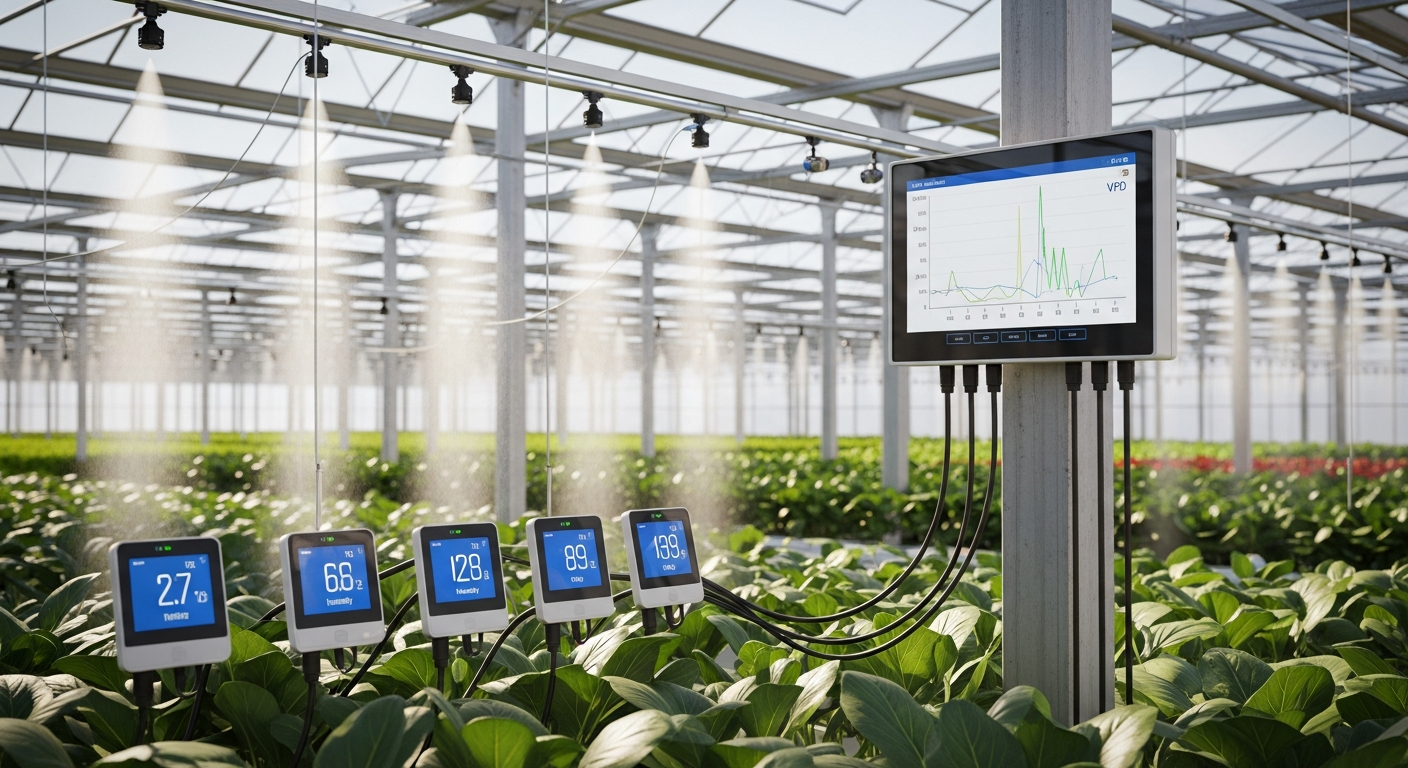
VPD is typically expressed in kilopascals (kPa), and it’s a more accurate and plant-centric metric than relative humidity (RH) alone. Why? Because relative humidity tells you how saturated the air is relative to its current temperature. As temperature changes, so does the air’s capacity to hold moisture. So, 60% RH at 20°C feels very different to a plant than 60% RH at 30°C. VPD, however, accounts for both temperature and humidity, giving you a consistent, absolute value of the air’s drying power.
For plants, VPD directly impacts their ability to transpire, which is the process of releasing water vapor through tiny pores on their leaves called stomata. This transpiration process is vital for overall plant health and growth, as we’ll explore next.
Why is VPD Crucial for Plant Growth?
The significance of VPD in your greenhouse cannot be overstated. It is a primary driver of several fundamental plant processes:
- Transpiration: VPD directly dictates the rate at which plants transpire. When VPD is high (dry air), plants transpire more rapidly, releasing water vapor. When VPD is low (humid air), transpiration slows down.
- Nutrient Uptake: Transpiration creates a “pull” that draws water and dissolved nutrients from the roots up through the plant to the leaves. An optimal transpiration rate, driven by a balanced VPD, ensures efficient delivery of essential nutrients for robust growth.
- Stomata Control: Plants regulate transpiration by opening and closing their stomata.
- High VPD (too dry): If VPD is too high, plants may close their stomata excessively to conserve water. While this prevents wilting, it also reduces CO2 intake, slowing photosynthesis and nutrient transport. This can lead to stunted growth and stress.
- Low VPD (too humid): Conversely, if VPD is too low, the air is nearly saturated, and the plant struggles to release water vapor. This can hinder nutrient uptake, reduce evaporative cooling (potentially leading to heat stress), and create a prime environment for fungal diseases like powdery mildew or botrytis due to excess moisture on leaf surfaces.
- CO2 Absorption: Stomata are not just for water release; they’re also the entry point for carbon dioxide, essential for photosynthesis. A VPD that encourages optimal stomatal opening ensures plants can efficiently take in CO2.
Finding the “sweet spot” for VPD is therefore paramount. It allows your plants to efficiently move water and nutrients, effectively cool themselves, and absorb CO2 without undue stress or disease risk. This balance leads to healthier plants, faster growth, and ultimately, higher yields.
How to Calculate VPD and Utilize Charts
While the full mathematical formulas for calculating VPD can be complex, involving saturated vapor pressure and actual vapor pressure, most greenhouse growers don’t need to perform these calculations manually every day. The key is to understand the inputs and utilize readily available tools.
Key Inputs for VPD Calculation:
- Air Temperature: Measured in degrees Celsius (°C) or Fahrenheit (°F).
- Relative Humidity (RH): Measured as a percentage (%).
- Leaf Temperature: This is the most crucial, yet often approximated, input. The temperature of the leaf surface, where transpiration occurs, is what truly matters to the plant. Due to evaporative cooling, leaf temperature is often 1-3°C cooler than ambient air temperature, especially under strong lighting. For precision, a non-contact infrared thermometer (IR gun) is invaluable for measuring leaf temperature. If an IR gun isn’t available, many growers start by assuming leaf temperature is 1-2°C below air temperature, but be aware this is an estimation.
Tools for Calculating and Monitoring VPD:
- VPD Charts: These are widely available online and in grow guides. You simply find your air temperature and relative humidity (and ideally, adjust for leaf temperature), and the chart will show you the corresponding VPD value. Many charts use air temperature, but some more advanced ones will have separate columns/rows for leaf temperature offsets.
- Online VPD Calculators & Apps: Numerous websites and smartphone apps allow you to input your temperature, humidity, and an optional leaf temperature offset, instantly providing the VPD.
- Environmental Controllers: Modern greenhouse climate control systems (environmental controllers) are often equipped with sensors that measure temperature and humidity. Many advanced models can automatically calculate and display the current VPD, and some can even be programmed to maintain a target VPD by adjusting heaters, humidifiers, and ventilation.
- Digital Thermometers/Hygrometers: While they don’t calculate VPD directly, these devices provide the essential temperature and RH readings you’ll need for charts or calculators. Look for models with accurate sensors and the ability to record min/max values.
Practical Tip: Regularly measure your leaf temperature with an IR gun, especially during peak light hours, to get the most accurate VPD reading. Small differences in leaf temperature can significantly alter the perceived VPD for your plants.
Optimizing VPD for Different Growth Stages
Just as plants have different light and nutrient requirements at various stages, their optimal VPD also shifts. Tailoring VPD to each growth phase minimizes stress and maximizes potential:
1. Propagation (Seedlings & Clones)
- Target VPD: 0.4 – 0.8 kPa (relatively low)
- Why: Young plants, especially clones, have underdeveloped root systems or no roots at all. A low VPD (high humidity) reduces transpiration demands, preventing wilting and allowing them to focus energy on root development without excessive water loss through their leaves.
- Management: Use humidity domes, misting systems, or foggers. Keep temperatures moderate.
2. Vegetative Growth
- Target VPD: 0.8 – 1.2 kPa (moderate)
- Why: As plants establish roots and begin rapid foliage development, they need a moderate VPD. This encourages robust transpiration, facilitating efficient nutrient uptake and strong, healthy growth. It allows stomata to remain open for optimal CO2 absorption without over-stressing the plant.
- Management: Balance temperature and humidity. Ensure good air circulation to prevent stagnant, high-humidity pockets.
3. Flowering/Fruiting
- Target VPD: 1.0 – 1.5 kPa (slightly higher)
- Why: During the reproductive stage, a slightly higher VPD is often beneficial. It continues to drive nutrient uptake to support fruit and flower development. Crucially, a slightly drier environment can help mitigate the risk of fungal diseases (like bud rot or powdery mildew) in dense canopies, as excess moisture is more quickly removed from the plant surface.
- Management: You might slightly increase temperature or decrease humidity to achieve this. Maintain excellent air circulation to manage humidity within the canopy.
Important Note: These ranges are general guidelines. Specific plant species and varieties may have slightly different preferences. Always observe your plants for signs of stress (wilting, drooping, yellowing) and adjust accordingly.
Strategies for Managing VPD in Your Greenhouse
Controlling VPD means managing the two primary factors that influence it: temperature and humidity. Here’s how you can actively manage these to maintain your target VPD:
1. Temperature Control
- Heating Systems: Heaters (gas, electric, hydronic) increase air temperature, which, if humidity remains constant, will increase VPD (make the air “thirstier”). This can be used to dry out the air.
- Cooling Systems: Exhaust fans, passive vents, and evaporative cooling systems (swamp coolers) reduce air temperature. Decreasing temperature, if humidity remains constant, will decrease VPD.
- Circulation Fans: Oscillating fans create uniform air temperature throughout the greenhouse, preventing hot or cold spots that can lead to localized VPD variations.
2. Humidity Control
- Increasing Humidity (Decreasing VPD):
- Humidifiers: Dedicated misting or fogging systems can directly inject water vapor into the air.
- Misting/Sprinkling: Periodically misting plants or floors can provide a temporary boost in humidity.
- Reducing Ventilation: Closing vents or reducing fan speed can trap existing moisture, raising humidity.
- Decreasing Humidity (Increasing VPD):
- Dehumidifiers: These extract moisture from the air, directly reducing relative humidity.
- Ventilation: Opening vents and running exhaust fans replaces humid air with drier outside air (assuming outside air isn’t too humid).
- Heating & Venting (“Heating for Humidity”): A common technique is to slightly raise the air temperature with heaters while simultaneously running exhaust fans. The warmer air holds more moisture, and the fans then expel this moisture-laden air, effectively drying the greenhouse. This is often the most effective method in humid climates.
3. Managing Leaf Temperature
- Grow Lights: High-intensity discharge (HID) lights emit significant radiant heat, which can directly warm leaf surfaces, potentially increasing leaf temperature above ambient air temperature. LEDs typically produce less radiant heat. Adjusting light intensity or distance can influence leaf temperature.
- Air Movement: Gentle air movement directly over the plant canopy can help equalize leaf temperature with air temperature and prevent boundary layer saturation, where a thin layer of humid air around the leaf inhibits transpiration.
4. Automated Environmental Control Systems
For serious commercial growers, integrated environmental control systems are invaluable. These systems can:
- Continuously monitor temperature, humidity, and sometimes CO2.
- Automatically calculate VPD in real-time.
- Control heaters, coolers, humidifiers, dehumidifiers, and ventilation fans to maintain a user-defined target VPD setpoint.
- Provide data logging for analysis and optimization over time.
By actively managing these variables and observing your plants, you can fine-tune your greenhouse environment to achieve optimal VPD for every stage of your crop’s life cycle.
Conclusion
Vapor Pressure Deficit is an invisible yet incredibly powerful metric that profoundly impacts the health, growth, and yield of plants in your greenhouse. By moving beyond just temperature and relative humidity, and embracing VPD, you gain a deeper understanding of your plants’ interaction with their atmospheric environment. From encouraging efficient nutrient uptake to mitigating disease risks and optimizing CO2 absorption, a well-managed VPD provides the foundation for truly thriving plants.
While mastering VPD might seem complex at first, the investment in understanding and controlling it will pay dividends in stronger plants and more abundant harvests. Start by monitoring, utilize available charts and tools, and make gradual adjustments to your climate control strategies. With continuous observation and refinement, you’ll soon be speaking your plants’ language, creating the ideal “Greenhouse Climate” for success.