
The agricultural landscape is undergoing a revolutionary transformation, driven by an urgent need for sustainable, efficient, and resilient food production systems. Traditional farming methods often struggle to meet the demands of a growing global population, fluctuating climates, and limited arable land. This paradigm shift has propelled controlled environment agriculture (CEA), particularly greenhouses, into the spotlight. However, to truly unlock the potential of CEA, operations must be designed not just for the present, but for a dynamic future. This is where the concept of modular greenhouse systems becomes not just beneficial, but essential. By embracing modular design, growers can build scalable, adaptable, and cost-effective operations that can evolve with market demands, technological advancements, and business growth, ensuring long-term profitability and environmental stewardship.
The Foundational Principles of Modular Greenhouse Design
At its heart, modular design is about breaking down a complex system into smaller, independent, and interchangeable units. In the context of greenhouses, this philosophy offers unprecedented flexibility and efficiency, moving away from monolithic, rigid structures towards dynamic, expandable frameworks.
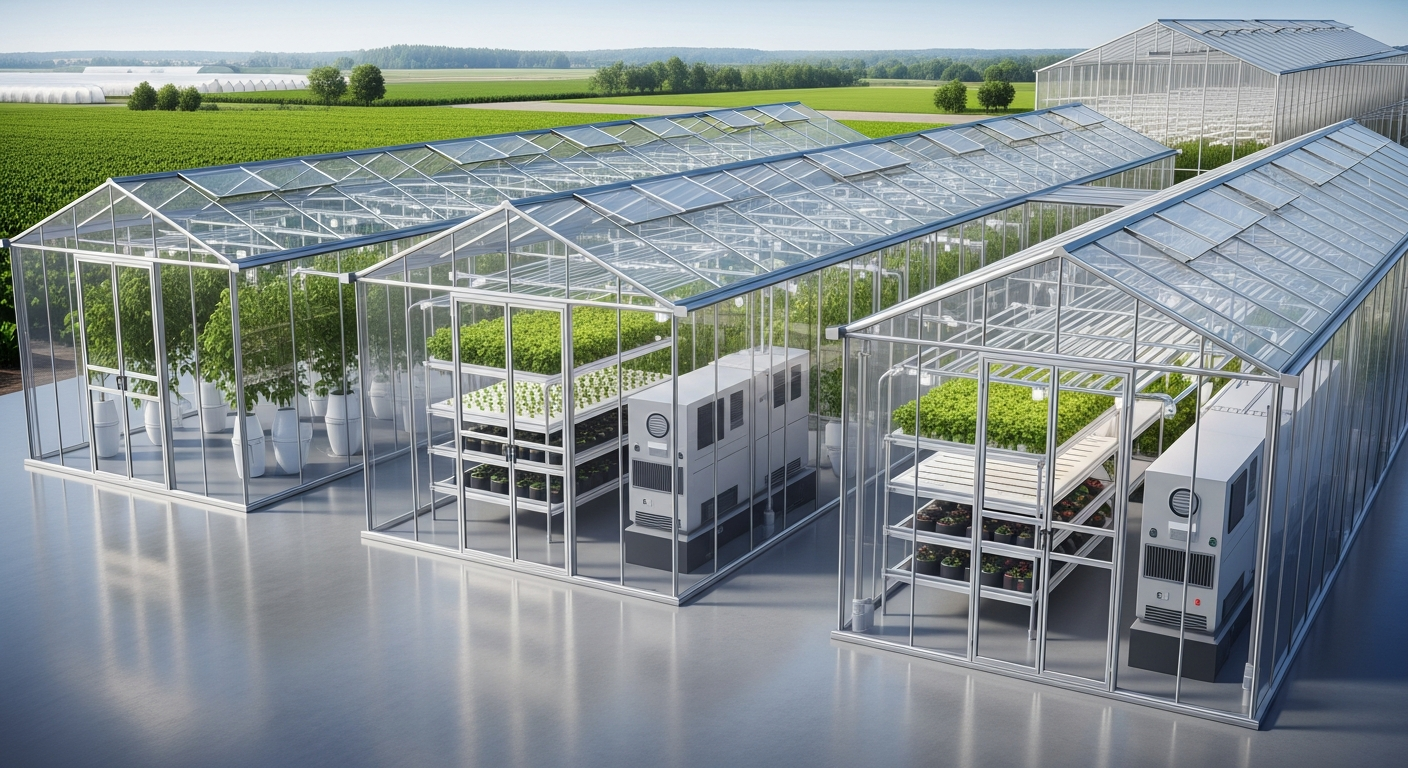
Defining Modularity in Controlled Environment Agriculture (CEA)
A modular greenhouse system is characterized by its use of standardized, pre-fabricated components or sections that can be easily assembled, disassembled, and rearranged. Imagine a set of building blocks: each block is a functional unit, and you can add more blocks as needed to expand your structure. For greenhouse operations, this means:
- Standardized Units: Components like structural bays, climate control units, growing trays, and irrigation lines are designed with consistent dimensions and interfaces.
- Interchangeable Parts: The ability to swap out or upgrade specific modules (e.g., lighting systems, sensor arrays) without overhauling the entire setup.
- Ease of Expansion: The core benefit, allowing growers to add capacity incrementally as demand grows, capital becomes available, or new crop types are introduced.
Key Benefits of Adopting a Modular Approach
The advantages of designing your greenhouse with scalability in mind extend across operational, financial, and strategic dimensions:
- Unparalleled Scalability: The most obvious benefit. Growers can start small, validate their market, and then expand their operations in manageable phases, minimizing initial capital outlay and risk. This enables a pay-as-you-grow model.
- Cost-Effectiveness: While initial per-unit costs might sometimes seem higher due to precision manufacturing, modular components often reduce construction time, labor costs during installation, and long-term maintenance expenses. Standardized parts also lead to economies of scale in manufacturing.
- Enhanced Flexibility and Adaptability: Modular systems can be reconfigured to accommodate different crops, growing methods (hydroponics, aeroponics, aquaponics), or market needs. This adaptability future-proofs the investment against changing agricultural trends.
- Reduced Risk: By allowing phased investment and expansion, modular designs mitigate financial risk associated with large, upfront capital commitments for unproven ventures. Failures can be isolated to a specific module rather than crippling the entire operation.
- Faster Deployment and Relocation: Pre-fabricated modules can be assembled much quicker than custom-built structures, getting your operation up and running faster. In some cases, modular units can even be disassembled and relocated, offering geographical flexibility.
- Optimized Resource Utilization: Individual modules can be fine-tuned for specific environmental conditions or crop requirements, leading to more precise control over inputs like water, nutrients, and energy.
Key Components of a Scalable Modular Greenhouse System
Achieving true modularity requires careful consideration of every aspect of the greenhouse, from its physical shell to its intricate internal systems. Each component should be viewed through the lens of standardization and expandability.
Structural Frameworks and Enclosures
The very backbone of your greenhouse should be designed for expansion. This typically involves:
- Standardized Bay or Section Design: Creating a repetitive structural unit (e.g., a 20×30 foot bay) that can be easily replicated side-by-side or end-to-end. Materials like galvanized steel or aluminum tubing with specific connection points facilitate this.
- Choice of Covering Materials: Opt for materials that are easy to install, replace, and integrate with modular frames. Polycarbonate panels, acrylic sheets, or specialized greenhouse films designed for sectional attachment are excellent choices, offering varying degrees of insulation and light transmission.
- Foundation Systems: Poured concrete footings or pre-fabricated concrete blocks designed for modular attachment points can significantly speed up expansion.
Environmental Control Modules
Climate management is crucial in CEA, and modularity ensures that these critical systems can scale efficiently.
- HVAC and Ventilation Units: Rather than a single massive system, consider multiple smaller, decentralized HVAC units that can be added or upgraded per section. This allows for zone-specific climate control and redundancy.
- Lighting Systems: LED grow lights are inherently modular. They can be installed in arrays, and more units can be added as growing area expands, or different light spectrums can be introduced for varied crop cycles.
- Irrigation and Nutrient Delivery: Design a main header system with standardized connections for branch lines that feed individual growing modules. This allows for easy attachment of new irrigation zones and nutrient dosing systems without disrupting existing operations.
- CO2 Dosing: Similar to irrigation, a central CO2 supply with modular distribution lines can be expanded to cover new growing areas.
Growing Systems
The actual platforms where crops grow are prime candidates for modular design, offering flexibility in crop rotation and density.
- Hydroponic/Aquaponic Racks and Beds: Pre-fabricated NFT (Nutrient Film Technique) channels, DWC (Deep Water Culture) rafts, ebb and flow tables, or vertical farming towers designed as self-contained units that can be replicated and integrated into a larger system.
- Substrate Benches: For media-based growing, standardized benches or movable trays that fit within the structural bays allow for easy scaling.
- Gutter Systems: For crops like strawberries or vine crops, modular gutter systems allow for precise spacing and easy extension.
Automation and Sensor Integration
The “smart” aspect of a smart greenhouse should also be modular, ensuring that intelligence scales with physical growth.
- Modular Control Systems: Centralized control software that can easily integrate new sensor inputs, actuator controls, and automation protocols as modules are added. Look for systems with open APIs.
- Sensor Arrays: Environmental sensors (temperature, humidity, CO2), nutrient sensors, and plant health sensors should be deployable in localized modules, feeding data back to a central system.
- Robotics and Conveyor Systems: While often a later-stage investment, consider designs that allow for the future integration of robotic crop care or automated material handling systems that can be extended across new modules.
Strategic Planning for Scalable Expansion
Designing for modularity isn’t just about selecting the right components; it’s about having a strategic vision for growth and implementation.
Phased Development and Capital Expenditure
One of the most powerful advantages of modular design is the ability to manage capital expenditure (CapEx) strategically. Instead of a massive, single-stage investment, growers can plan for:
- Pilot Phase: Start with a small, manageable number of modules to prove the concept, refine growing protocols, and secure initial market traction. This minimizes risk and provides valuable operational data.
- Incremental Expansion: As demand increases and cash flow allows, add new modules in a phased approach. This aligns investment with actual business growth, optimizing return on investment.
- Securing Funding: A clear modular expansion plan can be highly attractive to investors, as it demonstrates a well-thought-out growth strategy with defined milestones and lower upfront risk.
Site Planning and Infrastructure Considerations
Even if you start small, thinking big from day one is crucial for seamless expansion. Consider:
- Land Availability: Secure enough land not just for your initial setup, but for your projected future expansion over the next 5-10 years.
- Utility Access: Plan for scalable utility infrastructure. Can your initial water, electricity, and potentially natural gas lines handle future demand from additional modules? It’s often more cost-effective to oversize initial utility mains rather than having to dig them up and replace them later.
- Logistics and Access: Ensure there’s adequate space for service vehicles, product staging, and potential future automation pathways between modules.
- Drainage and Runoff: Plan for a drainage system that can accommodate the increased water runoff from a larger greenhouse footprint.
Workforce Planning and Training
Scalable operations also require scalable human resources. Modular systems, with their standardized components and repeatable processes, can simplify workforce management:
- Standardized Operating Procedures (SOPs): Develop clear SOPs for each module, making it easier to train new staff as you expand.
- Specialized Roles: As operations grow, you might need specialized technicians for specific modules (e.g., climate control, irrigation), which modularity can facilitate.
- Reduced Learning Curve: The familiarity of working with identical modules across an expanding facility reduces the learning curve for staff moving to new sections.
Practical Tips for Implementing Modular Greenhouse Solutions
Putting modular design into practice requires a pragmatic approach and foresight.
Start with a Comprehensive Master Plan
Before you even break ground, envision your greenhouse operation at its full potential. Even if you only build 10% of it initially, having a master plan that maps out future expansion ensures that every initial decision contributes to the larger vision. This plan should include site layout, utility pathways, traffic flow, and future crop strategies.
Prioritize Interoperability and Open Standards
When selecting hardware and software, lean towards systems that are designed to be interoperable. Opt for technologies that use open standards or have well-documented APIs. This allows different modules and systems to communicate effectively, preventing vendor lock-in and ensuring future compatibility as technology evolves.
Don’t Compromise on Quality for Core Components
While modularity offers cost savings, do not skimp on the quality of core structural elements, environmental control units, and robust automation hardware. These components form the foundation of your long-term operation. High-quality initial investments pay dividends through greater reliability, lower maintenance costs, and longer operational lifespans.
Embrace Automation and Data Analytics Early On
Integrate sensors and automation from the first module. This allows you to collect crucial data from day one, helping you optimize growing recipes, predict issues, and make data-driven decisions for future expansion. A modular approach to automation means you can add more sensors and controllers as your physical footprint grows.
Consider Energy Efficiency and Sustainability
Modular systems offer unique opportunities for energy optimization. Individual modules can be outfitted with specific insulation, lighting, or climate control strategies tailored to their specific crops or needs. Integrate renewable energy sources (solar, wind) that can scale with your operation, and design systems for water recycling and waste heat recovery to enhance sustainability and reduce operational costs in the long run.
Conclusion
Designing modular systems for scalable greenhouse operations is more than just a trend; it’s a strategic imperative for the future of controlled environment agriculture. By embracing standardization, flexibility, and phased development, growers can build resilient, efficient, and profitable farms that are not only capable of meeting today’s demands but are also future-proofed against tomorrow’s challenges. The journey from a single module to a sprawling, high-yield operation becomes a manageable, data-driven, and financially sound progression. As the world increasingly turns to CEA for sustainable food solutions, modular design stands as a cornerstone for innovation, empowering growers to cultivate not just crops, but a future of agricultural excellence.