
In the dynamic world of controlled environment agriculture, growers constantly seek innovative strategies to optimize plant growth, boost yields, and enhance crop quality. Two powerful tools frequently employed to achieve these goals are CO2 enrichment systems and automated ventilation cycles. While each system offers significant benefits independently, their true potential is unlocked when seamlessly integrated. The challenge lies in harmonizing their often-conflicting objectives: CO2 enrichment aims to retain valuable carbon dioxide within the growing space, while ventilation seeks to exchange air, potentially purging that very CO2. Mastering this delicate balance through intelligent integration is not merely an advantage; it’s a fundamental step towards creating a truly optimized, energy-efficient, and productive grow environment.
The Synergistic Power of CO2 and Ventilation in Plant Growth
Understanding the individual roles of CO2 enrichment and automated ventilation is crucial before delving into their integration. Each plays a distinct yet interconnected role in plant physiology and environmental control.
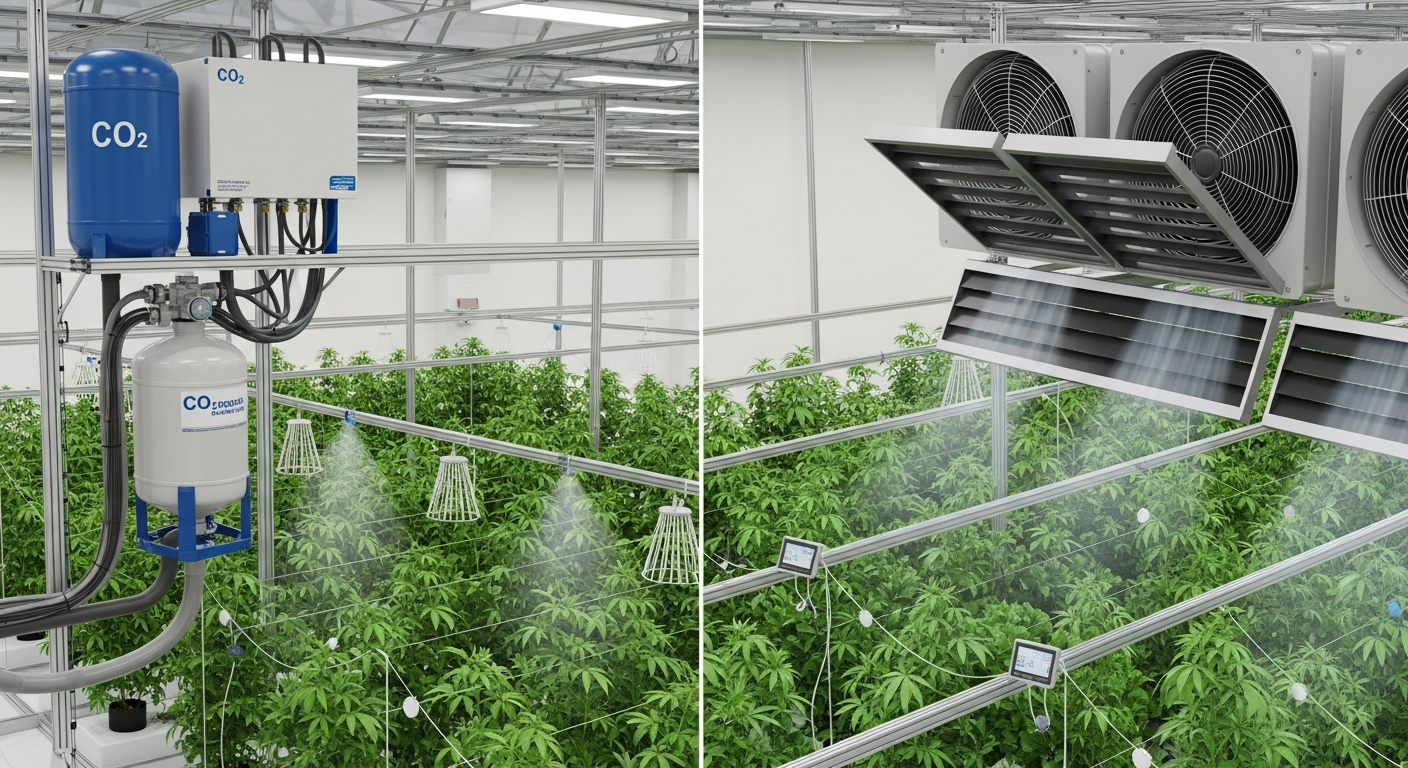
CO2 Enrichment: Fueling Photosynthesis for Accelerated Growth
Carbon dioxide (CO2) is an indispensable ingredient for photosynthesis, the process by which plants convert light energy into chemical energy, creating sugars for growth. In natural outdoor environments, atmospheric CO2 levels hover around 400-450 parts per million (ppm). However, in enclosed indoor growing spaces, plants can quickly deplete available CO2, limiting their growth potential. CO2 enrichment systems introduce additional carbon dioxide, typically raising levels to 800-1500 ppm, to supercharge photosynthesis. This leads to:
- Faster Growth Rates: Plants can process light energy more efficiently, resulting in quicker vegetative growth.
- Increased Yields: More robust growth often translates directly to higher crop yields.
- Enhanced Plant Vigor: Improved metabolism can lead to stronger plants more resilient to stress.
For CO2 enrichment to be effective, several conditions must be met, including adequate light intensity, optimal temperature, and proper humidity levels, all of which influence a plant’s ability to utilize the extra CO2.
Automated Ventilation: Maintaining a Balanced Environment
While CO2 fuels growth, automated ventilation cycles are the lungs of your grow space, maintaining a healthy, stable environment. Ventilation serves several critical functions:
- Temperature Regulation: Exhausting hot air generated by grow lights and equipment, and drawing in cooler air, prevents heat stress.
- Humidity Control: Plants transpire (release water vapor), significantly increasing humidity. Ventilation helps remove this excess moisture, preventing fungal diseases and maintaining optimal Vapor Pressure Deficit (VPD).
- Fresh Air Exchange: Replenishing oxygen (O2) for root respiration and preventing the buildup of ethylene and other volatile organic compounds.
- Air Circulation: Even without air exchange, internal circulation fans ensure uniform temperatures, humidity, and CO2 distribution throughout the canopy.
The inherent conflict arises when ventilation purges the very enriched CO2 that growers are actively introducing. This necessitates a strategic approach to integration to avoid wasting resources and negating benefits.
Strategic CO2 Deployment: Maximizing Absorption and Minimizing Waste
Effective CO2 enrichment is not simply about pumping gas into a room; it requires a nuanced understanding of plant needs and environmental conditions. Intelligent deployment minimizes waste and maximizes plant uptake.
When to Enrich CO2
Plants only actively use CO2 for photosynthesis during their light cycle. Therefore, CO2 enrichment should primarily occur when lights are on and plants are actively photosynthesizing. During the dark cycle, plants respire, releasing CO2, so additional enrichment is unnecessary and wasteful. High-quality CO2 sensors are essential here, detecting ambient levels and triggering enrichment only when needed.
Factors Influencing CO2 Absorption
The efficiency with which plants absorb CO2 is influenced by several environmental parameters:
- Light Intensity: Higher light levels generally allow plants to utilize more CO2, up to a saturation point.
- Temperature: Most plants have an optimal temperature range for CO2 uptake, typically slightly higher than temperatures without CO2 enrichment (e.g., 78-85°F or 25-29°C).
- Humidity (VPD): Appropriate humidity levels (low VPD) keep stomata open, facilitating CO2 entry. If humidity is too low (high VPD), stomata may close to conserve water, reducing CO2 uptake.
- Air Circulation: Gentle air movement prevents a localized boundary layer of depleted CO2 around leaves, ensuring a constant supply.
Growers should monitor these factors diligently. Automated environmental controllers that can integrate data from multiple sensors (light, temperature, humidity, CO2) are invaluable for creating an environment conducive to optimal CO2 utilization.
Types of CO2 Systems and Their Management
There are generally two main types of CO2 enrichment systems:
- CO2 Tanks/Regulators: Pressurized CO2 gas released through a regulator and emitter. This method offers precise control over CO2 dosing but requires tank refills. Integration typically involves a solenoid valve connected to a CO2 controller.
- CO2 Generators (Burners): Burn natural gas or propane to produce CO2 (and heat/water vapor) as a byproduct. This can be cost-effective for larger spaces but adds heat and humidity, which must be managed by the ventilation system. Integration involves safety protocols and coordination with temperature and humidity sensors.
Regardless of the system, a reliable CO2 controller is the central brain, reading sensor data and activating the CO2 source to maintain target levels, while also being smart enough to pause enrichment when ventilation is active.
Principles of Automated Ventilation in a CO2-Enriched Environment
The primary goal when running automated ventilation in a CO2-enriched space is to achieve environmental stability (temperature, humidity, fresh air) with minimal loss of enriched CO2. This requires careful orchestration of exhaust and intake fans.
The Balancing Act: Purging vs. Retaining
Ventilation is indispensable for managing heat and humidity. However, every time an exhaust fan runs and fresh air is introduced, a portion of your expensive, enriched CO2 is expelled. The key is to manage these cycles judiciously. This means avoiding continuous, high-volume ventilation during peak CO2 enrichment periods unless absolutely necessary for environmental stability.
Sensor-Driven Ventilation Control
The cornerstone of smart ventilation is reliable sensor data. Temperature and humidity sensors provide real-time information. An environmental controller then processes this data, activating exhaust fans only when set thresholds are exceeded. For instance:
- If temperature rises above 82°F, activate exhaust fan.
- If humidity rises above 65%, activate exhaust fan.
The challenge is to ensure these actions don’t waste CO2. This is where integration comes in: the environmental controller must understand the CO2 enrichment schedule.
Negative, Positive, and Balanced Pressure
Understanding air pressure within your grow space impacts how ventilation interacts with CO2:
- Negative Pressure: Exhaust fans are stronger or run more often than intake fans, drawing air from gaps and passively drawing fresh air in. This can be effective for odor control but might make it harder to maintain high CO2 levels.
- Positive Pressure: Intake fans are stronger or run more often, pushing air out. Can help prevent pests but might leak valuable CO2.
- Balanced Pressure: Intake and exhaust fans are matched in power and timing. This is often the ideal for CO2-enriched environments, as it allows for precise control over air exchange while minimizing unintended CO2 loss.
Achieving balanced pressure often involves using appropriately sized fans and potentially variable speed controllers to fine-tune airflow.
Advanced Integration Strategies and Best Practices
Moving beyond basic control, advanced integration employs sophisticated strategies to create a truly harmonious and efficient grow environment. This involves smart scheduling, optimizing air distribution, and considering energy efficiency.
Sensor-Driven Centralized Control: The Brain of Your System
The most effective integration relies on a centralized environmental controller that can read data from all relevant sensors (CO2, temperature, humidity, light) and command all corresponding equipment (CO2 system, exhaust fans, intake fans, circulation fans, heaters, dehumidifiers). This ‘brain’ allows for complex conditional logic:
- “If CO2 is below 1200ppm AND lights are on AND temperature is below 85°F AND humidity is below 70%, THEN activate CO2 system.”
- “If temperature is above 85°F OR humidity is above 70%, THEN activate exhaust fan AND pause CO2 system for 10 minutes OR until conditions are met.”
Many modern controllers offer app-based monitoring and remote control, providing growers with real-time insights and the ability to adjust settings from anywhere.
Strategic Ventilation Scheduling: Minimizing CO2 Loss
The goal is to ventilate only when necessary and as efficiently as possible during CO2 enrichment cycles. Here are some strategies:
- CO2 Purge Cycles: Instead of continuous ventilation, schedule short, intense “purge” cycles to refresh air when CO2 levels naturally drop during the dark period (due to plant respiration) or to quickly address high temperature/humidity. During the light cycle, prioritize brief, targeted ventilation events.
- Delaying Ventilation: Program your controller to prioritize CO2 retention. For instance, if temperature creeps up slightly, allow a small buffer before triggering ventilation, especially if the CO2 system is actively dosing. However, never compromise plant health for CO2 retention; extreme temperatures or humidity can quickly cause damage.
- Staggered Fan Operation: If using multiple exhaust fans, consider staggering their operation or using variable speed fans. This allows for more granular control, addressing minor environmental fluctuations without a full air exchange and significant CO2 loss.
- Minimum Air Exchange: Maintain a minimum ventilation rate, even during CO2 enrichment, to ensure some fresh air and prevent the buildup of undesirable gases. This can often be achieved with smaller, continuously running fans or by setting a minimal fan speed.
Optimizing Air Circulation and Distribution
Internal circulation fans (oscillating fans, clip-on fans) are critical for ensuring that enriched CO2 is evenly distributed throughout the canopy and that no “dead spots” of stale air develop. They also help to prevent localized humidity pockets and strengthen plant stems. These fans should run continuously during the light cycle, independent of the exhaust/intake fans, to ensure uniform environmental conditions at the plant level.
Practical Tip: Position CO2 emitters slightly above the plant canopy, as CO2 is denser than air and will naturally fall. Use circulation fans to gently mix the CO2 downwards and throughout the space.
Energy Efficiency and Cost Considerations
Integrating CO2 and ventilation smartly also has significant energy and cost implications:
- Insulation and Sealing: A well-insulated and sealed grow space reduces the workload on both heating/cooling and CO2 systems. Less air leakage means less CO2 escapes and less energy is needed to maintain temperature.
- Optimized CO2 Usage: Preventing unnecessary purging of CO2 directly reduces the amount of gas or fuel consumed by your CO2 system, leading to substantial cost savings over time.
- Variable Speed Fans: Investing in variable speed exhaust and intake fans allows for more precise control and often uses less electricity than fans that are constantly running at full power or cycling on/off frequently.
Conclusion
The intelligent integration of CO2 enrichment systems with automated ventilation cycles is a hallmark of advanced controlled environment agriculture. By understanding the symbiotic relationship between photosynthesis and environmental stability, growers can move beyond simple independent operation to a sophisticated, sensor-driven orchestration. This synergy maximizes the benefits of enriched CO2, boosts plant growth and yields, while efficiently managing temperature, humidity, and air quality. The initial investment in sophisticated controllers and careful setup is quickly recouped through optimized resource utilization, increased productivity, and the creation of a consistently ideal growing environment. Embracing this integrated approach is not just about technology; it’s about unlocking the full genetic potential of your plants and achieving unparalleled success in your cultivation endeavors.