
The agricultural landscape is undergoing a remarkable transformation, driven by innovations in controlled environment agriculture (CEA). Among these, vertical farming stands out as a revolutionary approach, promising unprecedented efficiency, reduced land use, and localized food production. By stacking crops in multi-tier environments, vertical farms maximize output within a minimal footprint. However, this dense, layered structure introduces a unique and often underestimated challenge: effective airflow management. In a multi-tier vertical farm, simply circulating air isn’t enough; precise control over air movement is paramount for optimizing plant health, maximizing yields, and ensuring energy efficiency. Without meticulous attention to the dynamics of air, growers risk creating microclimates that foster disease, inhibit growth, and ultimately undermine the immense potential of these advanced farming systems.
The Critical Role of Airflow in Vertical Farming Systems
In any growing environment, air movement is fundamental to plant health, but in the confined and complex spaces of a multi-tier vertical farm, its importance is amplified. Unlike traditional outdoor farms where natural breezes assist, indoor systems require engineered solutions to mimic and optimize atmospheric conditions. The primary functions of effective vertical farm airflow include:
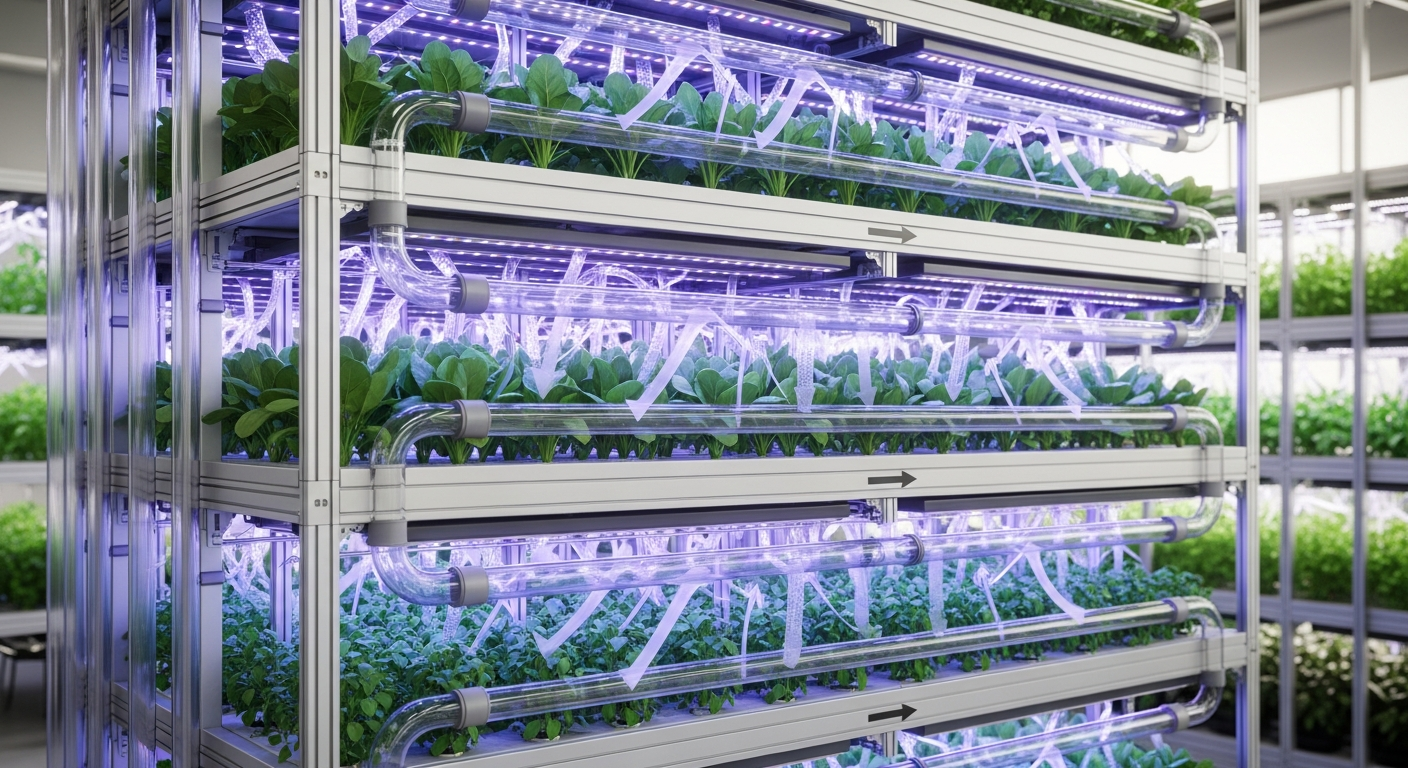
- CO2 Distribution for Photosynthesis: Plants absorb carbon dioxide (CO2) from the air for photosynthesis. Stagnant air around leaves quickly depletes local CO2 levels, limiting growth. Proper airflow ensures a continuous supply of fresh CO2 to the plant canopy, especially crucial in CO2-enriched environments.
- Temperature Regulation: Plants generate heat through metabolic processes and absorb heat from grow lights. Airflow helps dissipate this heat, preventing hot spots and maintaining an optimal temperature range across all tiers and within the plant canopy itself. Uneven temperatures can stress plants and reduce yield.
- Humidity Management and Transpiration: Plants release water vapor through transpiration. Without adequate air movement, a layer of saturated, humid air can build up around leaves, slowing down transpiration and nutrient uptake. Controlled airflow helps maintain the ideal Vapor Pressure Deficit (VPD), which is essential for healthy plant function and nutrient delivery.
- Disease and Pest Prevention: Stagnant, humid conditions are a breeding ground for fungal diseases like powdery mildew and botrytis, as well as an inviting habitat for pests. Consistent air circulation dries leaf surfaces, disrupts pathogen spore development, and makes the environment less hospitable for pests.
- Plant Strengthening (Thigmomorphogenesis): Gentle air movement creates a mild physical stress on plants, prompting them to develop stronger stems and more robust root systems, making them more resilient and less prone to lodging (falling over).
The dense packing of plants, multiple layers of shelving, and the presence of numerous light fixtures in multi-tier environments create significant obstacles to uniform air distribution, making the design and implementation of an effective vertical farm ventilation system a complex engineering challenge.
Understanding Air Movement Dynamics in Multi-Tier Environments
Achieving uniform airflow in a vertically stacked farm is more intricate than simply placing fans. Several dynamic factors must be considered:
The Plant Boundary Layer and Gas Exchange
Every leaf has a thin layer of relatively still air surrounding it, known as the boundary layer. This layer acts as a barrier, and without adequate air movement, it can become saturated with water vapor and depleted of CO2. When the boundary layer is thick, plants struggle to release moisture (transpire) and absorb CO2, impairing photosynthesis and nutrient transport. Effective airflow in multi-tier systems aims to constantly disrupt this boundary layer, facilitating efficient gas exchange and optimizing plant performance. This is particularly critical for maintaining an ideal VPD, which dictates how easily plants can transpire.
Air Stratification and Microclimates
Heat rises, and cold air sinks. In a tall, enclosed space like a vertical farm, this natural phenomenon leads to air stratification, where distinct temperature and humidity gradients can form between the top and bottom tiers. The upper tiers, being closer to powerful grow lights, tend to be warmer and potentially drier, while lower tiers might be cooler and more humid. Without active mixing, these differences create inconsistent microclimates, leading to uneven growth, varied yields, and increased susceptibility to disease in certain sections of the farm. Managing these gradients is a core component of effective environmental control in vertical farming.
Obstructions and Airflow Impedance
The very design of a multi-tier vertical farm, with its racks, trays, lighting fixtures, irrigation lines, and dense plant canopies, inherently impedes smooth air movement. These physical barriers create dead zones, turbulent areas, and uneven distribution. Designing the farm layout with airflow pathways in mind from the outset is crucial. Consideration must be given to how air will navigate around these obstructions to reach every plant uniformly.
Strategies and Technologies for Optimal Airflow Management
Effective airflow management in multi-tier vertical farms requires a combination of thoughtful design, appropriate technology, and intelligent control systems.
System Design and Layout Considerations
- Rack and Row Spacing: Ensure sufficient space between racks and within rows to allow air to flow freely. Overcrowding can negate even the best fan setup.
- Integrated Ducting Systems: For larger operations, a centralized HVAC system with strategically placed ducts and vents can deliver conditioned air uniformly across all tiers and recover CO2 efficiently.
- Open Grate Shelving: Using open mesh or grate shelving instead of solid surfaces allows air to move vertically between tiers, reducing stratification and improving overall circulation.
Fan Selection and Strategic Placement
Fans are the workhorses of vertical farm airflow, and their type and placement are critical:
- Circulation Fans: Small, oscillating clip-on fans or larger axial fans placed strategically within each tier, or even above and below racks, can break up boundary layers and distribute air locally. Oscillating fans are particularly effective at sweeping air across a broad area.
- Intake/Exhaust Fans: These are vital for bringing in fresh, CO2-rich air and expelling stale, humid air. They work in conjunction with the main environmental control system.
- Horizontal Air Flow (HAF) Fans: These fans are designed to create a gentle, continuous, and uniform air movement across an entire growing area, minimizing hot and cold spots.
- Variable Speed Fans: Utilizing fans with variable speed drives allows growers to adjust airflow intensity based on plant growth stage, ambient conditions, and specific needs, optimizing energy consumption and plant response.
Placement is key: fans should be positioned to create a gentle, consistent breeze, not a direct gale. Multiple smaller fans are often more effective than one large fan in creating uniform distribution across a multi-tier structure.
Environmental Sensors and Automated Control Systems
Modern vertical farming systems rely heavily on precision monitoring and automation. Integrating a network of environmental sensors is crucial:
- Temperature and Humidity Sensors: Placed at various heights and locations within the farm to detect stratification and microclimates.
- CO2 Sensors: To monitor CO2 levels and ensure even distribution.
These sensors feed data to a central environmental control unit, which can automatically adjust fan speeds, HVAC settings, and CO2 injection rates to maintain ideal conditions. This automated approach ensures consistent climate control and minimizes human error, making it a cornerstone of efficient CEA operations.
Airflow Diagnostics and Optimization
Even with careful planning, verifying effective airflow is essential. Tools like smoke tests (using non-toxic theatrical smoke) can visually demonstrate air patterns, revealing dead zones or turbulent areas. More advanced operations might utilize Computational Fluid Dynamics (CFD) analysis, a sophisticated simulation technique that predicts air movement patterns within the farm design before construction, allowing for proactive optimization of fan placement and system layout.
Practical Tips for Maximizing Airflow Efficiency and Plant Health
Beyond initial design and technology investment, ongoing management and optimization are critical for sustained success in multi-tier vertical farming.
- Regular Monitoring of Plant Health: Observe your plants closely. Wilting, scorched leaves, signs of fungal growth, or uneven growth across tiers are often indicators of airflow issues. Use handheld meters to check temperature and humidity at plant level in different sections.
- Optimize Fan Settings by Growth Stage: Younger plants may require less intense airflow than mature, dense canopies. Adjust fan speeds and oscillation patterns as plants grow to maintain optimal conditions for transpiration and CO2 uptake without causing physical stress. For instance, increasing airflow slightly during the dark period can help prevent condensation and fungal issues.
- Canopy Management is Crucial: Regular pruning, defoliation, and strategic plant spacing can significantly improve air penetration into dense canopies. Remove lower leaves that are no longer productive to allow better air circulation and light penetration to the main growing points. Think of it as creating ‘air tunnels’ through your crop.
- Routine Maintenance: Fans and filters can accumulate dust and debris, reducing their efficiency and potentially harboring pathogens. Regular cleaning of fan blades, grilles, and air filters is vital for maintaining optimal performance and air quality.
- Integrate Airflow with VPD Strategy: Air movement is a powerful tool for controlling VPD. By increasing airflow, you can lower the humidity immediately surrounding the leaves, thereby increasing the VPD and encouraging transpiration. Conversely, reducing airflow can raise localized humidity. Fine-tune your airflow in conjunction with temperature and overall humidity settings to achieve your target VPD.
- Consider Energy Efficiency: While powerful fans might seem like the simple solution, they consume energy. Optimize fan run times and speeds based on actual needs, utilizing variable speed drives and smart controllers. High-efficiency EC (electronically commutated) motors for fans can significantly reduce power consumption over time.
Conclusion
In the burgeoning world of vertical farming, efficient airflow management in multi-tier environments is far more than a secondary concern; it is a foundational pillar of success. From ensuring uniform CO2 distribution and regulating temperature to precisely managing humidity and preventing disease, optimized air movement directly impacts every aspect of plant health, growth rate, and ultimately, yield. While the dense, layered structure of vertical farms presents unique challenges, thoughtful system design, strategic fan placement, advanced sensor technology, and diligent operational management provide the tools necessary to overcome them. By investing in a robust and intelligent airflow strategy, vertical farm operators can unlock the full potential of their systems, leading to healthier crops, higher yields, greater energy efficiency, and a more sustainable future for agriculture.