
In the intricate dance of modern building management, maintaining an optimal indoor environment is a delicate balance. It’s not just about keeping occupants cool in summer or warm in winter; it’s about ensuring a constant supply of fresh, high-quality air without excessive energy consumption. Achieving this harmony requires sophisticated control strategies, particularly when it comes to synchronizing cooling and ventilation systems. Enter lead-lag logic – a powerful yet often understated control mechanism that orchestrates these critical components, extending equipment life, enhancing reliability, and unlocking significant energy savings. This article delves into the profound role lead-lag logic plays in synchronizing cooling and ventilation, transforming building operations from reactive to proactive, and inefficient to highly optimized.
Understanding Lead-Lag Logic in HVAC Systems
At its core, lead-lag logic is a control strategy designed to manage multiple, identical pieces of equipment that serve a common purpose. The principle is simple yet profoundly effective: one unit is designated as the “lead” unit, handling the primary operational load, while other units are designated as “lag” units, standing by to assist or take over when needed. In the context of Heating, Ventilation, and Air Conditioning (HVAC) systems, this logic is invaluable for managing components like multiple chillers, cooling towers, pumps, or fans.
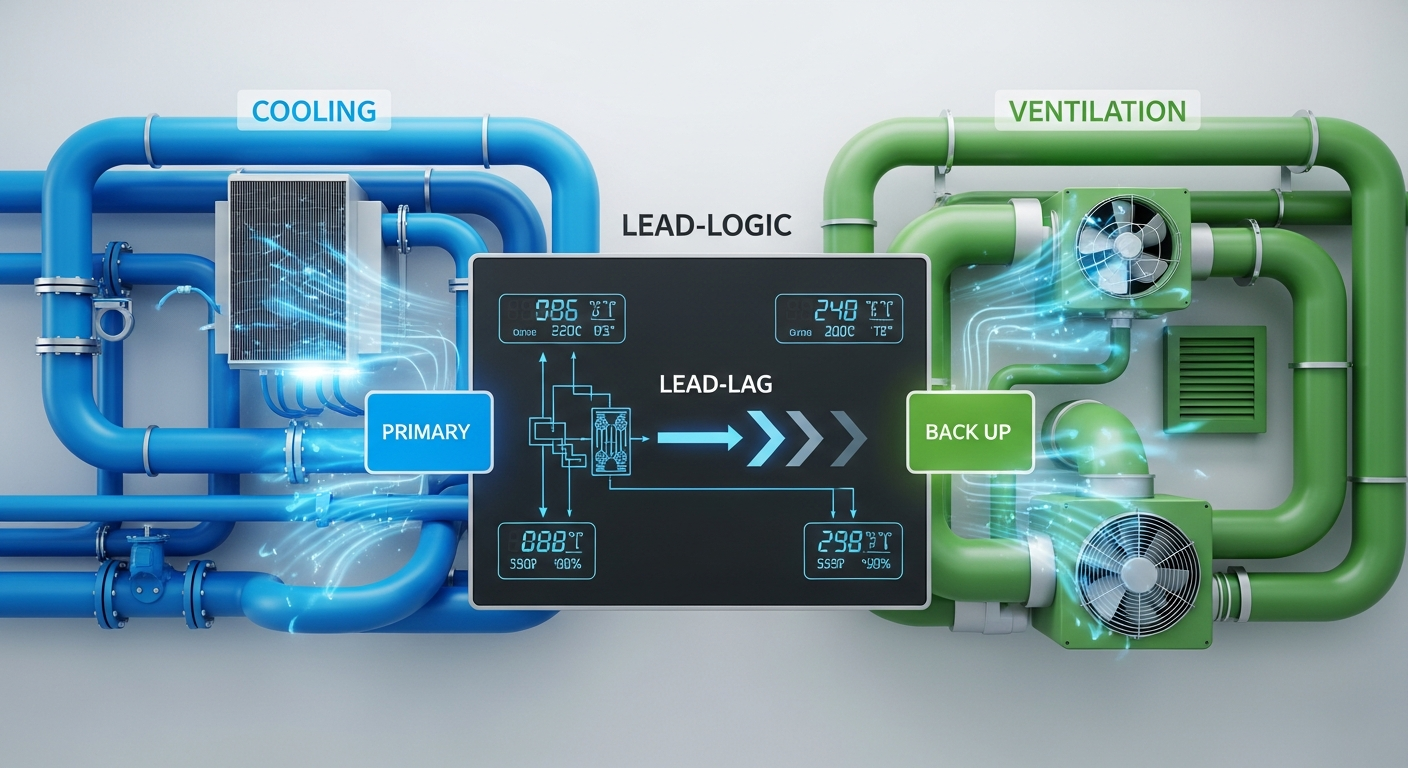
The primary objectives of employing lead-lag logic are threefold:
- Even Wear Distribution: By rotating which unit acts as the “lead” over time (e.g., daily, weekly, or based on runtime), lead-lag logic prevents any single piece of equipment from accumulating excessive operational hours. This wear leveling significantly extends the lifespan of individual components and the overall system.
- Enhanced Redundancy and Reliability: Should the primary (lead) unit fail or be taken offline for maintenance, a lag unit automatically steps in to assume the load. This seamless handover ensures continuous operation, minimizing downtime and maintaining critical environmental conditions.
- Optimized Energy Efficiency: The system can be programmed to bring lag units online only when the demand exceeds the capacity of the lead unit. Conversely, units can be shed as demand decreases, ensuring that only the necessary amount of power is consumed to meet the current load. This prevents over-sizing and unnecessary energy expenditure.
When applied to cooling systems, such as multiple chiller plants, lead-lag logic dictates which chiller operates first, and when subsequent chillers are activated based on cooling load requirements. For ventilation systems, it can manage an array of supply or exhaust fans, ensuring consistent airflow and proper building pressurization while distributing runtime evenly among them. This intelligent orchestration is the foundation upon which synchronized cooling and ventilation are built.
The Imperative for Synchronization: Why Cooling and Ventilation Must Work Together
Cooling and ventilation systems are often perceived as distinct entities, yet their functions are deeply intertwined. Cooling aims to control temperature and humidity, while ventilation focuses on introducing fresh air, diluting pollutants, and removing stale air. For a building to achieve true environmental comfort and health, these two systems cannot operate in isolation; they must be synchronized to work in concert. A lack of synchronization can lead to a host of problems:
- Poor Indoor Air Quality (IAQ): If cooling operates without adequate fresh air ventilation, occupants may experience “stuffy” conditions, increased CO2 levels, and a build-up of volatile organic compounds (VOCs). Conversely, over-ventilating with unconditioned outdoor air can introduce excessive humidity or pollutants, overwhelming the cooling system.
- Uncomfortable Thermal Conditions: Cooling systems working against excessive ventilation of hot, humid outdoor air will struggle to maintain set points, leading to uncomfortable temperatures and high humidity. This often results in occupants feeling sticky and dissatisfied.
- Significant Energy Waste: This is perhaps the most costly consequence. Imagine a cooling system working overtime to cool large volumes of hot, fresh air unnecessarily introduced by an overzealous ventilation system, or a ventilation system exhausting perfectly conditioned air to the outside. This mismatch forces both systems to work harder, consuming far more energy than required.
- Increased Strain and Premature Wear: When systems are out of sync, they operate inefficiently and often at higher capacities than necessary. This continuous overexertion puts undue stress on compressors, fans, and motors, accelerating wear and tear and leading to more frequent breakdowns and higher maintenance costs.
The ultimate goal of synchronization is to create an environment that is both thermally comfortable and boasts excellent Indoor Air Quality (IAQ), all while operating at peak energy efficiency. Lead-lag logic provides the framework for this synergy, ensuring that cooling capacity and ventilation rates are precisely matched to the dynamic needs of the building and its occupants.
Implementing Lead-Lag for Optimal Performance and Efficiency
Integrating lead-lag logic effectively translates into a sophisticated control strategy that considers real-time conditions. Here’s how it plays out in practice for both cooling and ventilation, and critically, how they are synchronized:
Lead-Lag in Cooling Systems
For systems with multiple chillers or large Direct Expansion (DX) units, lead-lag ensures that cooling capacity precisely matches demand. When the building’s cooling load is low, only the lead chiller operates. As the temperature rises or the cooling demand signal increases, the system intelligently stages on lag chillers one by one. The lead unit can be rotated based on:
- Runtime: The unit with the fewest operational hours becomes the lead.
- Scheduled Rotation: A fixed schedule (e.g., lead chiller A on Monday, B on Tuesday).
- Fault Condition: If the lead chiller develops a fault, a lag chiller immediately takes over.
This approach not only distributes wear but also ensures that only the necessary capacity is online, preventing partial load inefficiencies common with oversized single units.
Lead-Lag in Ventilation Systems
Similarly, ventilation systems often employ multiple supply and exhaust fans. Lead-lag logic here is crucial for maintaining consistent airflow, proper building pressurization (positive or negative, depending on design), and ensuring redundancy. For instance, in critical environments like hospitals or laboratories, a failed exhaust fan could have severe consequences. Lead-lag ensures that a backup fan is ready to engage instantly. It can also manage fans to provide varying levels of fresh air based on occupancy sensors or CO2 levels, optimizing IAQ without over-ventilating when spaces are empty.
Synchronizing Cooling and Ventilation with Lead-Lag
The true power of lead-lag logic emerges when it’s used to synchronize these two systems. This often happens through a central Building Management System (BMS) that interprets signals from various sensors and orchestrates the lead-lag sequence for both cooling and ventilation simultaneously:
- Demand-Driven Synchronization: When the cooling load in a zone increases, the BMS might trigger a lag chiller to come online. Simultaneously, it could instruct the ventilation system to increase fresh air supply proportionally, especially if CO2 levels are rising due to increased occupancy contributing to the heat load. This maintains IAQ while the cooling system tackles the thermal load.
- Occupancy-Based Control: In areas with variable occupancy, CO2 sensors can signal the need for more ventilation. The lead-lag logic would activate additional fans. If this fresh air influx significantly alters the room temperature, the cooling system (also managed by lead-lag) would respond by adjusting its output to maintain the set point, potentially bringing a lag chiller online or adjusting variable speed drives (VSDs) on existing units.
- Temperature and Humidity Control: If outdoor air is hot and humid, the BMS might prioritize recirculation and minimize fresh air intake to reduce the load on the cooling system, bringing in only the minimum required fresh air, ensuring the active cooling units are not overwhelmed. Conversely, on mild days, “free cooling” with increased ventilation might be prioritized.
The benefits of this synchronized approach are substantial:
- Extended Equipment Lifespan: Even wear distribution across all cooling and ventilation units.
- Enhanced System Reliability: Seamless operation even during equipment failure or maintenance.
- Significant Energy Savings: Optimizing both cooling and ventilation capacity to match actual demand.
- Improved IAQ and Thermal Comfort: Consistently meeting environmental standards and occupant expectations.
- Reduced Operational and Maintenance Costs: Fewer breakdowns, less emergency repair, and lower utility bills.
Practical Considerations and Advanced Applications
Implementing a robust lead-lag strategy for synchronized cooling and ventilation requires careful planning and execution. Here are some practical tips and a look at advanced applications:
Setup and Configuration Tips
- Proper Sizing: Ensure that your lead and lag units are appropriately sized for your building’s maximum and minimum loads. Oversized units can still lead to inefficiency, even with lead-lag.
- BMS Integration: A modern Building Management System (BMS) is essential. It serves as the brain, gathering data from sensors (temperature, humidity, CO2, differential pressure) and executing the lead-lag logic for all interconnected systems.
- Flexible Programming: The lead-lag logic should be programmable to allow for various rotation schedules (runtime-based, fixed schedule, first-on/first-off) and respond to different triggers (temperature setpoint deviation, CO2 levels, equipment fault).
- Continuous Monitoring: Regularly monitor the performance of your lead-lag system. Track runtime hours, energy consumption, and environmental parameters. This data helps identify opportunities for further optimization and ensures the system is operating as intended.
- Preventative Maintenance: Even with lead-lag distributing wear, regular maintenance is crucial for all units. A well-maintained system is more reliable and efficient.
Advanced Applications
The evolution of HVAC technology allows for even more sophisticated lead-lag integrations:
- Variable Speed Drives (VSDs): Integrating VSDs with lead-lag control for fans and pumps allows for incredibly granular control. Instead of simply turning units on/off, VSDs can adjust their speed and output, providing highly efficient partial load operation before an additional lag unit is staged on. This extends the range of efficient operation for a single lead unit.
- Predictive Analytics: Advanced BMS can integrate with external data sources like weather forecasts or occupancy schedules. This allows the lead-lag logic to anticipate changes in demand and pre-stage or de-stage equipment, optimizing response times and further reducing energy waste.
- Fault-Tolerant Systems: In critical environments, lead-lag can be configured for more aggressive redundancy, ensuring multiple layers of backup and faster failover times, potentially even with hot standby units.
- Demand Response Programs: For buildings participating in utility demand response programs, lead-lag can be programmed to intelligently shed non-critical loads or temporarily adjust setpoints during peak demand periods, contributing to grid stability and earning financial incentives.
By leveraging these advanced capabilities, organizations can elevate their building operations to new levels of efficiency, reliability, and occupant satisfaction, all while making a significant impact on their environmental footprint.
Conclusion
The symbiotic relationship between cooling and ventilation is paramount for creating healthy, comfortable, and energy-efficient indoor environments. Lead-lag logic stands out as a critical intelligent control strategy that orchestrates this relationship, ensuring that these vital systems work in perfect synchronization. From distributing wear evenly across equipment and enhancing system reliability through redundancy, to unlocking substantial energy efficiency and maintaining optimal Indoor Air Quality (IAQ), the benefits are far-reaching.
Investing in and properly configuring lead-lag control for your HVAC infrastructure is not merely an operational choice; it’s a strategic decision that contributes to the longevity of your assets, significantly reduces operational costs, and ultimately creates a superior experience for building occupants. As buildings become smarter and the demand for sustainability grows, the role of sophisticated control strategies like lead-lag logic will only become more vital, cementing its status as a cornerstone of modern, intelligent building management.