
Every structure, from a humble shed to a towering skyscraper, is a testament to careful planning and engineering. But what stands between a robust, long-lasting building and one vulnerable to the forces of nature or everyday use? The answer lies in meticulous structural load calculations. These aren’t just arcane mathematical exercises; they are the bedrock of safety, longevity, and efficiency in construction. In agricultural settings, where structures like greenhouses and barns face the combined challenge of environmental elements and the sheer weight of their produce, understanding and accurately calculating loads from snow, wind, and especially crop weight becomes paramount. Neglecting these critical engineering considerations can lead to catastrophic failures, costly repairs, and potential risks to life and investment. This article delves into the essential world of structural load calculations, illuminating how engineers design structures to stand firm against these varied and powerful forces.
The Imperative of Structural Load Calculations: Understanding the Forces at Play
At its core, structural engineering is about ensuring that a building can safely support all the forces acting upon it throughout its lifespan. These forces are collectively known as structural loads, and their accurate assessment is the very first step in any sound construction project. Ignoring or underestimating these loads is a recipe for disaster, potentially leading to anything from minor cracking to complete structural collapse. Engineers categorize these loads to systematically address their impact:
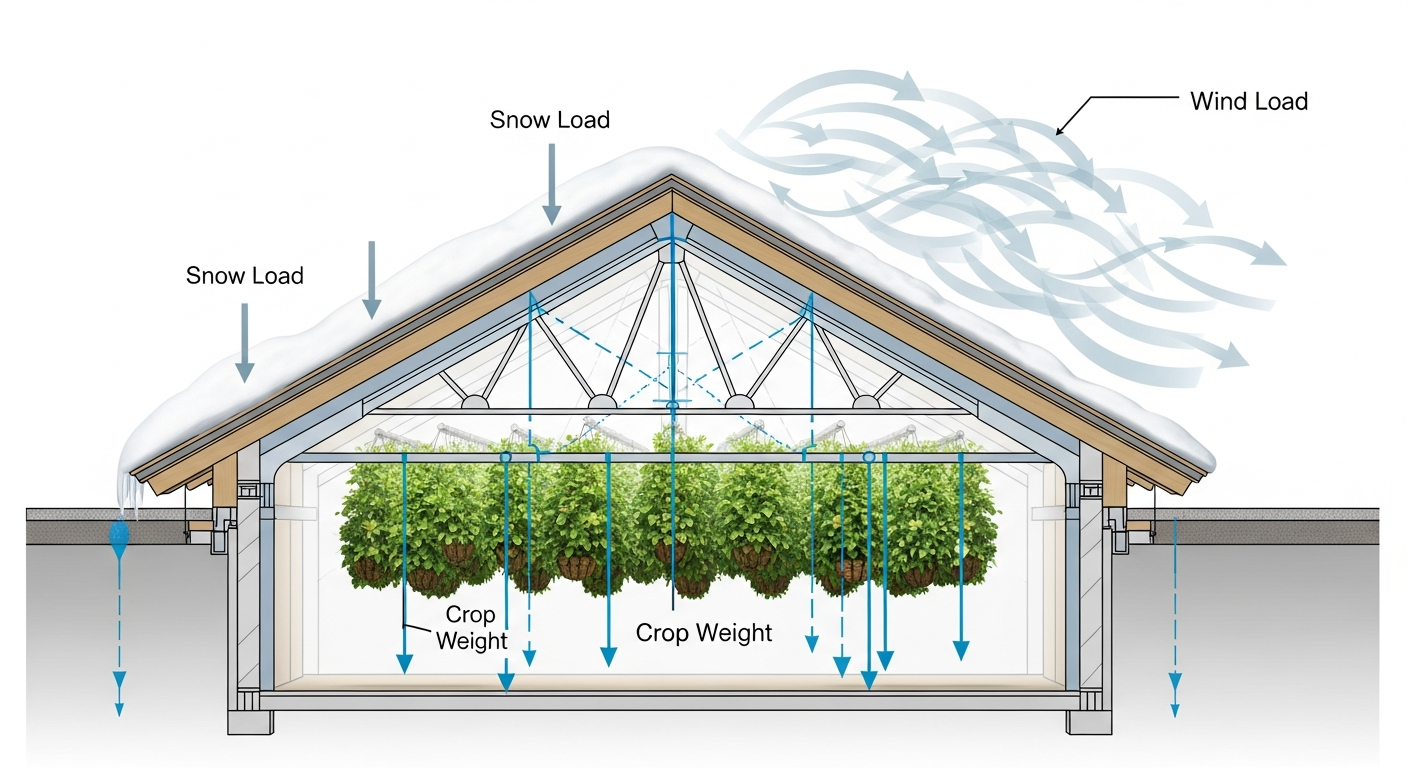
- Dead Loads: These are permanent, unchanging loads that include the weight of the structure itself – walls, floors, roofs, and all fixed building components. They are predictable and constant.
- Live Loads: These are variable loads that change over time. They include the weight of occupants, furniture, equipment, stored materials, and in the context of agricultural structures, the significant and often fluctuating crop weight load.
- Environmental Loads: These are external forces exerted by natural phenomena. The most common and critical among these are snow load and wind load, but also include seismic (earthquake) loads and flood loads, depending on the geographical location.
The entire purpose of structural design is to create a framework that can safely and economically transfer these loads through the various structural elements – beams, columns, walls, and foundations – down to the ground. This requires not just knowing the types of loads, but precisely quantifying them according to stringent building codes and standards.
Conquering the Elements: Designing for Snow and Wind Loads
Nature’s forces, particularly snow and wind, are dynamic and powerful, demanding careful consideration in structural design. Buildings must be engineered to resist both the downward pressure of snow and the complex forces of wind, which can push, pull, and uplift.
Snow Load Calculation: The Weight of Winter
Snow load refers to the weight of accumulated snow on a roof. This might seem straightforward, but it’s a complex calculation influenced by several factors:
- Geographic Location: Local building codes specify ground snow loads based on historical weather data for different regions. A building in the Rocky Mountains will have a much higher design snow load than one in Florida.
- Roof Shape and Slope: Flat roofs accumulate more snow than steeply pitched roofs, where snow can slide off. Complex roof geometries can also lead to snow drifting, where snow accumulates disproportionately in valleys or against parapets, creating localized areas of much higher load.
- Thermal Properties: Heat loss from the building can melt snow, which might then refreeze as ice, adding significant weight, or create dangerous icicle formations.
- Exposure: Sheltered roofs might accumulate more snow than exposed ones where wind can blow snow away.
Engineers use formulas and tables provided in codes like ASCE 7 (Minimum Design Loads for Buildings and Other Structures) to convert ground snow loads into design roof snow loads, accounting for these variables. This ensures that the roof trusses, beams, and columns are robust enough to prevent collapse under the heaviest expected snowfall. Practical Tip: When planning a structure in a snowy region, always consult the local building authority for specific ground snow load requirements. Consider roof designs that naturally shed snow, like steeper pitches, to reduce accumulation.
Wind Load Calculation: Standing Against the Gust
Wind load is the pressure exerted by wind on a building’s surfaces. Unlike snow, wind can act in multiple directions simultaneously – pushing on windward walls, pulling (suction) on leeward walls and roofs, and creating uplift forces on the entire structure. The calculation of wind loads is highly sophisticated, considering factors such as:
- Basic Wind Speed: Determined by codes based on geographic location and recurrence interval (e.g., a 50-year or 100-year event).
- Building Height and Shape: Taller buildings experience greater wind forces. Irregular shapes can create complex aerodynamic effects.
- Terrain Exposure: A building in an open field (Exposure D) will experience higher wind pressures than one nestled within a dense urban area (Exposure B), which offers shielding.
- Internal Pressure: If a building has openings (e.g., a broken window), wind can enter and create internal pressure, adding to the forces on the roof and walls.
Wind load calculations result in design pressures applied to walls and roofs, and overall forces that the structure must resist laterally and vertically (uplift). This dictates the required strength of walls, roof framing, and crucially, the anchorage systems that tie the building to its foundation. Without proper consideration for wind, roofs can peel off, walls can buckle, and entire structures can overturn. Practical Tip: Ensure that all connections, from roof to wall and wall to foundation, are adequately designed for uplift and shear forces. Use hurricane ties or strong anchor bolts where wind speeds are significant.
The Unique Challenge: Designing for Crop Weight in Agricultural Structures
While snow and wind loads are universal concerns, structures designed for agriculture, such as greenhouses, vertical farms, and barns, face the unique and often substantial challenge of managing crop weight load. This falls under the category of live loads but demands specialized consideration due to its scale and variability.
- Greenhouses: The weight of plants, especially mature crops like tomatoes, cucumbers, or cannabis, can be immense. When grown using hanging systems, trellises, or hydroponic channels, this weight is directly transferred to the greenhouse’s roof structure (purlins, trusses, and columns). Add to this the weight of irrigation water, growing media, and potentially heavy harvesting equipment, and the total load can easily exceed that of typical occupancy loads. A single mature tomato plant can weigh several pounds, and a commercial greenhouse might house thousands.
- Vertical Farms: These innovative structures involve multiple layers of crops, often stacked many feet high. Each layer, along with its irrigation system, lighting, and growing medium, contributes significant load. The cumulative weight on the lower levels and the foundation can be staggering, requiring extremely robust floor systems and columns.
- Storage Buildings & Barns: Stored feed, hay bales, grain, and even livestock impose substantial live loads on floors, lofts, and support beams. These loads can be highly concentrated and change drastically depending on storage practices and harvest cycles.
Accurately assessing crop weight requires understanding the specific crop, its yield per unit area, the growing system employed, and the potential maximum weight at peak harvest. It’s often prudent to over-design for these loads to accommodate future changes in crop type or growing methods. For hydroponic systems, the weight of water in reservoirs and circulation systems must also be factored in. Practical Tip: For agricultural structures, always consult with a structural engineer who has experience in designing for specialized live loads. Clearly communicate your intended crops, growing methods, and maximum expected yields. Design for the heaviest possible scenario, including fully irrigated plants at peak maturity.
The Structural Engineering Process: From Calculation to Construction
The journey from understanding loads to a safe, compliant structure involves a systematic engineering process that integrates all the aforementioned calculations:
- Load Identification: The engineer first identifies all applicable dead, live, and environmental loads for the specific project location and intended use. This includes detailed assessment of snow load, wind load, and critical crop weight load.
- Code Compliance: All load magnitudes are determined in strict accordance with adopted building codes (e.g., International Building Code – IBC, ASCE 7, and local amendments). These codes provide minimum safety factors and design criteria.
- Load Combinations: Structures rarely experience a single load in isolation. Engineers use complex “load combinations” prescribed by codes to determine the worst-case scenarios (e.g., Dead Load + Live Load + Snow Load, or Dead Load + Wind Load). These combinations account for the probability of different loads occurring simultaneously.
- Structural Analysis: Using sophisticated software and analytical methods, the engineer then analyzes how these combined loads will affect every component of the structure – beams, columns, foundations, connections. This determines the internal forces (bending moments, shear forces, axial forces) within each element.
- Member Sizing and Material Selection: Based on the analysis, appropriate materials (steel, concrete, wood) and member sizes are selected to safely resist these internal forces while maintaining structural integrity and economy. This involves checking for strength, stiffness, and stability.
- Foundation Design: Finally, the loads are transferred to the foundation, which must be designed to safely distribute them to the underlying soil without excessive settlement.
Throughout this process, the expertise of a licensed structural engineer is indispensable. They not only perform the calculations but also interpret codes, assess site-specific conditions, and provide designs that are both safe and constructible. Engaging a professional early in the design phase is crucial for avoiding costly redesigns, delays, and, most importantly, ensuring the long-term safety and performance of your investment.
Conclusion: Building with Confidence and Integrity
Structural load calculations are far more than a technical requirement; they are the cornerstone of responsible and safe construction. By meticulously accounting for the immutable forces of dead loads, the dynamic variations of live loads (including crucial crop weight), and the unpredictable power of environmental forces like snow load and wind load, engineers create structures that are resilient, durable, and secure. Whether it’s a residential home or a state-of-the-art agricultural facility, adhering to proper design principles and engaging qualified professionals ensures compliance with building codes and, more importantly, provides peace of mind. Investing in thorough structural analysis is an investment in the safety, longevity, and ultimate success of any building project, safeguarding both human lives and valuable assets against the relentless forces they are designed to withstand.