
The gentle hum of a well-ventilated greenhouse is music to a grower’s ears. It signifies an environment where plants thrive, free from the stresses of excessive heat, humidity, or stagnant air. While many factors contribute to a healthy greenhouse climate, one often underestimated aspect is the fundamental influence of its physical shape on natural convection and airflow. Far from being a mere aesthetic choice, the architectural form of a greenhouse dictates how warm air rises, how cool air enters, and how effectively the internal environment regulates itself, playing a critical role in temperature control, humidity management, and overall crop vigor. Understanding this interplay between design and atmospheric physics is paramount for optimizing passive climate control and ensuring sustained agricultural success.
The Physics Behind Greenhouse Airflow: Natural Convection Explained
At the heart of efficient greenhouse climate management lies the principle of natural convection, often referred to as the “stack effect.” This fundamental heat transfer mechanism relies on density differences in fluids, in this case, air. When sunlight penetrates a greenhouse, it warms the internal air. As air heats up, its molecules spread out, making it less dense than the cooler air surrounding it. This less dense, warm air naturally rises.
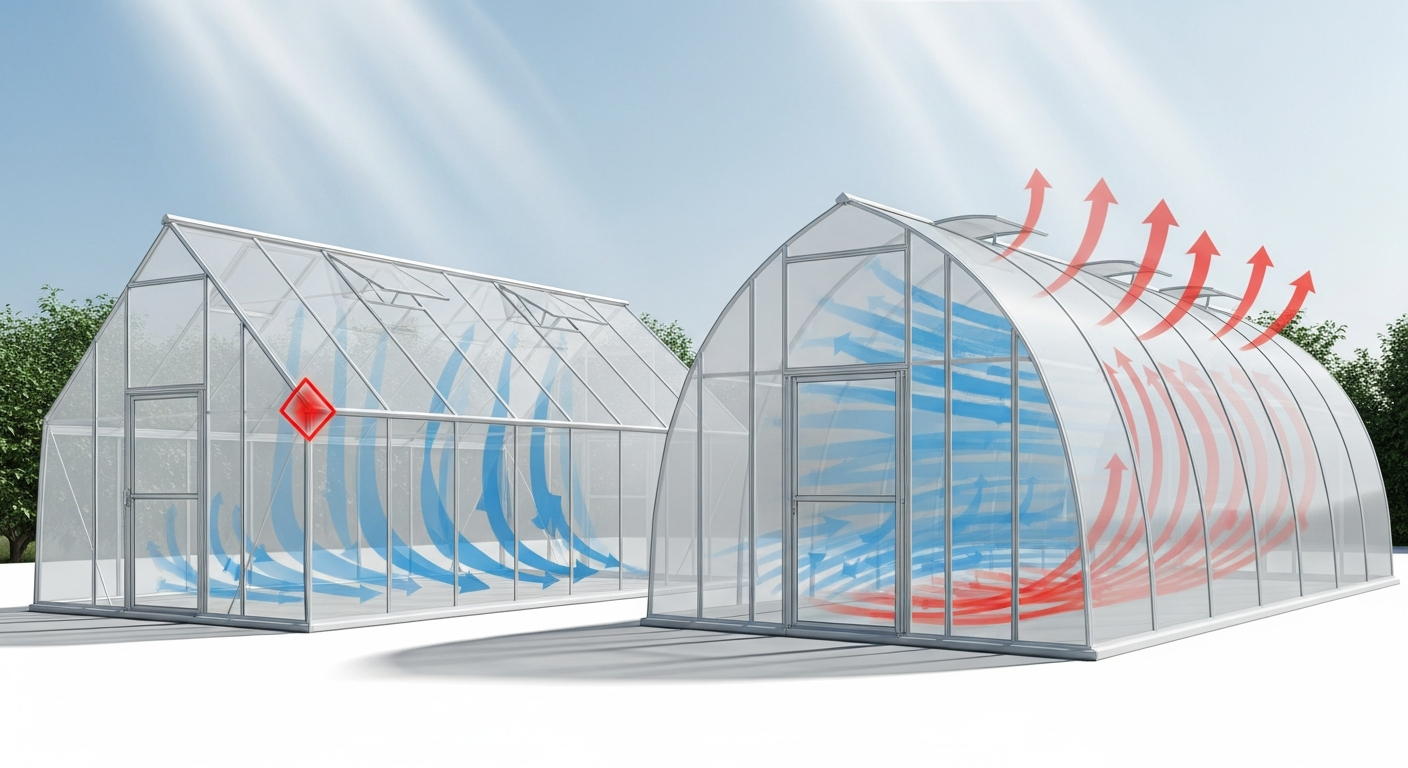
In a well-designed greenhouse, this rising warm air creates a vacuum effect, drawing in cooler, denser air from lower entry points, typically side vents. As the warm air continues to rise, it eventually exits through higher openings, such as ridge vents. This continuous cycle of warm air rising and exiting, replaced by cooler air entering below, establishes a natural, passive airflow pattern. This process is crucial for:
- Temperature Regulation: Preventing overheating by expelling hot, stagnant air.
- Humidity Control: Removing moisture-laden air, reducing the risk of fungal diseases.
- CO2 Replenishment: Bringing in fresh air rich in carbon dioxide, essential for photosynthesis.
The efficiency and strength of this natural convection loop are profoundly influenced by the greenhouse’s structural geometry. Factors like the height difference between air inlet and outlet, the volume of air, and the shape of the internal space all contribute to how effectively air moves and heat dissipates without the constant reliance on energy-intensive mechanical fans.
Greenhouse Shapes and Their Convection Dynamics
Different greenhouse shapes offer distinct advantages and disadvantages when it comes to harnessing natural convection and promoting optimal airflow. The choice of shape isn’t just about structural integrity or cost; it’s a critical decision that impacts the fundamental atmospheric conditions within.
Even-Span (A-Frame) Greenhouses
The classic A-frame or even-span greenhouse, characterized by its symmetrical pitched roof, is a popular choice for many growers. Its distinct roof pitch directly influences the stack effect. A steeper pitch generally allows for more rapid and efficient stratification of hot air towards the ridge. This concentrated pocket of hot air can then be effectively expelled through ridge vents. The smooth, upward-sloping surfaces guide the rising air directly towards the exit points, minimizing turbulence and dead air pockets. However, the exact angle of the roof is critical; too shallow, and hot air may linger; too steep, and it could impact structural costs and heat retention during colder periods. The overall height of the walls also plays a significant role, as taller walls increase the volume of air and enhance the vertical temperature differential, strengthening the stack effect.
Gothic Arch Greenhouses
Gothic arch greenhouses feature a pointed, often elegant, arch shape that sheds snow and minimizes condensation drip. From an airflow perspective, their steeply sloped sides and central peak are highly conducive to natural convection. The continuous, smooth curve from the base to the apex allows warm air to rise efficiently along the interior surface without encountering sharp corners or obstructions that could impede flow. This promotes a strong stack effect, similar to a well-pitched even-span, often even more effectively due to the absence of a distinct eave where warm air might pool. The increased internal volume associated with the high peak also contributes to more stable temperatures and better air circulation.
Quonset (Hoop House) Greenhouses
Quonset greenhouses, or hoop houses, are characterized by their semicircular or elongated dome shape. While cost-effective and structurally robust, their curved roof can present unique challenges and opportunities for airflow. The continuous curve can guide rising warm air, but without a clear, defined ridge, the stratification of hot air might be less concentrated. Hot air tends to accumulate along the entire top curve, requiring multiple or extended ridge vents (often continuous roll-up sides at the apex or specialized vent designs) to expel it effectively. Side ventilation is particularly crucial in Quonset designs to introduce cooler air and facilitate cross-ventilation, especially in wider structures where air movement towards the center might be sluggish. The height of a Quonset also greatly impacts its thermal performance; taller structures offer more air volume and a stronger convective pull.
Lean-To Greenhouses
Lean-to greenhouses, attached to an existing building, have only one pitched roof and one or more open sides. Their airflow dynamics are heavily influenced by the adjacent structure and prevailing winds. The single slope encourages natural convection towards the higher side, where vents are typically placed. Cross-ventilation becomes paramount here, utilizing side vents and potentially relying on the main building’s ventilation system if connected. The effectiveness of natural convection in a lean-to depends on the height difference between its lowest air intake and its highest exhaust, as well as its orientation relative to the sun and wind.
Circular or Dome Greenhouses
Less common for commercial operations but gaining interest for unique applications, circular or dome greenhouses present an interesting case. Their curvilinear forms are aerodynamic and structurally strong. From an airflow perspective, their smooth, uninterrupted surfaces allow warm air to rise along the interior without turbulence. A central opening or vent at the apex of a dome is highly effective for exhausting hot air due to the strong stack effect created by the uniform rise of air. However, the large, unobstructed internal volume means that uniform air distribution can be challenging without supplementary fans, especially near the perimeter, unless carefully designed intake vents are incorporated around the base.
Specific Shape Characteristics and Their Airflow Implications
Beyond the general architectural categories, specific features within each greenhouse shape critically modulate natural convection and overall airflow patterns. Understanding these nuances allows for more precise design and optimization.
The Role of Roof Pitch and Ridge Vents
The angle, or pitch, of a greenhouse roof is perhaps the single most important factor influencing the efficiency of the stack effect. A steeper roof pitch encourages warmer, lighter air to rise more rapidly and directly towards the apex. This creates a stronger pressure differential, enhancing the natural convective pull. When combined with adequately sized and strategically placed ridge vents, this design allows for efficient expulsion of heat and humidity. Ridge vents should ideally span a significant portion of the greenhouse length to maximize exhaust capacity. In contrast, a flatter roof pitch can cause hot air to stratify over a larger area, making it harder to expel and potentially leading to hot spots and stagnant zones. For optimal performance, many experts recommend a minimum roof pitch of 25-30 degrees.
Curved vs. Angled Surfaces
The interior surfaces of a greenhouse, whether smoothly curved (like in Quonsets or Gothic arches) or sharply angled (like in even-spans), impact air movement. Smooth curves tend to guide airflow with less turbulence, allowing for a more laminar (smooth) flow towards the vents. This can reduce friction and enhance the overall efficiency of air exchange. Sharp angles, such as those found at the eaves of some even-span designs, can sometimes create minor dead air pockets where warm, humid air might accumulate, especially if ventilation is insufficient. Good design mitigates this with proper vent placement and sufficient height.
Greenhouse Height and Air Volume
The overall height of a greenhouse, particularly the sidewall height and the peak height, significantly impacts its thermal stability and the strength of natural convection. Taller greenhouses offer several advantages:
- Increased Air Volume: A larger air volume acts as a buffer against rapid temperature fluctuations, providing more thermal inertia.
- Stronger Stack Effect: A greater vertical distance between the air inlet (side vents) and the air outlet (ridge vents) creates a stronger pressure differential, amplifying the stack effect and improving ventilation efficiency. Hot air has more vertical space to rise and gain buoyancy before exiting.
- Reduced Crop Stress: Taller structures mean that the plant canopy is further away from the hottest air accumulating at the peak, reducing heat stress on crops.
While taller structures generally perform better in terms of passive climate control, they also come with higher construction costs and potentially increased heating requirements in colder climates. A balance must be struck based on specific crop needs and regional climate.
Footprint and Cross-Ventilation
The overall footprint of the greenhouse – whether it’s square, rectangular, or unusually shaped – influences how easily air can move horizontally through the structure. For wider greenhouses, especially those without ridge vents, cross-ventilation becomes critical. Strategic placement of side vents, often on opposite walls, allows prevailing winds to push air across the growing area. However, without a strong stack effect, cross-ventilation alone might not be sufficient to remove heat from the very center of very wide structures, potentially leading to uneven temperatures and humidity. Rectangular greenhouses, particularly those oriented perpendicular to prevailing summer winds, can benefit immensely from strong cross-flow, while square or excessively wide designs may require more sophisticated venting or supplementary fan assistance.
Optimizing Greenhouse Design for Enhanced Natural Airflow
Thoughtful design choices can significantly enhance the natural convection and airflow within any greenhouse shape. Here are practical tips for growers and designers:
- Strategic Vent Placement and Sizing:
- Ridge Vents: Ensure they are continuous or cover a substantial portion of the roof’s peak, allowing maximum hot air expulsion. Automated openers reacting to temperature changes are highly beneficial.
- Side Vents: Position these low on the sidewalls to allow cool, fresh air to enter at crop level. Roll-up or hinged side vents are excellent for flexibility. The total area of all vents (inlets and outlets) should ideally be at least 15-20% of the greenhouse floor area for effective natural ventilation.
- Gable Vents: While less effective than ridge vents for stack effect, gable end vents can aid in cross-ventilation, especially for shorter houses.
- Consider Prevailing Wind Directions: Orient the greenhouse to maximize beneficial wind patterns. For cross-ventilation, align the longer side perpendicular to summer prevailing winds. For stack effect emphasis, consider placing the ridge parallel to strong winds, which can create a Venturi effect, “sucking” air out of the ridge vents.
- Maximize Greenhouse Height: As discussed, taller sidewalls and a higher peak improve the stack effect and provide a larger buffer against temperature fluctuations. Invest in adequate height if budget allows.
- Choose Appropriate Glazing Materials: While not directly affecting shape, the thermal properties and light transmission of glazing materials (polycarbonate, polyethylene film, glass) indirectly influence internal temperature and thus the intensity of natural convection. Materials with high light transmission can lead to greater heat gain and a stronger stack effect.
- Internal Air Circulation Fans: Even with excellent passive design, very large or wide greenhouses may benefit from horizontal airflow fans (HAF fans) to ensure uniform air distribution, break up stagnant pockets, and move air towards the vents. These are complementary, not substitutes, for natural ventilation.
- Manage Crop Canopy Density: Dense crop canopies can impede airflow. Strategic plant spacing and pruning can improve air movement within the crop zone, supporting better disease prevention and CO2 exchange.
- Integrate Shade Systems: External or internal shade cloths can reduce solar heat gain on intense days, moderating the need for aggressive ventilation and making natural convection more manageable.
Conclusion
The shape of a greenhouse is far more than an architectural detail; it is a fundamental determinant of its internal climate. By understanding the intricate relationship between greenhouse geometry, natural convection, and airflow, growers can make informed design choices that maximize passive ventilation efficiency. Whether it’s the classic pitch of an even-span, the graceful curve of a Gothic arch, or the practical sweep of a Quonset, each shape presents unique opportunities and challenges for managing heat and humidity. Optimizing elements like roof pitch, overall height, vent placement, and even orientation can significantly enhance a greenhouse’s ability to self-regulate, leading to healthier plants, reduced energy consumption, and ultimately, greater success in sustainable horticulture. A well-designed greenhouse, where airflow moves effortlessly and naturally, is truly a living, breathing environment optimized for growth.