
The world of indoor cultivation has undergone a profound transformation, moving far beyond simply illuminating plants with generic grow lights. Today, expert growers are harnessing the incredible power of light itself, not just as fuel, but as a sophisticated signaling mechanism. This revolution is centered around light recipes and programmable spectrums, a scientific approach that allows cultivators to precisely tailor light wavelengths to meet the exact physiological needs of plants at every stage of their lifecycle. Welcome to the era where horticulture meets advanced photobiology, where every photon counts, and the secret to unlocking unparalleled growth, yield, and quality lies in understanding the science of light.
Beyond Broad Spectrum: Decoding the Plant-Light Relationship
For centuries, growers understood that plants needed light to grow, but the intricate relationship between specific wavelengths and plant development remained largely unexplored in practical terms. Traditional grow lights, such as HPS (High-Pressure Sodium) and MH (Metal Halide), offered a broad, static spectrum, often inefficient and lacking the precision required for optimization.
Photosynthesis: The Engine of Growth
At its core, plant life is driven by photosynthesis, the process by which plants convert light energy into chemical energy. This process primarily utilizes light within the Photosynthetically Active Radiation (PAR) range, roughly 400 to 700 nanometers (nm). Chlorophyll a and b, the primary pigments, absorb strongly in the blue and red regions of the spectrum. While green light is often reflected, it still contributes to photosynthesis, especially deeper within the plant canopy.
Photomorphogenesis: Light as a Director
Crucially, light does more than just power photosynthesis; it actively directs plant development through a process called photomorphogenesis. Plants possess photoreceptors (like phytochromes, cryptochromes, and phototropins) that detect specific wavelengths, triggering a cascade of biochemical responses. These responses dictate everything from seed germination and stem elongation to flowering, fruiting, and the production of vital secondary metabolites.
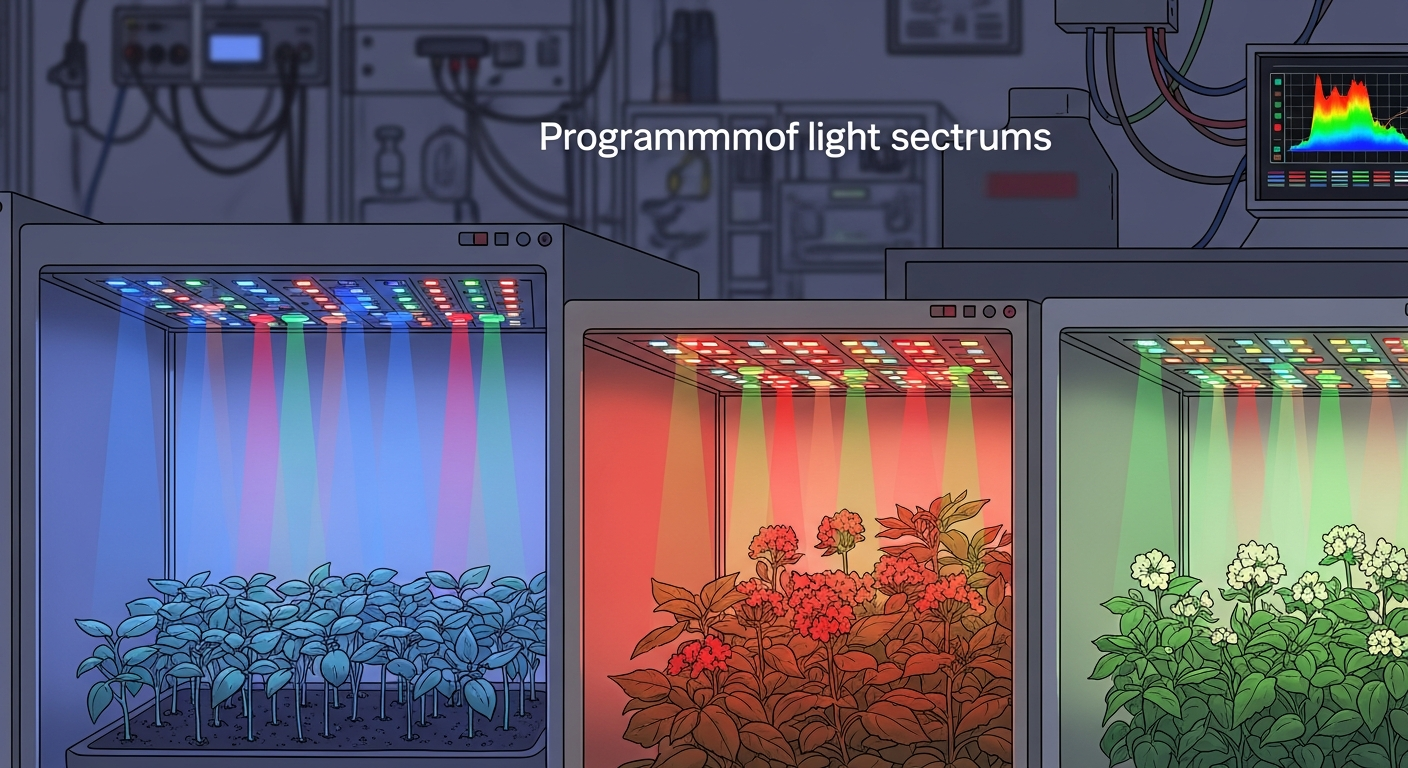
The advent of advanced LED grow lights has been a game-changer for horticulture lighting. Unlike their predecessors, LEDs offer unprecedented control over individual wavelength outputs, allowing growers to create dynamic, custom programmable spectrums. This precision control is what enables the creation and application of specific light recipes, moving cultivation from a broad-stroke approach to a finely tuned scientific art.
The Spectrum Palette: Wavelengths and Their Specialized Roles
Imagine light as a palette of colors, each with a unique impact on plant physiology. By understanding these individual impacts, cultivators can strategically combine wavelengths to achieve desired outcomes for plant growth and development.
Blue Light (400-500nm)
- Impact: Promotes compact, stocky growth, preventing stretching. Essential for strong root development and robust vegetative growth. Crucial for stomatal opening, enhancing gas exchange.
- Secondary Metabolites: Can increase the production of flavonoids, anthocyanins, and terpenes, contributing to color, aroma, and potency.
- Application: Highly beneficial during the seedling stage, propagation, and early vegetative growth to build a strong foundation.
Red Light (600-700nm)
- Impact: The most efficient wavelength for photosynthesis. Drives stem elongation, leaf expansion, and overall biomass accumulation. Critical for initiating and enhancing the flowering stage and fruiting stage.
- Application: Dominant in flowering light recipes, often combined with blue light to balance growth and prevent excessive stretching.
Green Light (500-600nm)
- Impact: Often underestimated, green light penetrates deeper into the plant canopy than red or blue light. It contributes to photosynthesis in lower leaves, helping to reduce overall canopy shading effects. While less efficiently absorbed by chlorophyll, its penetration can be beneficial for dense canopies.
- Application: A moderate amount of green light in the spectrum can improve overall plant health and productivity, especially in dense setups like vertical farming. It also makes plant inspection easier for human eyes.
Far-Red Light (700-800nm)
- Impact: Not directly photosynthetic, but crucial for photomorphogenesis. Triggers the “shade avoidance response,” leading to stem elongation and larger leaves. In conjunction with red light, it exhibits the Emerson enhancement effect, boosting overall photosynthetic efficiency. It can also accelerate flowering in certain species.
- Application: Used strategically to influence plant architecture, enhance biomass, and potentially speed up the flowering transition.
Ultraviolet (UV-A and UV-B) Light
- Impact: While too much UV can be damaging, controlled exposure to UV-A (315-400nm) and UV-B (280-315nm) can induce a beneficial stress response. This often leads to increased production of protective compounds like phenolic compounds, terpenes, and anthocyanins, enhancing flavor, aroma, color, and resilience.
- Application: Often incorporated in small, controlled doses during the late vegetative or flowering stages, particularly for crops where secondary metabolite enhancement is a priority.
Understanding these roles allows for precise spectrum control, turning generic grow lighting into a sophisticated tool for plant optimization.
Dynamic Light Recipes for Every Growth Stage
The true power of programmable spectrums lies in their dynamism. A plant’s light needs change dramatically throughout its life. A static spectrum, no matter how balanced, cannot optimize every phase. This is where tailored light recipes come into play, dynamically adjusting the spectral output to match specific growth stages.
1. Propagation & Seedling Stage: The Foundation Recipe
During germination and early seedling development, the goal is to establish a strong root system and compact, sturdy initial growth.
- Recipe: Moderate to higher blue light content (e.g., 30-40% blue, 60-70% red) with relatively lower intensity (PPFD – Photosynthetic Photon Flux Density).
- Why: Blue light promotes compact growth and prevents stretching (etiolation), which is common under red-dominant or insufficient light. It encourages strong taproot and fibrous root development.
- Practical Tip: Start with lower light intensities and gradually increase as seedlings establish true leaves. Monitor for stretching; if plants are tall and thin, increase blue light or light intensity.
2. Vegetative Growth: Building Biomass
Once seedlings are established, the focus shifts to maximizing green biomass, branching, and overall plant structure.
- Recipe: A balanced spectrum with a strong emphasis on blue light, but ample red light for vigorous photosynthesis. Many recipes utilize a blue-to-red ratio around 20-30% blue and 70-80% red, possibly with some green and minimal far-red. Higher PPFD values are common here.
- Why: Blue light continues to promote lateral branching and compact internodes, creating a bushier plant. Red light fuels rapid leaf and stem expansion.
- Practical Tip: Ensure adequate Daily Light Integral (DLI) to support rapid growth. Periodically scout for pests and nutrient deficiencies, as robust growth can mask underlying issues.
3. Flowering & Fruiting Stage: Yield and Quality Maximization
This is where the plant dedicates its energy to reproductive structures, and light recipes can dramatically impact yield, size, and secondary metabolite profiles.
- Recipe: A shift towards a higher red-to-blue ratio (e.g., 80-90% red, 10-20% blue), often incorporating far-red light and strategic UV exposure. PPFD is typically at its highest.
- Why: Red light is paramount for flower and fruit development, biomass accumulation, and overall yield. Far-red can accelerate flowering and enhance the “Emerson effect” for photosynthetic efficiency. Targeted UV can boost desired compounds.
- Practical Tip: Introduce far-red in the last 15-30 minutes of the light cycle to promote a “lights off” signal and potentially accelerate flowering. If using UV, start with very short durations (e.g., 1-2 hours/day) and observe plant response closely.
4. Finishing/Pre-Harvest (Optional): Enhancing Specific Attributes
For some crops, a final light adjustment can fine-tune specific qualities.
- Recipe: Maintain high red, but potentially increase UV-A or specific blue peaks for a short period (e.g., last 1-2 weeks).
- Why: To enhance specific attributes like color (e.g., anthocyanins), aroma (terpenes), or potency (cannabinoids).
- Practical Tip: This stage requires careful observation and experimentation, as not all plants respond identically, and too much stress can be detrimental.
Implementing Programmable Light Systems in Modern Cultivation
The ability to deploy precise light recipes is no longer theoretical; it’s a practical reality made possible by technological advancements in LED grow lights and sophisticated control systems.
Advanced LED Technology
Modern horticultural LEDs feature multiple individual diode channels (e.g., deep red, far red, blue, green, UV) that can be controlled independently. This granular control allows growers to create custom spectral blends in real-time or according to predefined schedules.
Control Systems and Automation
The heart of a programmable spectrum system is its controller. These can range from simple dimmers to advanced software platforms that manage entire grow operations.
- Scheduling: Automate light cycles, including sunrise/sunset simulations.
- Dynamic Spectrum Shifts: Program gradual changes in spectral ratios throughout the day or across growth stages.
- DLI Management: Integrate with light sensors to ensure plants receive a consistent Daily Light Integral, adjusting intensity based on external light or other factors.
- Integration: Link with environmental controls (temperature, humidity, CO2) for a truly holistic controlled environment agriculture (CEA) system, common in hydroponics and aeroponics.
Data-Driven Optimization
The beauty of programmable systems is the ability to collect data. Monitoring plant response to different light recipes—in terms of biomass, yield, height, color, and biochemical analysis—allows growers to continually refine and optimize their strategies. This iterative process is key to achieving consistent, high-quality results and improving yield optimization.
Practical Tip: When investing in programmable LED lights, prioritize fixtures with intuitive control software and robust customer support. Start with proven light recipes provided by manufacturers or research institutions, then gradually experiment with small adjustments, meticulously documenting your results. Understanding your plants’ specific responses to light is an ongoing learning process.
The Future of Cultivation: Benefits and Beyond
The science of light recipes and programmable spectrums is fundamentally reshaping the landscape of modern agriculture, particularly in controlled environment agriculture (CEA) and vertical farming. The benefits extend far beyond simply growing plants.
- Increased Yields: By providing precisely what a plant needs when it needs it, growers can maximize photosynthetic efficiency and push genetic potential, leading to significantly higher biomass and harvestable yields.
- Enhanced Crop Quality: Beyond mere quantity, spectrum control allows for the targeted enhancement of desired traits such as flavor, aroma, nutritional value, color, and medicinal compound concentrations (e.g., terpenes, flavonoids, anthocyanins, phenolic compounds).
- Resource Efficiency: Optimized light use, combined with the inherent efficiency of LEDs, leads to lower energy consumption. Furthermore, tailored light can reduce grow cycles, conserve water, and minimize the need for pesticides by promoting healthier, more resilient plants.
- Consistency and Predictability: In a controlled environment, light recipes provide a repeatable, consistent growing parameter, leading to more predictable harvest schedules and product quality, regardless of external climate conditions.
- Species-Specific Optimization: Different plant species, and even different cultivars within a species, have unique light requirements. Programmable spectrums allow for the development of highly specific recipes for each crop, from leafy greens and herbs to fruiting plants and specialized medicinal crops.
The ongoing research in plant science continues to uncover new nuances in plant-light interactions, promising even more sophisticated and precise light recipes in the future. As LED technology becomes more affordable and advanced, the ability to control and manipulate light will become an indispensable tool for every serious grower, transforming cultivation into a finely tuned, scientific endeavor.
In conclusion, the era of “dumb” grow lights is over. By embracing the science of light recipes and implementing programmable spectrums, growers are no longer just illuminating plants; they are communicating with them in their own language of light. This precision approach not only leads to superior yields and enhanced quality but also drives greater efficiency and sustainability, lighting the way for a brighter, more productive future in agriculture.