
In the dynamic world of indoor horticulture, mastering your environment is paramount to achieving robust growth and bountiful harvests. Among the many variables growers meticulously control, lighting stands as a cornerstone. Modern LED grow light systems offer unprecedented control over light intensity, spectrum, and duration, but the method by which you dim your lights can have a subtle yet significant impact on plant health, energy efficiency, and even the longevity of your equipment. Two primary protocols dominate the dimming landscape: Pulse Width Modulation (PWM) and Analog dimming. Understanding the nuances of each is crucial for any grower looking to optimize their setup. This article delves deep into these two methods, comparing their mechanisms, advantages, disadvantages, and practical implications for your grow operation.
Understanding Grow Light Dimming: Why It Matters
Before dissecting the specific dimming protocols, let’s establish why precise light intensity control is so vital for modern grow light systems. Dimming your grow lights isn’t just about saving electricity; it’s a sophisticated tool for optimizing plant growth across different developmental stages:
- Energy Efficiency: Reducing light intensity when not needed directly lowers energy consumption, leading to significant savings on electricity bills.
- Customized Growth Stages: Young seedlings and clones require lower light intensities (lower PPFD – Photosynthetic Photon Flux Density) to prevent stress and photobleaching, while vegetative growth and flowering stages demand much higher levels for optimal photosynthesis and yield. Dimming allows you to fine-tune PPFD output according to your plants’ specific needs.
- Stress Reduction: Abrupt changes in light intensity or excessively high levels can stress plants, leading to slowed growth, leaf burn, or other issues. Gradual dimming or setting appropriate light levels minimizes stress.
- Heat Management: Lower light output naturally reduces the heat generated by the fixtures, contributing to a more stable grow room temperature and potentially reducing the load on your HVAC system.
- Photoperiod Control: While not direct dimming, the ability to smoothly ramp up and down light intensity can mimic natural sunrise/sunset, which some growers believe reduces plant shock and improves overall vigor.
Effective light intensity control is a cornerstone of advanced horticultural practices, allowing growers to maximize optimal plant growth and achieve superior results. Knowing which dimming method is at play in your LED grow lights can significantly influence your strategic decisions.
PWM Dimming: How It Works and Its Implications
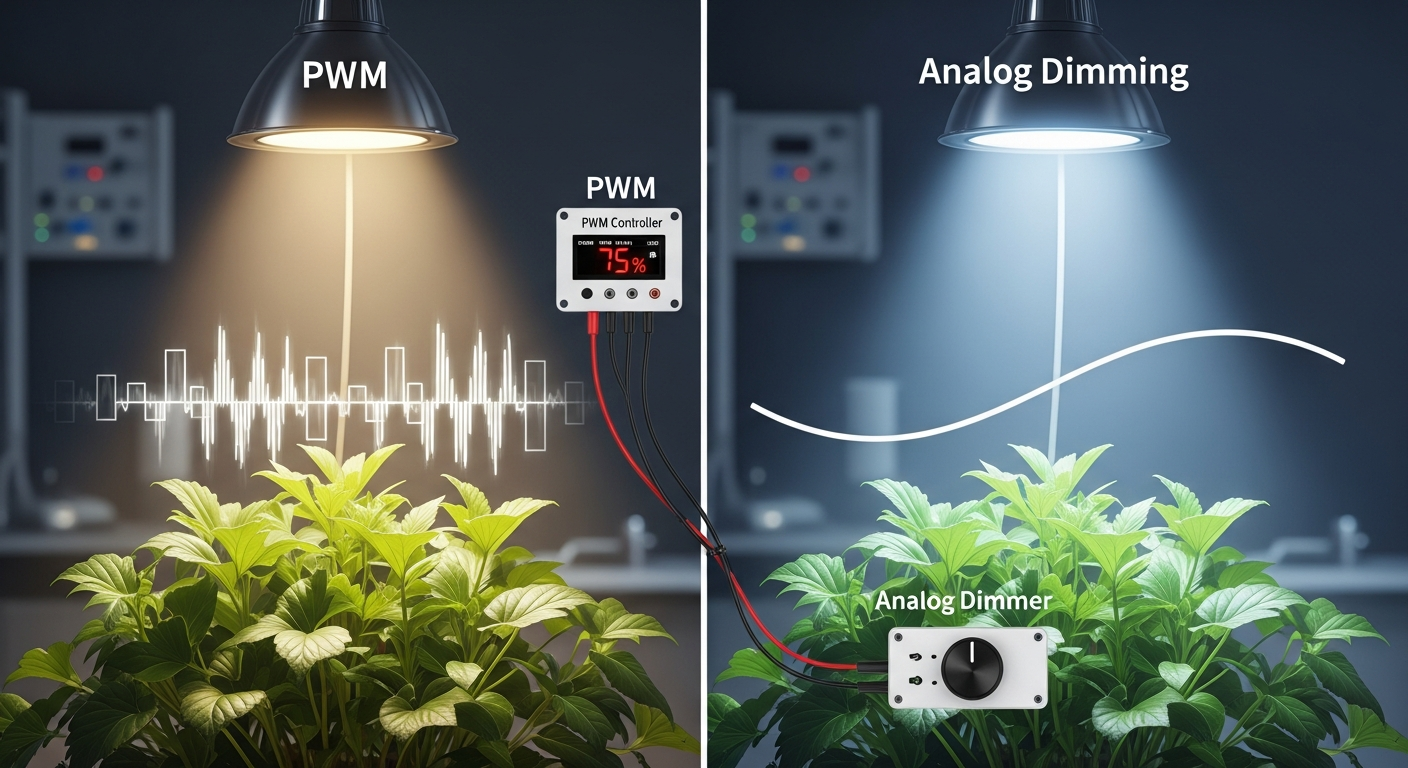
Pulse Width Modulation (PWM) is a widely adopted digital dimming technique, especially prevalent in modern LED drivers. Instead of continuously varying the voltage or current, PWM achieves dimming by rapidly switching the LED power supply on and off at a very high frequency.
The Mechanism of PWM Dimming
Imagine a light switch being flicked on and off thousands of times per second. With PWM, the “on” time (known as the duty cycle) is varied while the frequency remains constant. For example, to achieve 50% brightness, the LED might be on for 50% of the cycle and off for the remaining 50%. For 25% brightness, it’s on for 25% and off for 75%. Because these cycles occur at frequencies typically well above 200 Hz (often in the kilohertz range), the human eye perceives a continuous, dimmer light, rather than a flickering one.
Advantages of PWM Dimming for Grow Lights
- Excellent Color Stability: One of the most significant advantages of PWM dimming is that it maintains the LEDs’ color temperature and spectral quality across the entire dimming range. Since the LEDs are always operating at their full current when “on,” their inherent color properties remain consistent. This is vital for plants, as a stable spectrum ensures consistent photosynthetic efficiency.
- High Efficiency at Low Dimming Levels: Because the LEDs are either fully on or fully off, energy losses associated with current reduction (as seen in some analog methods) are minimized. This can lead to better overall energy efficiency, especially when dimming to very low levels.
- Precise Digital Control: PWM signals are inherently digital, making them easy to integrate with advanced grow light controllers, timers, and environmental management systems. This allows for highly accurate and repeatable light level settings.
- Wide Dimming Range: High-quality PWM drivers can dim LEDs down to very low percentages (e.g., 1% or even 0.1%) without significant performance degradation.
Disadvantages of PWM Dimming
- Potential for Flicker: While high-frequency PWM is imperceptible to the human eye, some individuals may still be sensitive to it, or it can be visible when filming plants with cameras (causing banding effects). This is less common with modern high-frequency drivers but remains a theoretical concern.
- Electromagnetic Interference (EMI): The rapid switching involved in PWM can generate electromagnetic interference. While good driver design incorporates shielding and filtering to mitigate this, poorly designed or inexpensive PWM drivers could potentially interfere with other electronic equipment in your grow room.
- Audible Hum: In rare cases, especially with lower quality components or at specific dimming levels, the rapid switching can cause inductors or capacitors in the driver to vibrate, leading to an audible hum.
For growers prioritizing spectral quality and precise LED driver control, PWM dimming often presents a robust solution.
Analog Dimming: The Alternative Approach
Analog dimming, particularly the 0-10V standard, is another common method for controlling horticultural LED lighting. Unlike PWM’s on/off switching, analog dimming works by directly varying the continuous power supplied to the LEDs.
The Mechanism of Analog Dimming
The most common analog dimming protocol for commercial grow lights is 0-10V dimming. In this system, a low-voltage DC signal (between 0 and 10 volts) is sent from a controller to the LED driver. A 10V signal typically corresponds to 100% light output, while a 0V signal corresponds to 0% (or the lowest dimmable percentage, usually 1-10%). The driver responds to this varying voltage by adjusting the current flowing through the LEDs. Other analog methods might use 0-5V or resistive dimming, where a potentiometer varies resistance to control current, but 0-10V is the industry standard for grow lights.
Advantages of Analog Dimming
- Smooth Dimming Transitions: Analog dimming offers a very smooth and continuous change in light intensity, which can be visually pleasing and perceived as more natural. There’s no inherent “flicker” associated with this method.
- No Flicker: Since the LEDs are always continuously powered (just at a lower current), there’s no rapid on/off cycling, eliminating any potential for flicker. This can be beneficial for those sensitive to flicker or when using cameras for monitoring.
- Less EMI: Without the high-frequency switching of PWM, analog dimming typically generates less electromagnetic interference, making it a “quieter” electrical environment.
- Simpler Circuitry: In some implementations, the control circuitry for analog dimming can be simpler, potentially leading to more robust or cost-effective drivers (though this varies significantly).
Disadvantages of Analog Dimming
- Potential for Color Shift (Spectral Shift): This is arguably the biggest drawback for plant growth. When LEDs are driven at lower currents, their internal operating temperature decreases, which can cause a slight shift in their dominant wavelength. For instance, a “white” LED might appear slightly “cooler” or “warmer” at very low dimming levels compared to full power. While often subtle, consistent spectral shift could theoretically impact specific photomorphogenic responses or photosynthetic efficiency over time.
- Reduced Efficiency at Low Dimming Levels: Reducing current through the LEDs can lead to increased power dissipation within the driver itself, resulting in slightly lower efficiency when dimmed to very low levels compared to a well-implemented PWM system.
- Limited Dimming Range: Some analog dimming systems may struggle to dim reliably below a certain percentage (e.g., 10%) or may not achieve a true “off” state, requiring a separate switch.
- Non-Linearity: A 5V signal (half of 10V) doesn’t always translate to exactly 50% light output. The relationship between the control voltage and actual light output (PPFD) can be non-linear, requiring calibration or a driver with built-in linearization.
0-10V dimming is a reliable and straightforward method for smooth dimming, but growers should be aware of its potential impact on LED color stability.
PWM vs. Analog: A Direct Comparison & Practical Considerations
When comparing PWM vs. Analog dimming, there’s no universally “better” option; the ideal choice depends on your specific priorities and the quality of the components. Here’s a direct comparison and some practical tips for growers:
Key Differences Summarized
| Feature | PWM Dimming | Analog Dimming (e.g., 0-10V) |
|---|---|---|
| Mechanism | Rapid on/off cycling (duty cycle control) | Continuous current/voltage reduction |
| Flicker | Potential (perceptible to sensitive eyes/cameras at lower frequencies) | None |
| Spectral Stability | Excellent (consistent color temperature) | Potential for slight spectral shift at low levels |
| Efficiency at Low Dimming | Generally very good | Can be slightly lower (heat dissipation in driver) |
| EMI Generation | Higher potential (requires good design/shielding) | Lower potential |
| Control Precision | Very high, especially at low levels | Can be less precise at very low levels, potential for non-linearity |
| Integration with Controllers | Digital, often preferred for advanced systems | Analog signal, widely supported |
Practical Advice for Growers
- Check Your Driver Specifications: The most crucial step is to understand what dimming protocol your grow light drivers support. Many high-quality drivers today are “hybrid,” meaning they use 0-10V as the control signal but internally convert it to PWM to drive the LEDs, combining the benefits of both. Always consult the manufacturer’s data sheet.
- Consider Your Dimming Range Needs: If you frequently need to dim your lights down to very low percentages (e.g., below 10-20%) for delicate seedlings or specific photoperiodic transitions, PWM might offer more stable and consistent performance in that lower range, maintaining grow light color consistency.
- Sensitivity to Flicker: If you or anyone working in your grow room is particularly sensitive to flicker, or if you plan to frequently film your plants under artificial light, pure analog dimming (without internal PWM conversion) would be preferable to avoid any potential issues.
- Integration with Automation: Both protocols integrate well with modern grow room automation systems. Digital controllers often output 0-10V for compatibility with a wide range of devices, but the LED driver then dictates the internal dimming method.
- Quality Matters: The performance disparities between PWM and analog dimming are significantly narrowed by high-quality LED drivers. A premium analog driver will have better efficiency at low levels and minimal spectral shift, just as a high-quality PWM driver will have imperceptible flicker and low EMI. Invest in reputable brands.
- Focus on Plant Response: Ultimately, the plants are the best judges. Monitor their health, growth rates, and any signs of stress when adjusting light levels. Experimentation within safe parameters is key to discovering what works best for your specific crops and setup.
Understanding these aspects is vital for grow room optimization and ensuring your LED grow light performance meets the demands of your plants.
Conclusion
Both PWM and analog dimming protocols offer effective ways to control the intensity of your grow light systems, each with its unique strengths and weaknesses. PWM excels in maintaining spectral stability and efficiency at low dimming levels, making it a favorite for applications where consistent light quality is paramount. Analog dimming, particularly 0-10V, provides smooth, flicker-free operation and simpler electrical characteristics, though it may introduce subtle spectral shifts at very low outputs. Modern advancements often see a convergence of these technologies, with many high-end LED drivers utilizing analog control signals to internally manage PWM dimming.
For the discerning grower, the most important takeaway is to understand the capabilities of your specific horticultural lighting drivers. Don’t assume; check the specifications. By making an informed decision based on your grow environment, plant species, and personal preferences, you can leverage the power of precise light control to cultivate healthier plants and achieve outstanding yields, all while managing your energy consumption efficiently. The future of advanced grow light control lies in understanding these fundamental principles.