
In an era where operational efficiency and environmental responsibility are paramount, businesses across sectors are scrutinizing every aspect of their energy consumption. For decades, High-Intensity Discharge (HID) lighting systems have illuminated everything from sprawling warehouses and bustling gymnasiums to expansive outdoor areas and industrial facilities. While once the go-to solution for powerful illumination, the landscape of lighting technology has dramatically evolved. Today, Light Emitting Diodes (LEDs) stand out as a superior alternative, promising not just brighter spaces but also substantial long-term savings. The pivotal question for facility managers and business owners contemplating an upgrade isn’t just about the initial cost, but rather the comprehensive Energy Return on Investment (ROI) derived from transitioning from traditional HID systems to modern LED solutions. Understanding this ROI is key to making an informed decision that impacts your bottom line, operational efficiency, and environmental footprint for years to come.
Understanding the Energy Drain of HID Systems
To truly appreciate the value of an LED upgrade, it’s essential to first grasp the inherent inefficiencies and operational drawbacks of the HID systems they replace. HID lamps, encompassing types like Metal Halide (MH), High-Pressure Sodium (HPS), and Mercury Vapor (MV), operate by passing an electric arc through a mixture of gas and metal salts. This process generates an impressive amount of light from a single source, making them suitable for large-area illumination.
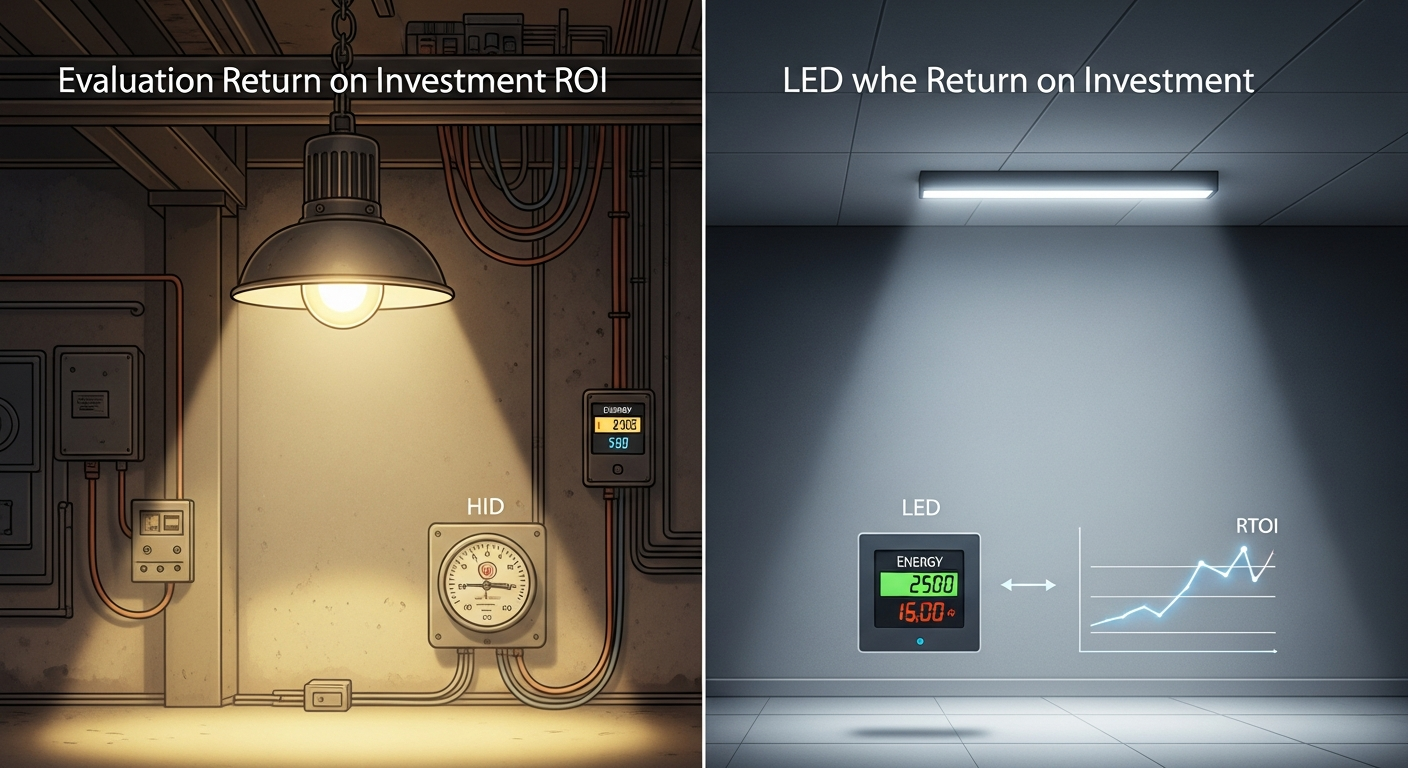
The Energy Consumption Predicament
While powerful, HID lamps are notorious energy hogs. A significant portion of the electricity consumed by an HID lamp is converted into heat rather than light, leading to considerable energy waste. For instance, a typical 400-watt Metal Halide lamp might consume closer to 450-480 watts when factoring in ballast losses – the often-overlooked component that regulates current to the lamp. These ballast losses can account for 10-20% of the total system wattage, translating directly into higher electricity bills. Multiply this by hundreds or even thousands of fixtures operating for thousands of hours annually, and the cumulative energy drain becomes staggering.
Furthermore, HID lamps often suffer from poor lumen maintenance. This means that as they age, their light output diminishes significantly, sometimes dropping to 50% or even less of their initial brightness long before they completely fail. To compensate for this reduced illumination, facilities often over-light their spaces initially or are forced to replace lamps prematurely, both of which drive up energy consumption and operational costs.
Operational Headaches and Hidden Costs
- Short Lifespan: Compared to modern LEDs, HID lamps have a relatively short operational life, typically ranging from 10,000 to 20,000 hours. This necessitates frequent lamp replacements.
- Slow Start-Up Times: HID lamps require a warm-up period, often several minutes, to reach full brightness. This isn’t just inconvenient; it can be a safety concern in areas requiring immediate illumination and hinders the integration of dynamic lighting controls.
- Degraded Light Quality: Over time, the color temperature of HID lamps can drift, leading to inconsistent and often unappealing light quality. Metal Halide lamps, for example, can experience significant color shift towards the green or pink spectrum as they age.
- High Maintenance Burden: The combination of shorter lifespans, ballast failures, and the need for specialized equipment (like lifts or scaffolding for high-ceiling installations) makes HID systems incredibly maintenance-intensive. Each lamp or ballast replacement involves labor costs, equipment rental, and the administrative overhead of managing inventory and scheduling.
- Hazardous Waste: Many HID lamps contain mercury, a toxic heavy metal, requiring special disposal procedures and incurring additional costs to comply with environmental regulations.
These factors – high energy consumption, frequent maintenance, and diminishing performance – represent a continuous drain on operational budgets, making HID systems an increasingly unsustainable choice in today’s energy-conscious world. Understanding these inherent weaknesses lays the groundwork for appreciating the transformative potential of LED technology.
The LED Advantage: A Deep Dive into Energy Efficiency
The transition from HID to LED isn’t just an upgrade; it’s a leap into a fundamentally more efficient and effective lighting paradigm. LEDs leverage semiconductor technology to convert electricity directly into light, a process that is inherently more efficient than the gas discharge mechanism of HIDs. This fundamental difference underpins the comprehensive advantages LEDs offer.
Unparalleled Energy Efficiency
LEDs are significantly more efficacious than HID lamps, meaning they produce more lumens per watt (lm/W). Where a 400W Metal Halide fixture with ballast might produce around 30,000 lumens, a comparable LED fixture can deliver the same light output while consuming as little as 120-150 watts. This drastic reduction in wattage consumption translates directly into substantial energy bill savings. The efficiency gains are driven by several factors:
- Minimal Heat Generation: Unlike HIDs, LEDs emit very little heat in the form of infrared radiation, meaning most of the energy is converted directly into visible light. This also contributes to lower cooling loads in air-conditioned indoor spaces, generating a secondary layer of energy savings.
- Directional Light: LEDs typically emit light directionally, reducing the need for reflectors and diffusers that can absorb significant light output in HID fixtures. This ensures that more light reaches the intended target area, maximizing effective illumination.
- Instant On/Off: LEDs illuminate instantly at full brightness, eliminating the warm-up delays of HID lamps. This capability is crucial for safety and enables seamless integration with advanced control systems.
Extended Lifespan and Drastically Reduced Maintenance
One of the most compelling arguments for LED conversion is their extraordinary lifespan. High-quality LED fixtures are rated to last anywhere from 50,000 to 100,000 hours, or even more. To put this into perspective, a fixture operating 12 hours a day, 7 days a week, would last 11 to 22 years. This is 5 to 10 times longer than the typical lifespan of an HID lamp.
The implications for maintenance are profound:
- Fewer Replacements: Drastically reduces the frequency of lamp and ballast replacements.
- Lower Labor Costs: Less time spent by maintenance staff or external contractors replacing failed lamps. For high-bay applications, this means fewer expensive lift rentals.
- Reduced Inventory: Eliminates the need to stock a wide array of replacement lamps and ballasts.
- Predictable Performance: LEDs experience significantly less lumen depreciation over their lifespan, maintaining consistent light output and quality for far longer.
Enhanced Light Quality and Control Capabilities
Beyond efficiency and longevity, LEDs offer superior light quality and unprecedented control:
- Superior Color Rendering (CRI): LEDs come in a wide range of Color Rendering Index (CRI) values, with many fixtures boasting CRIs of 80+ or even 90+, accurately revealing the true colors of objects. HID lamps often have lower CRIs, making colors appear dull or distorted.
- Consistent Color Temperature: LEDs maintain a stable color temperature throughout their operational life, ensuring uniform and aesthetically pleasing illumination across a facility.
- Dimmability and Smart Controls: LEDs are inherently dimmable and integrate seamlessly with advanced lighting control systems, including occupancy sensors, daylight harvesting, and networked smart lighting solutions. This allows facilities to fine-tune lighting levels based on need, saving even more energy and optimizing comfort. Imagine turning off lights automatically when a room is empty or dimming them when natural light is abundant – this level of control is challenging and costly with HID, but standard with LED.
The combination of these advantages makes LED lighting not just an energy-saving technology, but a comprehensive solution that enhances operational efficiency, improves safety, and contributes significantly to a facility’s overall modernization and sustainability goals.
Calculating Your Energy ROI: The Financial Perspective
The decision to switch from HID to LED is ultimately a financial one, requiring a clear understanding of the Energy Return on Investment (ROI). This isn’t just about saving money on your electricity bill; it encompasses a broader range of financial benefits and cost reductions. Here’s how to calculate it:
1. Determine Your Baseline Costs (HID)
Before you can calculate savings, you need a clear picture of your current expenditures:
- Annual Energy Costs:
- Identify the wattage of each HID fixture (lamp + ballast).
- Estimate annual operating hours (e.g., 4,000 hours for a typical office, 8,760 hours for 24/7 operation).
- Calculate total annual kWh: (Total Fixture Wattage / 1000) * Annual Operating Hours.
- Multiply by your average electricity rate ($/kWh).
- Annual Maintenance Costs:
- Lamp/Ballast Replacement Frequency: How often are lamps and ballasts replaced? (e.g., every 1-3 years for lamps, 5-7 years for ballasts).
- Cost per Replacement: Cost of new lamp/ballast + labor cost for replacement (including lift rental if applicable) + disposal costs.
- Calculate total annual maintenance cost.
2. Estimate Your Investment Costs (LED)
This includes all upfront expenses for the LED conversion:
- LED Fixture/Retrofit Kit Costs: The price of the new LED luminaires or retrofit kits.
- Installation Costs: Labor for removing old fixtures and installing new ones. This can vary significantly based on fixture type and accessibility.
- Disposal Costs: Proper disposal of old HID lamps and ballasts (which may contain hazardous materials like mercury or PCBs).
- Contingency: Always factor in a small percentage for unforeseen circumstances.
3. Project Your Savings (LED)
This is where the ROI starts to become clear:
- Annual Energy Savings:
- Determine the wattage of the new LED fixtures.
- Calculate new annual kWh consumption.
- Subtract new annual kWh from old annual kWh to get kWh saved.
- Multiply kWh saved by your electricity rate.
- Annual Maintenance Savings:
- With LEDs lasting 50,000+ hours, annual replacement costs are drastically reduced, often to near zero for many years.
- Calculate the difference between your old annual maintenance cost and the projected LED maintenance cost (which might only involve occasional cleaning or repair over a decade).
- Additional Savings:
- Reduced HVAC Load: If you are in a climate-controlled environment, the reduced heat output from LEDs can lower cooling costs.
- Rebates and Incentives: Crucially, many utility companies and government programs offer significant rebates, grants, or tax incentives for energy-efficient lighting upgrades. These can dramatically offset the initial investment, sometimes covering 20-50% or more of the project cost. Research local, state, and federal programs thoroughly.
Total Annual Savings = (Energy Savings + Maintenance Savings + HVAC Savings + Annualized Rebates/Incentives)
4. Calculate Key ROI Metrics
- Simple Payback Period: This is the most straightforward calculation.
Simple Payback Period (Years) = Total Initial Investment / Total Annual SavingsA typical HID to LED conversion often sees a payback period of 1 to 3 years, especially with robust rebates.
- Return on Investment (ROI): For a longer-term view, you can calculate the total ROI over the lifespan of the LED system.
ROI (%) = ((Total Savings over LED Lifespan - Initial Investment) / Initial Investment) * 100Considering LEDs can last 10-20 years, the cumulative savings can be immense, leading to ROI percentages in the hundreds or even thousands.
Practical Tips for Accurate ROI Calculation:
- Conduct a Professional Lighting Audit: An expert can accurately assess current consumption, recommend optimal LED replacements, and calculate precise savings.
- Factor in Disposal Costs: Don’t overlook the expense of properly disposing of old HID lamps and ballasts.
- Research All Available Incentives: Rebates can significantly shorten the payback period and boost ROI.
- Consider Lifecycle Costs (TCO): Look beyond the initial purchase price to the total cost of ownership over the product’s entire lifespan. LEDs shine brightly here.
By meticulously calculating these factors, businesses can build a compelling financial case for transitioning from HID to LED, demonstrating a clear and substantial return on investment that goes directly to the bottom line.
Beyond Energy Savings: Broader Benefits of LED Conversion
While the financial impetus for transitioning from HID to LED is undeniable, the benefits extend far beyond the immediate reduction in utility bills and maintenance expenses. These broader advantages contribute significantly to a business’s operational excellence, sustainability goals, and overall environment.
Enhanced Safety and Productivity
- Improved Visibility and Light Quality: LEDs offer superior light quality with high Color Rendering Index (CRI) values, meaning colors appear truer and more vibrant. This improved visual acuity is critical in industrial settings, warehouses, and manufacturing plants, where it can reduce errors, prevent accidents, and enhance the overall work environment. Better light helps employees see tasks more clearly, leading to increased productivity and fewer strains.
- Instant On/Off and Reliability: Unlike HIDs, LEDs provide instant illumination without warm-up times. This is vital for safety in emergencies, power outages, or in areas requiring immediate light. The reliability and consistent light output of LEDs reduce dark spots and flickering, which can be distracting and contribute to eye strain.
Sustainability and Environmental Impact
The switch to LED is a powerful statement of environmental responsibility:
- Reduced Carbon Footprint: By consuming significantly less electricity, LEDs directly reduce the demand for fossil fuel-generated power, leading to a substantial decrease in greenhouse gas emissions. This contributes to a smaller carbon footprint for your organization.
- No Hazardous Materials: Most LED lamps and fixtures do not contain mercury, lead, or other hazardous materials commonly found in HID lamps and ballasts. This simplifies disposal and reduces the environmental risk associated with lighting waste.
- Less Waste: The extended lifespan of LEDs means fewer lamps and fixtures end up in landfills, further minimizing waste generation.
Integration with Smart Building Technologies
LEDs are the cornerstone of modern smart lighting and smart building ecosystems:
- Advanced Control Capabilities: LEDs are inherently compatible with advanced lighting control systems, including occupancy sensors, daylight harvesting, dimming, and scheduling. These controls allow for dynamic adjustment of light levels based on real-time conditions, maximizing energy savings and providing optimal illumination.
- Internet of Things (IoT) Integration: Many advanced LED systems can be integrated into broader IoT platforms. This allows lighting to become a data-gathering network, monitoring everything from temperature and occupancy to asset tracking, providing invaluable insights for facility management and operational optimization.
- Flexibility and Adaptability: The ability to control individual fixtures or zones allows for unprecedented flexibility in lighting design and adaptation to changing facility needs, creating multi-functional spaces.
Employee Well-being and Aesthetic Appeal
- Improved Occupant Comfort: High-quality, flicker-free LED lighting with appropriate color temperatures can significantly improve occupant comfort, reduce eye strain, and even positively impact mood and alertness. This is particularly important in offices, educational institutions, and healthcare settings.
- Enhanced Aesthetics and Brand Image: Modern LED fixtures offer sleek designs and precise light distribution, enhancing the aesthetic appeal of both indoor and outdoor spaces. For retail environments or public-facing facilities, this can create a more inviting atmosphere, improve merchandise presentation, and bolster brand image.
- Future-Proofing Your Facility: Investing in LED technology is an investment in the future. As energy costs continue to rise and environmental regulations become stricter, facilities with outdated lighting systems will face increasing operational burdens. LEDs position your organization at the forefront of energy efficiency and technological advancement.
Considering these broader advantages alongside the compelling financial ROI paints a complete picture of why transitioning to LED lighting is not just a smart business decision, but a strategic imperative for any forward-thinking organization.
Making the Smart Switch: A Brighter Future Awaits
The journey from traditional High-Intensity Discharge (HID) lighting to modern Light Emitting Diode (LED) systems is more than just a technological upgrade; it represents a fundamental shift towards greater efficiency, sustainability, and operational intelligence. As we’ve explored, the energy drain and myriad hidden costs associated with HID systems — from excessive power consumption and frequent maintenance to inferior light quality and environmental concerns — present a compelling case for change.
Conversely, LED technology offers a robust solution, delivering not only dramatic energy savings through superior efficacy and directional light output but also significantly extended lifespans that translate into drastically reduced maintenance burdens. The financial calculations, encompassing the initial investment against substantial energy and maintenance savings, often reveal a surprisingly rapid payback period, frequently within 1-3 years, especially when factoring in the valuable utility rebates and government incentives available.
Beyond the impressive financial ROI, the transition to LED systems unlocks a host of broader benefits. These include enhanced safety and productivity through improved light quality and instant illumination, a significant reduction in your organization’s carbon footprint, and the invaluable capability to integrate with advanced smart building controls and IoT platforms. Furthermore, the enhanced aesthetics and improved occupant comfort that LED lighting provides contribute to a more positive and productive environment for employees and customers alike, ultimately bolstering your brand image and future-proofing your facility.
For any facility manager, business owner, or decision-maker grappling with rising energy costs and the imperative for sustainable operations, evaluating the energy ROI of an HID to LED transition is not just advisable, but essential. By conducting a thorough lighting audit, meticulously calculating potential savings, and actively seeking available incentives, you can build a clear and compelling case for this transformative upgrade. The smart switch to LED isn’t merely an expense; it’s a strategic investment in a brighter, more efficient, and sustainable future for your operations.