
In the rapidly evolving world of automation, where precision, speed, and reliability are paramount, understanding the intricate relationship between various system components is critical. Among these, two factors often sit at the heart of an automated system’s efficiency and responsiveness: sensor response time and automation latency. While seemingly similar, these concepts represent distinct yet interconnected stages in the journey from real-world event to system action. A robust automated process hinges on its ability to react swiftly and accurately to changing conditions, and any delay in this chain can have significant consequences, from minor inefficiencies to catastrophic failures. This article delves into the nuances of sensor response time, unpacks the broader concept of automation latency, explores their profound impact across diverse industries, and offers actionable strategies for optimizing these critical performance indicators to achieve superior automated system performance.
The Fundamentals of Sensor Response Time
At the very foundation of any automated system lies the sensor – the device responsible for perceiving and quantifying physical parameters from the environment. Whether it’s temperature, pressure, proximity, light, or chemical composition, a sensor’s ability to accurately and promptly report changes is crucial. This intrinsic characteristic is quantified by what we call sensor response time.
Defining Sensor Response Time
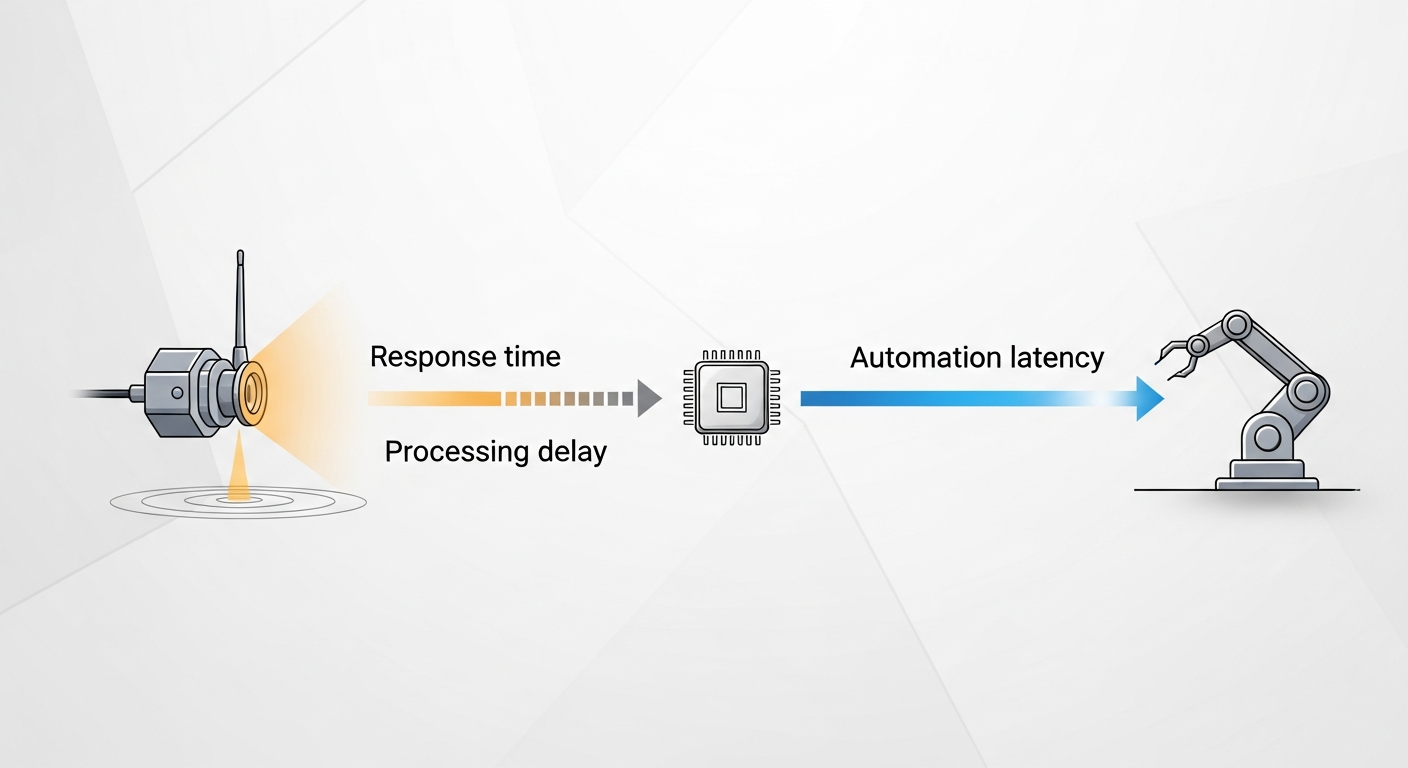
Sensor response time refers to the duration it takes for a sensor to detect a change in its input stimulus and produce a corresponding stable output. It’s not a single, monolithic value but rather a composite of several temporal characteristics, each shedding light on a different aspect of the sensor’s agility:
- Rise Time (Tr): This is typically defined as the time taken for the sensor’s output to rise from a specified low percentage (e.g., 10%) to a specified high percentage (e.g., 90%) of its final, steady-state value after a sudden step change in the input. A faster rise time indicates quicker initial detection.
- Fall Time (Tf): Conversely, fall time measures the duration for the output to drop from a high percentage to a low percentage of its final value following a step decrease in input.
- Delay Time (Td): This refers to the time lag between the exact moment the input stimulus changes and the moment the sensor’s output begins to respond perceptibly. It’s the initial “dead time” before any output change occurs.
- Settling Time (Ts): Perhaps one of the most practical metrics, settling time is the time required for the sensor’s output to reach and remain within a specified accuracy band (e.g., ±2% or ±5%) of its final steady-state value. This indicates when the measurement can be considered reliable for downstream processing.
Understanding these different facets of response time is vital, as a sensor might have a quick rise time but a long settling time, or vice-versa, depending on its internal design and sensing principle.
Factors Influencing Sensor Response Time
Numerous factors contribute to how quickly a sensor can react to its environment:
- Sensing Principle and Technology: Different sensor types inherently possess varying response characteristics. For instance, a thermocouple (thermal conduction) will generally have a slower response than a thermistor or an infrared temperature sensor (radiation). Photoelectric sensors typically respond faster than inductive proximity sensors.
- Physical Design and Materials: The mass, thermal conductivity, and mechanical design of a sensor can significantly affect its response. A larger, more robust temperature probe, for example, will take longer to heat up or cool down than a miniature one.
- Environmental Conditions: External factors like temperature, humidity, air flow, and pressure can influence a sensor’s internal dynamics, thereby affecting its response. A sensor designed for dry conditions might exhibit slower response in high humidity.
- Internal Signal Processing: Many modern sensors include integrated electronics for signal conditioning, amplification, and analog-to-digital conversion (ADC). These internal processes, while improving signal quality, introduce their own inherent delays. Filtering algorithms, for example, can smooth noise but at the cost of increased latency.
- Output Interface: The method by which a sensor communicates its data (e.g., analog voltage, current loop, digital bus like I2C, SPI, or Ethernet) can also introduce minor delays, although these are typically small compared to the physical sensing delay.
In essence, a sensor’s response time is a direct consequence of its physical interaction with the stimulus, its internal conversion mechanisms, and the complexity of its signal processing chain. Optimizing this initial link in the automation chain is paramount for overall system performance.
Decoding Automation Latency
While sensor response time is a critical component, it is just one piece of a much larger puzzle: automation latency. This broader concept encompasses the total time delay from the occurrence of an event in the physical world to the system’s final, desired action in response to that event. It’s the end-to-end journey of information and control, a journey where every millisecond counts in high-speed or safety-critical applications.
What is Automation Latency?
Automation latency, also known as system latency or end-to-end latency, is the cumulative delay encountered as a signal or command propagates through an automated system. Imagine a production line where a part needs to be detected and then gripped by a robot. The latency would be the total time from the part entering the sensor’s field of view until the robot’s gripper successfully closes around it. This total delay is a sum of multiple individual delays at various stages of the automation architecture.
Components of Total Automation Latency
To truly understand and optimize automation latency, it’s essential to break it down into its constituent parts:
- Sensor Response Time: As discussed, this is the initial delay from the physical event to the sensor generating a stable, corresponding electrical signal. It sets the baseline for all subsequent delays.
- Signal Transmission Latency: Once the sensor generates a signal, it needs to travel to a processing unit (e.g., a PLC, industrial PC, or edge device). This transmission can be via analog wiring, digital buses, or network cables. The length and type of cable, along with the communication protocol used (e.g., Ethernet/IP, PROFINET, EtherCAT, Modbus TCP), all contribute to this delay. Wireless communication introduces additional latency due to overheads and potential retransmissions.
- Data Acquisition and Processing Latency: The processing unit receives the raw sensor data. This stage involves:
- Analog-to-Digital Conversion (ADC): If the sensor outputs an analog signal, it must be converted into a digital format. The ADC’s sampling rate and conversion time add delay.
- Input/Output (I/O) Scan Time: PLCs and industrial controllers continuously scan their inputs, process logic, and update outputs. The duration of this scan cycle directly adds to latency.
- Application Logic Execution: The time taken for the controller’s CPU to execute the control algorithms, perform calculations, and make decisions based on the sensor data. More complex algorithms inherently require more processing time.
- Actuator Command Transmission Latency: After processing, the controller sends a command to an actuator (e.g., a motor, valve, or robot joint). This command also travels via a network or direct wiring, incurring further transmission delay.
- Actuator Response Latency: Finally, the actuator itself takes time to physically respond to the command. A motor needs time to accelerate to the desired speed, a valve to open, or a robot arm to move into position. This mechanical or hydraulic response time is a significant part of the overall latency.
The cumulative effect of these delays defines the overall automation latency. While some delays might be individually small, their sum can become substantial, especially in complex, distributed systems. The goal in system design is often to minimize this cumulative latency to achieve real-time responsiveness and control.
The Critical Role of Sensor Response Time Within Total Latency
It’s evident that sensor response time is not merely one component but often the initiating component of the entire latency chain. If a sensor is slow to respond, every subsequent process is delayed by that initial lag. Even if all other system components (network, CPU, actuator) are extremely fast, a slow sensor acts as a bottleneck, directly increasing the total automation latency. In essence, the speed limit of your entire automated reaction is often first set by how quickly your system can perceive a change in its environment. Therefore, understanding and optimizing sensor response time is a foundational step in building a low-latency, high-performance automated system.
Real-World Impacts: Where Latency Hurts (and Helps)
The implications of automation latency extend far beyond theoretical discussions, manifesting in tangible consequences across virtually every industry employing automated systems. From minor annoyances to critical safety hazards, latency dictates the very feasibility and efficacy of many modern applications.
Consequences of High Latency
High automation latency can lead to a multitude of problems, impacting efficiency, quality, safety, and ultimately, profitability:
- Reduced Precision and Accuracy: In applications requiring fine control, such as robotic welding or machining, even slight delays can cause the system to react based on outdated information, leading to inaccuracies, defects, and wasted material.
- Decreased Throughput and Productivity: In manufacturing or logistics, processes like pick-and-place or sorting rely on rapid, successive actions. High latency means longer cycle times for individual operations, consequently reducing the overall production rate and lowering throughput.
- Safety Risks: Perhaps the most critical impact, high latency in safety-critical systems can be disastrous. Imagine an emergency stop system on a conveyor belt; if the sensor detecting an obstruction is slow, or the signal takes too long to reach the motor, severe damage or injury could occur. In autonomous vehicles, delayed sensor input or decision-making could lead to collisions.
- System Instability and Oscillations: In feedback control loops, excessive latency can destabilize the system. The controller might overcompensate for a deviation that has already changed by the time the command reaches the actuator, leading to oscillations around the desired setpoint or even runaway behavior.
- Waste of Resources: Delayed responses in energy management systems (e.g., HVAC control) can result in unnecessary energy consumption. Similarly, in fluid control, late valve adjustments can lead to material waste.
- Poor User Experience: While more common in human-machine interaction, even industrial HMIs can feel sluggish if the underlying automation system has high latency, leading to operator frustration and decreased efficiency.
Scenarios Where Fast Response is Paramount
Certain applications intrinsically demand ultra-low latency, where every millisecond shaved off the total delay translates into significant performance gains or safety improvements:
- High-Speed Robotics: Collaborative robots (cobots) and industrial arms performing intricate tasks like assembly, dispensing, or welding require near-instantaneous feedback and action to maintain precision at high speeds.
- Autonomous Vehicles and Drones: LiDAR, radar, camera, and ultrasonic sensors feeding data to AI systems for navigation, obstacle avoidance, and emergency braking need to operate with minimal latency to ensure safety and reliable operation.
- Real-time Quality Control: Vision systems on production lines inspecting products at high speeds must detect defects and trigger rejection mechanisms almost instantly to prevent faulty products from progressing.
- Machine Tool Control: CNC machines demand extremely tight feedback loops between tool position sensors and motor actuators to achieve micron-level precision and complex geometries.
- Critical Infrastructure Monitoring: Systems monitoring conditions in power grids, nuclear facilities, or chemical plants require immediate response to anomalies to prevent large-scale incidents.
- High-Frequency Trading: While not strictly industrial automation, financial trading algorithms often leverage low-latency data feeds and execution platforms where microsecond differences can mean millions in profit or loss.
Scenarios Where High Latency is Tolerable (or Even Desirable)
Conversely, not all automated systems demand blistering speed. In some contexts, moderate or even relatively high latency is acceptable, and sometimes, purposefully introduced for stability or noise reduction:
- Environmental Monitoring: Systems monitoring long-term trends in temperature, humidity, or air quality in a building or agricultural field often don’t require instant updates. Hourly or even daily readings might suffice.
- Asset Tracking and Inventory Management: RFID or GPS-based tracking systems for assets or inventory typically operate with refresh rates that are seconds or minutes apart, as immediate updates are not critical for these functions.
- Building Management Systems (BMS): While some aspects of BMS (like fire alarms) are latency-critical, many functions such as lighting control, scheduled HVAC adjustments, or access control can tolerate noticeable delays without significant impact.
- Data Logging and Archiving: Systems primarily designed for collecting historical data for later analysis, rather than real-time control, are less sensitive to latency.
- Filtering for Stability: Sometimes, a small amount of intentional delay (through filtering or averaging) is introduced to smooth out noisy sensor readings, preventing the system from overreacting to transient fluctuations. In such cases, the trade-off between speed and stability is carefully managed.
The key takeaway is that understanding the specific requirements of an application is paramount. Over-specifying for ultra-low latency where it’s not needed can lead to unnecessary complexity and cost, while under-specifying can lead to significant operational failures.
Strategies for Minimizing Latency and Optimizing Systems
Achieving optimal automation performance requires a strategic approach to managing and minimizing latency at every possible juncture. This involves careful component selection, intelligent system design, and continuous optimization.
1. Sensor Selection and Placement
The journey to low latency begins at the source: the sensor itself.
- Match Sensor Response Time to Application Needs: Do not simply buy the fastest sensor available. Evaluate the required update rate and reaction time for your specific application. A temperature sensor for a furnace might need to respond in seconds, while a safety light curtain needs microsecond response. Over-specifying can lead to higher costs without proportional benefits.
- Consider Sensing Principle: Opt for sensor technologies inherently faster for your parameter. For instance, an optical encoder will be faster for position sensing than a mechanical poteniometer. Infrared temperature sensors are generally faster than thermocouples for surface measurements.
- Optimize Physical Coupling: Ensure the sensor has excellent physical contact or line of sight with the phenomenon being measured. For temperature sensors, proper thermal coupling can significantly reduce physical delay. For proximity sensors, optimal placement reduces detection ambiguity.
- Sensor Fusion: In some cases, combining data from multiple sensor types (e.g., a fast but less precise sensor with a slower but more accurate one) can leverage the strengths of each to provide timely and reliable information.
Practical Tip: Always review the manufacturer’s data sheet carefully for specified response times, settling times, and any environmental conditions that might affect these values.
2. Optimize Signal Processing and Control Logic
Once raw data is acquired, how it’s processed and interpreted is crucial for minimizing delays.
- Edge Computing: Instead of sending all raw sensor data to a central cloud or server for processing, perform critical computations closer to the sensor, at the “edge” of the network. This significantly reduces network latency for decision-making.
- Efficient Algorithms: Streamline control algorithms. Avoid unnecessary complex calculations or deep nested logic that consumes excessive CPU cycles. Prioritize critical tasks.
- Filtering Strategies: While filtering can introduce delay, intelligent adaptive filtering can reduce noise without excessively slowing down the response. Avoid overly aggressive low-pass filters if fast reaction is critical. Consider predictive algorithms like Kalman filters that can estimate future states.
- Fast I/O Modules and Controllers: Choose PLCs or industrial PCs with high-speed I/O modules and fast scan times. Modern industrial controllers are designed for deterministic, low-latency operation.
Practical Tip: Profile your control code and system processing to identify bottlenecks. Even small optimizations in frequently executed loops can yield significant latency reductions.
3. Network and Communication Optimization
The communication backbone of your automation system plays a vital role in data transfer speed.
- Choose Appropriate Network Protocols: For high-speed industrial applications, utilize deterministic Ethernet-based protocols like EtherCAT, PROFINET IRT, or Sercos III. These offer synchronized communication and guaranteed delivery times far superior to standard Ethernet/IP or older fieldbus systems for real-time control.
- Wired vs. Wireless: Whenever possible, opt for wired connections for critical, high-speed data. While wireless technologies (Wi-Fi, 5G, UWB) are improving, they generally introduce more variability and higher latency than robust wired connections, especially in noisy industrial environments. If wireless is essential, invest in industrial-grade, low-latency solutions.
- Network Architecture: Design networks to minimize hops and maximize bandwidth. Flat network structures can reduce routing delays. Implement Quality of Service (QoS) to prioritize critical control traffic over less time-sensitive data.
- Data Packet Size: While counterintuitive, sometimes sending smaller, more frequent data packets can reduce perceived latency compared to large, infrequent packets, as the system receives fresh information more often.
Practical Tip: Conduct network performance tests (ping times, jitter, packet loss) in your operational environment to baseline and identify potential communication bottlenecks.
4. System Architecture and Design
The overall structure of your automated system profoundly impacts its latency characteristics.
- Distributed Control Systems: Decentralize control by placing intelligence closer to the actuators and sensors. Instead of a single central controller managing everything, use smaller, interconnected controllers for specific machine segments. This reduces the amount of data traveling to a central point and allows for parallel processing.
- Direct Sensor-to-Actuator Links: For extremely critical and fast feedback loops (e.g., safety interlocks), consider direct hardwired connections between a sensor and an actuator or emergency shutdown circuit, bypassing network and complex processing for ultimate low latency in emergencies.
- Parallel Processing: Design systems where non-dependent tasks can be executed simultaneously, thereby reducing the cumulative time for operations.
- Deterministic Operating Systems: For embedded systems or industrial PCs, consider real-time operating systems (RTOS) that guarantee specific task execution times, crucial for consistent low latency.
Practical Tip: Think about the “critical path” of your system – the sequence of events that absolutely must happen quickly. Design this path to be as short and direct as possible.
5. Calibration and Maintenance
Even the best-designed systems can degrade over time without proper care.
- Regular Calibration: Calibrate sensors according to manufacturer recommendations. A poorly calibrated sensor might give accurate readings eventually but take longer to settle, or provide incorrect data that requires more processing to correct.
- Preventive Maintenance: Keep sensors clean and free from debris. Dust on optical sensors, corrosion on electrical contacts, or mechanical wear can all introduce delays or reduce sensitivity, increasing effective response time.
- Firmware and Software Updates: Keep sensor firmware and controller software updated. Manufacturers often release updates that include performance enhancements or bug fixes that can reduce latency.
By implementing a combination of these strategies, engineers and automation specialists can significantly reduce overall system latency, leading to more responsive, accurate, and safer automated operations.
Conclusion
In the high-stakes arena of modern automation, understanding and meticulously managing both sensor response time and overall automation latency is not merely an engineering nicety—it is a fundamental requirement for success. These two intertwined concepts dictate the rhythm and precision of every automated action, from the most delicate robotic maneuver to the most robust industrial process. A slow sensor can cripple an otherwise high-performance system, while cumulative delays across the entire control chain can compromise efficiency, reduce quality, and even introduce significant safety hazards.
As we’ve explored, minimizing latency requires a holistic approach, starting with the judicious selection of sensors optimized for specific application needs, extending through efficient signal processing and robust network communication, and culminating in intelligent system architecture and diligent maintenance. It’s a continuous balancing act of speed, accuracy, cost, and reliability. By adopting these strategies, engineers and system integrators can design and deploy automation solutions that not only meet but exceed operational demands, fostering a new generation of hyper-responsive, intelligent, and safe automated environments.
As automation continues to push the boundaries of what’s possible, the relentless pursuit of lower latency will remain a cornerstone of innovation, enabling systems that are not just automated, but truly agile and perceptive.