
In the intricate world of horticulture, where science meets nature to cultivate verdant abundance, understanding the atmospheric dance within a greenhouse is paramount. Just as humans require oxygen to thrive, plants demand a steady supply of carbon dioxide (CO2) to perform their life-sustaining magic: photosynthesis. Yet, CO2 is often the silent, invisible limiting factor in many greenhouse operations. This is where the sophisticated partnership between CO2 sensors and proper greenhouse ventilation emerges as a cornerstone of modern, efficient, and highly productive cultivation. It’s a relationship built on precise measurement and intelligent response, transforming guesswork into a science and unlocking the full genetic potential of every plant grown under glass.
The Vital Role of CO2 in Greenhouse Plant Growth
At the heart of all plant life is photosynthesis, a remarkable biochemical process that converts light energy into chemical energy, fueling growth and development. The formula is elegantly simple: carbon dioxide + water + light energy → glucose + oxygen. From this, it becomes clear that CO2 is not merely a component but a fundamental building block. Without adequate CO2, plants cannot efficiently convert light into energy, even if all other conditions – light intensity, water, nutrients, and temperature – are perfectly met. It becomes a limiting factor, directly throttling growth potential.
Understanding CO2 as a Limiting Factor
The ambient CO2 concentration in Earth’s atmosphere is approximately 400-420 parts per million (ppm). While this is sufficient for plants in open fields, a sealed or poorly ventilated greenhouse environment presents a unique challenge. Plants rapidly deplete the available CO2 within the enclosed space as they photosynthesize, especially during peak daylight hours. This depletion can cause CO2 levels to drop well below atmospheric concentrations, often falling to 200 ppm or even lower, within just a few hours. At such low levels, plant growth can be significantly stunted, leading to:
- Reduced Photosynthesis Rates: Plants struggle to produce sugars, slowing down metabolism.
- Slower Growth and Development: This directly impacts the time to harvest and overall plant size.
- Decreased Yield: Fewer flowers, fruits, or marketable biomass.
- Lower Quality Crops: Reduced nutrient uptake efficiency and overall plant vigor.
Conversely, increasing CO2 levels beyond ambient concentrations, a practice known as CO2 enrichment, can significantly boost photosynthesis, leading to faster growth, larger yields, and improved crop quality. Optimal CO2 levels for most greenhouse crops range from 800-1500 ppm, depending on the plant species, growth stage, and light intensity. However, blindly enriching CO2 without accurate measurement can be wasteful and potentially harmful if levels become excessively high (though this is less common with typical enrichment methods) or if CO2 is introduced when plants cannot utilize it effectively.
How CO2 Sensors Work and Why They Are Essential
The invisible nature of CO2 makes accurate measurement indispensable. This is where CO2 sensors come into play, acting as the “eyes” of your greenhouse climate control system. These devices provide real-time, quantitative data on the carbon dioxide concentration within the growing environment, allowing growers to make informed decisions and implement automated responses.
The Technology Behind CO2 Measurement
Most modern greenhouse CO2 sensors utilize Non-Dispersive Infrared (NDIR) technology. This method works by passing infrared light through a sample of air. CO2 molecules absorb infrared radiation at specific wavelengths. By measuring the amount of infrared light that passes through the air sample versus the amount absorbed, the sensor can accurately determine the concentration of CO2. Key characteristics of effective greenhouse CO2 sensors include:
- Accuracy and Precision: Essential for maintaining tight control over CO2 levels.
- Stability: The ability to provide consistent readings over time without significant drift.
- Responsiveness: Quick detection of changes in CO2 levels, allowing for timely ventilation or enrichment.
- Calibration: Regular calibration (often an automatic background calibration or manual adjustment) is crucial to maintain accuracy.
- Environmental Robustness: Ability to withstand the harsh conditions of a greenhouse (high humidity, temperature fluctuations).
Why CO2 Sensors are Non-Negotiable for Modern Greenhouses
The integration of CO2 sensors moves greenhouse management from guesswork to precision agriculture. Here’s why they are essential:
- Preventing CO2 Depletion: Sensors immediately flag when CO2 levels drop below optimal ranges, prompting ventilation (to bring in fresh air) or CO2 enrichment.
- Optimizing CO2 Enrichment: For growers who actively enrich CO2, sensors prevent over-enrichment (wasting costly CO2) and under-enrichment (missing growth opportunities). They ensure CO2 is only applied when plants can effectively use it, typically during daylight hours.
- Informing Ventilation Strategies: Sensors provide the data needed to activate ventilation systems only when necessary, balancing CO2 replenishment with temperature and humidity control, thereby saving energy.
- Real-time Monitoring and Data Logging: Growers can track CO2 trends over hours, days, and weeks. This historical data is invaluable for understanding plant responses, troubleshooting issues, and fine-tuning environmental parameters for future crop cycles.
- Enhanced Crop Health and Yield: By maintaining consistent, optimal CO2 levels, plants experience less stress, photosynthesize more efficiently, leading to faster growth, larger yields, and improved quality.
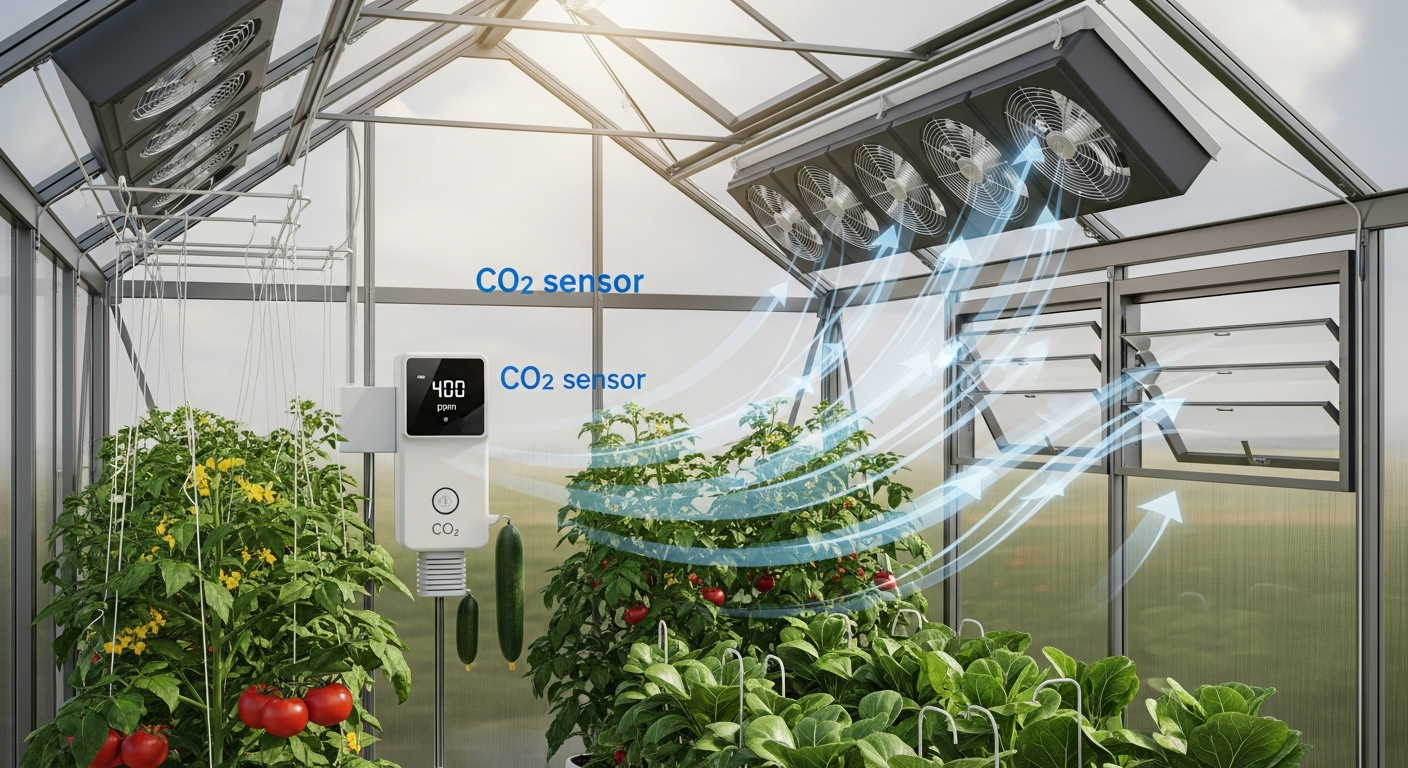
Proper placement of CO2 sensors is also critical. They should typically be placed near the plant canopy level, where the plants are actively respiring, and in multiple locations if the greenhouse is large or has varied microclimates. Avoid placing them directly near CO2 enrichment sources or ventilation fans, as this can lead to inaccurate readings.
The Mechanics of Proper Greenhouse Ventilation
Ventilation is the controlled exchange of air between the inside and outside of the greenhouse. While it plays a crucial role in temperature and humidity regulation, its function in replenishing CO2 is equally vital, forming the other half of the relationship with CO2 sensors.
Purposes of Greenhouse Ventilation
Beyond CO2 replenishment, effective ventilation serves several critical purposes in a greenhouse environment:
- Temperature Control: Removing excess heat generated by solar radiation, especially during warm periods, to prevent plant stress and maintain optimal growing temperatures.
- Humidity Management: Expelling moist, saturated air that can lead to condensation, fungal diseases (like botrytis or powdery mildew), and hinder transpiration.
- Introducing Fresh Air: Bringing in ambient air not just for CO2, but also for general air exchange, which can help with pollutant dilution and introduce beneficial microorganisms.
- Air Movement: Preventing stagnant air pockets around the plant canopy, which can exacerbate disease issues and reduce CO2 uptake efficiency even if overall CO2 levels are adequate.
- Pest and Disease Control: A well-ventilated greenhouse is less hospitable to many common greenhouse pests and pathogens.
Types of Greenhouse Ventilation Systems
Greenhouses typically employ two primary types of ventilation, often used in combination:
Natural Ventilation
This method relies on natural forces like wind pressure and the stack effect (hot air rising). It typically involves strategically placed vents on the sidewalls and ridges of the greenhouse structure.
- Ridge Vents: Located at the highest point of the greenhouse, allowing hot, buoyant air to escape.
- Sidewall Vents: Located lower down, allowing cooler, fresh air to enter.
- Benefits: Energy-efficient (no fans), quieter operation, provides a gentle air exchange.
- Limitations: Dependent on external weather conditions (wind speed, temperature differences), can be less effective on still days, and harder to precisely control CO2 levels.
Forced Ventilation
This method uses mechanical fans to actively draw air into and out of the greenhouse, providing more precise and controllable air exchange.
- Exhaust Fans: Mounted on one end or side of the greenhouse, they pull air out, creating negative pressure that draws fresh air in through intake vents on the opposite side.
- Circulation Fans (Horizontal Airflow Fans – HAF): These fans do not exchange air with the outside but rather move air within the greenhouse to ensure uniform temperature, humidity, and CO2 distribution around the plant canopy, preventing microclimates.
- Benefits: Highly controllable, effective regardless of external weather, capable of rapid air exchange, crucial for precise CO2 management when combined with sensors.
- Limitations: Higher energy consumption, can be noisy, requires careful sizing and placement of fans and vents.
The choice and design of a ventilation system significantly impact how effectively CO2 levels can be managed. A system with robust air exchange capabilities is crucial when CO2 sensors indicate depletion, allowing for rapid replenishment of fresh air.
Integrating CO2 Sensors for Smart Greenhouse Ventilation
The true power of this relationship is unlocked when CO2 sensors are integrated into a smart climate control system that automates ventilation based on real-time data. This synergy transforms a greenhouse from a simple enclosure into a precisely tuned growing machine.
Automated Climate Control Driven by CO2 Data
In an integrated system, CO2 sensors continuously transmit data to a central climate controller. This controller, programmed with specific CO2 setpoints (e.g., maintain 800-1200 ppm), makes intelligent decisions regarding ventilation and CO2 enrichment. Here’s how it typically works:
- Monitoring: CO2 sensors constantly measure the CO2 concentration at various points within the greenhouse.
- Data Analysis: The climate controller receives this data and compares it to the grower’s desired setpoints.
- Decision Making:
- If CO2 levels fall below the lower setpoint (e.g., 800 ppm) during periods of high light and active photosynthesis, and CO2 enrichment is enabled, the controller might activate a CO2 generator or injector.
- If CO2 levels are within the optimal range but temperature or humidity are too high, the controller will prioritize opening vents or activating exhaust fans to regulate temperature/humidity, while potentially pausing CO2 enrichment to avoid waste.
- If CO2 levels are adequately high but the greenhouse has been sealed for CO2 enrichment, and then light levels drop or temperature rises excessively, the system will trigger ventilation to manage other environmental factors.
- If ambient CO2 levels are sufficient (e.g., 400 ppm) but the CO2 inside has dipped due to plant uptake, and enrichment is not desired or available, the system will open vents to bring in fresh air.
- Action: The controller sends commands to actuators that open/close vents, switch fans on/off, or control CO2 enrichment systems.
This dynamic interaction ensures that plants always have access to the optimal CO2 levels necessary for peak performance, while simultaneously managing other critical environmental factors like temperature and humidity.
Tangible Benefits of This Integration
The harmonious working relationship between CO2 sensors and intelligent ventilation systems yields a multitude of benefits for growers:
- Maximized Plant Growth and Yield: Consistent, optimized CO2 levels directly translate to faster vegetative growth, earlier flowering, increased fruit set, and higher overall crop yields. Studies have shown yield increases of 20-30% or more with proper CO2 enrichment and monitoring.
- Enhanced Energy Efficiency: Instead of continuous, wasteful ventilation or manual, inefficient adjustments, the system ventilates only when necessary to achieve specific CO2, temperature, or humidity targets. This reduces fan run-time and heating/cooling loads. If CO2 enrichment is used, sensors prevent CO2 from being vented away prematurely.
- Reduced Labor Costs: Automation significantly reduces the need for manual monitoring and adjustment of vents and fans, freeing up growers’ time for other critical tasks.
- Improved Crop Quality: Healthier plants grown under optimal conditions tend to have better flavor, color, texture, and nutritional value.
- Precise Environmental Control: The ability to maintain stable and ideal growing conditions minimizes plant stress, leading to more robust and resilient crops less susceptible to environmental fluctuations.
- Pest and Disease Prevention: By maintaining ideal humidity and air movement, the environment becomes less conducive to the proliferation of many common greenhouse pests and fungal diseases.
- Data-Driven Decision Making: The continuous data collection from CO2 and other environmental sensors provides invaluable insights for optimizing future growing cycles, troubleshooting issues, and demonstrating ROI.
Consider a scenario where a grower manually opens vents in the morning. If the CO2 level is still high from the previous night or if there’s no immediate CO2 depletion, this action might prematurely expel valuable CO2 (if enrichment is used) or introduce cold air unnecessarily. A sensor-driven system prevents such inefficiencies, acting only when the data dictates.
Practical Tips for Optimizing Your Greenhouse Environment
Implementing a CO2 sensor and ventilation strategy requires careful planning and ongoing attention. Here are some practical tips for maximizing their effectiveness:
- Strategic Sensor Placement:
- Place sensors at canopy height, as this is where plants actively respire and uptake CO2.
- Use multiple sensors in larger greenhouses to account for potential microclimates and ensure uniform readings.
- Keep sensors away from direct sunlight (which can affect readings), air inlets, or CO2 enrichment sources to avoid false readings.
- Ensure sensors are properly protected from water and physical damage.
- Regular Calibration and Maintenance:
- CO2 sensors require periodic calibration to maintain accuracy. Some have auto-calibration features, but manual checks with a known reference gas or outdoor air (approx. 400-420 ppm) are recommended.
- Keep sensors clean and free of dust, which can impede their function.
- Regularly inspect fans, vents, and actuators to ensure they are clean, functional, and free of obstructions.
- Understand Your Crop’s Needs:
- Research the optimal CO2 range, temperature, and humidity for your specific crops at different growth stages. These are your target setpoints.
- Start with conservative setpoints and gradually adjust as you observe plant response and analyze data.
- Integrate All Environmental Factors:
- CO2, temperature, humidity, light intensity, and air movement are interconnected. A smart climate controller should consider all these factors when making ventilation or enrichment decisions.
- For example, if light levels are low, plants won’t utilize high CO2 as effectively, so enrichment might be paused or reduced.
- Implement Horizontal Airflow (HAF) Fans:
- Even with excellent intake and exhaust ventilation, stagnant air pockets can occur. HAF fans ensure uniform distribution of CO2, temperature, and humidity throughout the canopy, maximizing the benefits of your sensor-driven system.
- Monitor and Analyze Data:
- Regularly review the historical data from your CO2 sensors and climate controller. Look for trends, identify periods of depletion or excess, and use this information to fine-tune your settings.
- Data logging helps confirm the effectiveness of your ventilation strategy and justifies investments in technology.
- Consider Energy Efficiency:
- While automation saves energy, continuously evaluate your system. Are fans running unnecessarily? Is CO2 being enriched and immediately vented? Optimize setpoints and dead zones to find the balance between ideal growth and energy consumption.
Conclusion
The relationship between CO2 sensors and proper greenhouse ventilation is not merely complementary; it is symbiotic, each element empowering the other to create an optimal growing environment. CO2 sensors provide the invaluable, real-time intelligence about the invisible atmospheric conditions that directly impact plant health and productivity. Ventilation systems then act on this intelligence, precisely adjusting the greenhouse atmosphere to ensure CO2 is always available in optimal concentrations, while simultaneously managing temperature and humidity.
By investing in and intelligently integrating these technologies, growers move beyond traditional methods, embracing precision agriculture. The result is a more resilient, efficient, and productive greenhouse operation, yielding healthier plants, significantly higher crop yields, reduced energy consumption, and ultimately, a more sustainable and profitable future for horticulture. This partnership is truly the breath of life for modern greenhouse cultivation, transforming potential into unparalleled reality.