
In the intricate world of plant science and agriculture, understanding a plant’s health and vitality often hinges on subtle indicators. Among the most critical yet frequently misunderstood metrics is temperature. While ambient air temperature is a common environmental parameter, the temperature of a leaf’s surface tells a far more nuanced story about a plant’s immediate physiological state. This distinction – between air temperature, a broad environmental measurement, and leaf surface temperature, a direct indicator of plant response – is fundamental for anyone seeking to optimize plant growth, detect stress early, or conduct robust plant research. Delving into the science behind these two measurements reveals why both are essential, yet distinct, tools in the arsenal of modern plant management and why focusing solely on one can lead to misinterpretations and suboptimal outcomes.
The Critical Role of Leaf Temperature in Plant Physiology
Leaf temperature is not just a passive reflection of the environment; it is a dynamic indicator deeply intertwined with a plant’s core life processes. From the microscopic pores on its surface to the complex biochemical reactions within, a plant constantly regulates its internal temperature to survive and thrive. Understanding this regulation is paramount for discerning plant health.
Photosynthesis: The Temperature Sweet Spot
At the heart of plant life is photosynthesis, the process by which plants convert light energy into chemical energy. This crucial process is highly temperature-dependent. Enzymes responsible for photosynthesis, such as RuBisCO, have optimal temperature ranges within which they function most efficiently. If leaf temperature deviates too far from this optimal range – either too cold or too hot – enzyme activity can decrease significantly, leading to reduced photosynthetic rates and slower growth. Extremely high temperatures can even lead to irreversible damage to the photosynthetic machinery.
- Cold Stress: Low leaf temperatures can slow down metabolic rates, reduce enzyme efficiency, and impair membrane function, leading to chilling injury or frost damage.
- Heat Stress: High leaf temperatures can denature proteins, disrupt enzyme activity, increase respiration rates (consuming more energy than is produced), and lead to oxidative stress, severely impacting growth and yield.
Transpiration: The Plant’s Cooling System
One of the most remarkable aspects of plant temperature regulation is transpiration, the process by which water vapor is released from stomata – tiny pores – on the leaf surface. This process is analogous to sweating in humans; as water evaporates, it carries away latent heat, effectively cooling the leaf. The rate of transpiration is influenced by several factors, including:
- Stomatal Conductance: The degree to which stomata are open or closed. When stomata are open, transpiration increases, and the leaf cools. When they close, transpiration decreases, and the leaf temperature tends to rise.
- Vapor Pressure Deficit (VPD): The difference between the amount of moisture in the air and how much moisture the air can hold when saturated. A higher VPD drives higher transpiration.
- Air Movement: Wind can increase transpiration by sweeping away humid air near the leaf surface, maintaining a steep water potential gradient.
Monitoring leaf temperature can therefore provide direct insights into a plant’s stomatal activity and its ability to regulate water loss, which is a key indicator of water status.
An Early Warning System for Plant Stress
Perhaps the most powerful application of leaf temperature monitoring is its ability to act as an early warning system for various forms of plant stress. Long before visible symptoms appear, a plant’s temperature can signal distress:
- Water Stress (Drought): When a plant experiences water scarcity, it conserves water by closing its stomata. This reduces transpiration, leading to a noticeable increase in leaf temperature. This rise in temperature can be detected long before wilting or other visual signs of drought appear.
- Heat Stress: If the ambient temperature is excessively high, or if a plant’s cooling mechanisms are compromised, leaf temperatures can soar, leading to heat stress and potential damage.
- Nutrient Deficiencies: Some nutrient deficiencies can impair stomatal function or reduce the plant’s ability to transpire effectively, indirectly affecting leaf temperature.
- Pest and Disease Infestation: Pathogens or pests can damage leaf tissue, disrupt vascular function, or induce stomatal closure, leading to localized or widespread changes in leaf temperature. Detecting these thermal anomalies can facilitate early intervention.
By understanding the physiological basis of leaf temperature, we can move beyond mere environmental observation to gain a profound, real-time understanding of a plant’s internal well-being.
Understanding Air Temperature: The Environmental Context
Air temperature is perhaps the most common and easily measured environmental parameter in agricultural and horticultural settings. It provides a broad overview of the thermal conditions surrounding plants, influencing everything from growth rates to pest development. However, while essential, it’s crucial to understand its role and limitations when trying to gauge the precise thermal state of a plant.
What is Air Temperature and How is it Measured?
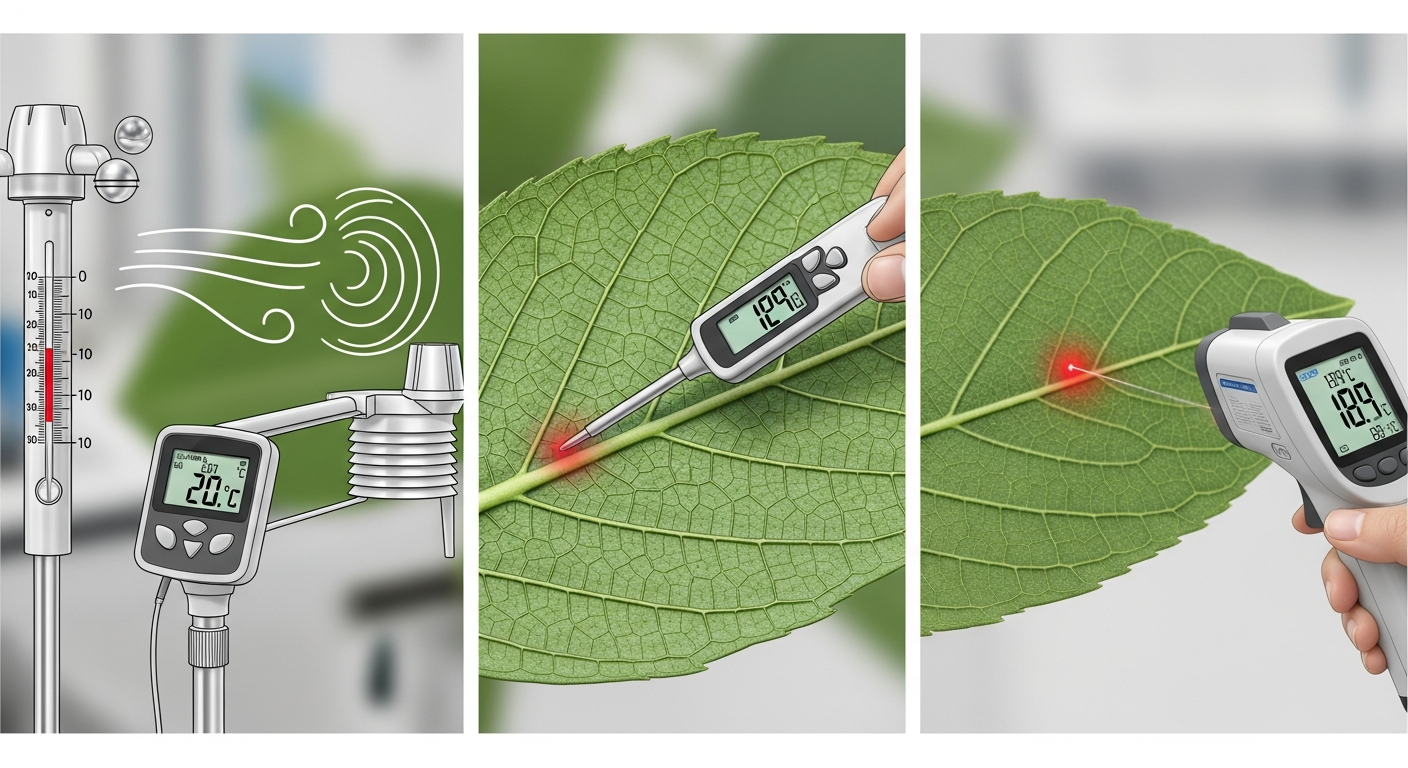
Air temperature refers to the temperature of the atmosphere at a specific location and time. It’s a measure of the kinetic energy of air molecules. Standard measurements are typically taken at a height of 1.5 to 2 meters above the ground in a shaded, well-ventilated location to avoid direct solar radiation and ground heat effects. Common instruments include liquid-in-glass thermometers, thermistors, and thermocouples housed in Stevenson screens or aspirated radiation shields.
Influence on Leaf Temperature: Convection and Radiation
Air temperature certainly influences leaf temperature through several mechanisms:
- Convection: The transfer of heat between the leaf surface and the surrounding air. If the air is cooler than the leaf, the leaf loses heat to the air; if the air is warmer, the leaf gains heat from the air. The rate of convection is significantly affected by wind speed.
- Radiation: While air temperature itself doesn’t directly emit radiation, the thermal conditions of the air contribute to the overall radiation balance that impacts a leaf. The surrounding air, along with other objects in the environment, exchanges longwave radiation with the leaf.
Thus, air temperature sets a baseline thermal environment. However, it’s critical to remember that a leaf is an active biological entity, not merely a passive thermometer mirroring the ambient air.
Limitations of Relying Solely on Air Temperature
Despite its importance, air temperature alone often fails to provide a complete picture of a plant’s thermal reality. Several factors contribute to this discrepancy:
- Microclimates: Within a field or even within a single plant canopy, significant temperature gradients can exist. Air temperature measured at a standard height might not accurately represent the microclimate experienced by leaves lower in the canopy or those subjected to specific localized conditions (e.g., proximity to soil, shade from neighboring plants).
- Leaf Boundary Layer: A thin layer of still or slow-moving air surrounds each leaf. This boundary layer acts as an insulator, affecting the rate of heat and water vapor exchange between the leaf and the bulk air. Its thickness varies with wind speed and leaf morphology.
- Transpiration’s Cooling Effect: As discussed, transpiration actively cools the leaf. This biological process can cause the leaf surface temperature to be significantly cooler than the surrounding air, especially on hot, sunny days with ample water availability.
- Radiant Heat Load: Leaves exposed to direct sunlight absorb substantial solar radiation, which can heat them up well above air temperature, even if the air itself is not excessively hot. Conversely, leaves in deep shade will have a much lower radiant heat load. Air temperature sensors are typically shielded from direct radiation, thus capturing only the air’s kinetic energy, not the combined radiative and convective load a leaf experiences.
When is Air Temperature a Good Proxy?
While not a direct measure of plant status, air temperature remains an indispensable parameter:
- General Environmental Monitoring: It’s crucial for understanding regional climate, scheduling planting/harvesting, predicting pest cycles, and assessing overall growing conditions.
- Controlled Environments: In greenhouses or indoor farms, where humidity, light, and CO2 are also controlled, maintaining a stable air temperature is critical for creating an optimal growing environment. Here, the relationship between air and leaf temperature is often more predictable.
- Phenological Studies: Many plant developmental stages (e.g., flowering, fruiting) are strongly influenced by cumulative heat units derived from air temperature.
Practical Tip for Air Temperature Measurement: To ensure accurate and representative air temperature readings for plant monitoring, place sensors in a well-ventilated, shaded location within the plant canopy, ideally at the height of the active growing leaves. Use an aspirated radiation shield to prevent solar radiation from directly heating the sensor, which would lead to artificially high readings.
Diving Deep into Surface Temperature: The Leaf’s Perspective
While air temperature provides the environmental context, leaf surface temperature offers a direct window into the plant’s physiological activity. It tells us how the plant is interacting with its environment, particularly its ability to regulate water loss and manage heat stress. This is where the true science of plant temperature monitoring lies.
What is Leaf Surface Temperature?
Leaf surface temperature is the actual temperature of the outer surface of the leaf tissue. Unlike air temperature, which measures the ambient environment, leaf surface temperature reflects the complex interplay between environmental factors (solar radiation, air temperature, wind, humidity) and the plant’s internal physiological responses, primarily transpiration. It’s often the single best non-invasive indicator of a plant’s water status and heat stress levels.
Methods of Measurement
Measuring the delicate surface temperature of a leaf requires specialized techniques:
1. Infrared Thermometry (Non-Contact)
- Principles: All objects with a temperature above absolute zero emit thermal radiation. Infrared (IR) thermometers detect this emitted radiation in the infrared spectrum and convert it into a temperature reading. Since leaves are highly emissive (meaning they emit radiation very efficiently, close to a black body), IR thermometry is a highly accurate method for non-contact surface temperature measurement.
- Advantages:
- Non-invasive: Does not disturb the plant or alter the leaf’s thermal environment.
- Rapid measurement: Provides instant readings.
- Remote sensing capabilities: Can be used for individual leaves, entire canopies (e.g., from drones or satellites), or large fields.
- Suitable for diverse environments: Works well in field, greenhouse, and laboratory settings.
- Disadvantages:
- Emissivity settings: Requires accurate setting of the leaf emissivity (typically around 0.95-0.98 for most green leaves). Incorrect emissivity leads to errors.
- Field of View (FOV): The sensor measures an average temperature over its FOV. Ensure the FOV is completely filled by the target leaf/canopy and not contaminated by background (soil, sky).
- Angle of measurement: Should ideally be close to perpendicular to minimize path length through air and ensure accurate target coverage.
- Environmental interference: Can be affected by high humidity or dust in the air between the sensor and the leaf over long distances.
2. Contact Sensors (Thermocouples/Thermistors)
- Principles: These sensors measure temperature through direct physical contact. Thermocouples generate a voltage proportional to temperature difference, while thermistors change resistance with temperature. They are typically very small and can be attached directly to the leaf surface.
- Advantages:
- High accuracy: When properly calibrated and applied, they can provide very precise readings of the exact point of contact.
- Continuous logging: Can be left in place for continuous data acquisition over time.
- Disadvantages:
- Invasiveness: Attaching the sensor can physically damage the leaf surface and, more importantly, disrupt the leaf’s boundary layer, potentially altering the very temperature it’s trying to measure due to changes in convection or transpiration.
- Labor-intensive: Requires careful attachment to multiple leaves for representative sampling.
- Limited spatial coverage: Measures only a tiny spot, making it difficult to capture canopy-level variability without many sensors.
- Impact of adhesive: Adhesives used to attach sensors can affect the leaf’s thermal properties or stomatal function.
Factors Influencing Leaf Surface Temperature
A leaf’s surface temperature is a result of its energy balance – the sum of incoming and outgoing energy. Key factors include:
- Transpiration Rate: As discussed, this is the primary biological cooling mechanism. High transpiration means cooler leaves; low transpiration means warmer leaves.
- Solar Radiation: Direct sunlight is a major source of incoming energy. Leaves fully exposed to the sun will typically be warmer than shaded leaves, all else being equal.
- Wind Speed: Higher wind speeds increase convective heat transfer between the leaf and the air, usually leading to leaves having a temperature closer to that of the air. Low wind can result in a thicker boundary layer and greater temperature differences.
- Air Temperature and Humidity: These influence the gradients for heat and water vapor exchange, respectively.
- Leaf Morphology and Orientation: Traits like leaf thickness, hairiness (trichomes), surface reflectivity (albedo), and the angle at which a leaf presents itself to the sun can all modify its energy balance and thus its temperature.
Interpreting Leaf Surface Temperature Data
Raw leaf temperature values are informative, but their true power comes from comparison and context:
- Temperature Differential: Often, the difference between leaf temperature and air temperature (Tleaf – Tair) or leaf temperature and ambient wet-bulb temperature is more indicative than the absolute leaf temperature.
- Leaf Temperature Depression (LTD): When Tleaf < Tair, it indicates active transpiration and healthy cooling. A larger depression suggests vigorous water use.
- Leaf Temperature Rise (LTR): When Tleaf > Tair, it suggests reduced transpiration, often due to water stress, stomatal closure, or excessive heat load.
- Canopy Temperature vs. Individual Leaf: For field applications, measuring average canopy temperature using a wider-angle IR sensor provides a good aggregate indicator of the plant population’s water status. For precise research, individual leaf measurements may be necessary.
Practical Tip for IR Thermometry: When using an IR thermometer, always measure healthy, fully sun-exposed leaves first to establish a baseline. Maintain a consistent angle (as close to perpendicular as possible) and distance from the target. Calibrate the emissivity setting for your specific plant type (a value of 0.98 is often a good starting point for green leaves). Take multiple readings across different plants and areas of the canopy to get a representative average.
Air vs. Surface: A Comparative Analysis for Informed Decision-Making
The distinction between air and leaf surface temperature is not just academic; it has profound implications for how we monitor, manage, and understand plant health. While both are crucial, their roles are fundamentally different, and their combined use offers the most comprehensive insights.
Direct Comparison: Pros and Cons of Each Measurement Type
| Feature | Air Temperature | Leaf Surface Temperature |
|---|---|---|
| What it Measures | Ambient thermal environment | Plant’s physiological response and thermal state |
| Primary Utility | General environmental context, climate control, growth modeling | Direct stress detection (water, heat), stomatal function, irrigation scheduling |
| Sensitivity to Plant State | Low (indirect influence) | High (direct physiological indicator) |
| Measurement Difficulty | Relatively easy (shielding important) | More technical (emissivity, FOV, angle, representative sampling) |
| Invasiveness | Non-invasive | Non-invasive (IR) or potentially invasive (contact) |
| Cost of Sensors | Generally lower | Generally higher (especially for high-quality IR) |
| Microclimate Insight | Limited (measures bulk air) | High (reflects leaf-level conditions) |
When to Use Air Temperature vs. Surface Temperature
- Prioritize Air Temperature When:
- Monitoring general environmental conditions to track growing degree days, chilling hours, or broad climate trends.
- Controlling the overall climate in a greenhouse or indoor farm (e.g., setting HVAC thresholds).
- Assessing the risk of frost or extreme heat events that affect entire crops.
- Forecasting regional pest and disease pressure based on thermal accumulation.
- Prioritize Surface Temperature When:
- Precise Stress Detection: Identifying water stress or heat stress at its earliest stages, often before visible symptoms appear.
- Irrigation Scheduling: Determining precisely when plants need water, based on their physiological response to water availability, rather than just soil moisture or calendar days.
- Physiological Research: Studying stomatal behavior, drought tolerance, heat shock responses, or the efficacy of different treatments on plant thermoregulation.
- Optimizing Growth and Yield: Fine-tuning environmental controls (e.g., misting, ventilation) to keep leaves within their optimal temperature range for photosynthesis.
- Disease and Pest Scouting: Detecting localized hot spots or cool spots indicative of pathogen infection or pest damage.
The Importance of Both: A Holistic Understanding
For truly informed decision-making, it’s rarely an “either/or” situation. The most powerful approach integrates both air and leaf surface temperature measurements. The air temperature serves as the environmental baseline, while the leaf temperature reveals the plant’s active response to that environment.
This combined approach allows for the calculation of crucial indices:
- Canopy Temperature Depression (CTD) or Leaf Temperature Depression (LTD): The difference between leaf temperature (or canopy temperature) and air temperature (Tleaf – Tair). A significant negative value (Tleaf < Tair) indicates healthy transpiration and good water status. As this difference approaches zero or becomes positive (Tleaf ≥ Tair), it signals increasing water stress or heat stress, as the plant struggles to cool itself.
- Crop Water Stress Index (CWSI): A more sophisticated index derived from the difference between canopy and air temperature, normalized by vapor pressure deficit. It provides a robust, quantitative measure of plant water stress, enabling precise irrigation scheduling.
Case Studies and Applications
- Precision Agriculture: Farmers use drone-mounted thermal cameras to map large fields, identifying areas of water stress (hotter canopies) that require targeted irrigation, optimizing water use and improving yields.
- Greenhouse/Controlled Environment Agriculture (CEA): Growers monitor leaf temperature to fine-tune climate control systems, ensuring plants remain in their optimal photosynthetic temperature range, preventing stress, and maximizing energy efficiency by adjusting ventilation or supplemental cooling only when physiologically necessary.
- Plant Breeding and Research: Scientists use thermal imaging to screen thousands of genotypes for drought tolerance or heat resistance, selecting plants that maintain cooler leaf temperatures under stress, indicating superior water use efficiency or heat dissipation mechanisms.
- Disease Detection: In vineyards, for example, thermal imaging can detect early stages of fungal diseases like powdery mildew, which can subtly alter leaf temperature due to changes in stomatal function or localized tissue damage, allowing for proactive treatment.
Actionable Advice for a Comprehensive Monitoring Strategy:
- Integrate Sensors: Install reliable air temperature sensors (with radiation shields) alongside either handheld or fixed-position infrared thermometers for leaf/canopy temperature.
- Collect Baseline Data: Understand typical leaf-air temperature differentials for your specific crop under optimal, non-stressed conditions. This baseline is crucial for interpreting deviations.
- Monitor Trends, Not Just Snapshots: Look for sustained shifts in leaf temperature relative to air temperature. A single hot reading might be an anomaly, but a consistently warmer canopy over several hours or days indicates stress.
- Combine with Other Data: Integrate temperature data with other environmental parameters (humidity, light intensity, wind speed) and plant metrics (soil moisture, growth rates) for a truly holistic understanding.
- Automate When Possible: For large-scale operations, consider automated thermal cameras or sensor networks that provide continuous data and alert systems for early intervention.
Synthesizing Insights for Optimal Plant Health
The journey into the science of leaf temperature monitoring reveals a fascinating interplay between a plant and its environment. What initially appears as a simple distinction between “air” and “surface” temperature evolves into a critical lesson in physiological insight. We’ve learned that air temperature, while indispensable for understanding the broader thermal environment and influencing growth, is merely the backdrop. The true drama unfolds at the leaf surface, where the plant actively engages in a sophisticated dance of energy exchange and water regulation.
Leaf surface temperature is not just a measurement; it’s a direct, real-time physiological report card. It tells us whether a plant is transpiring efficiently, managing heat stress effectively, or silently struggling with water scarcity or disease, often long before any visible symptoms betray its distress. Tools like infrared thermometry empower growers, researchers, and hobbyists alike to listen to these subtle thermal whispers from their plants.
The most effective strategy, therefore, is to embrace both air and leaf temperature monitoring. By understanding the environmental context provided by air temperature and interpreting it through the lens of the plant’s direct thermal response captured by leaf temperature, we unlock a powerful diagnostic capability. This integrated approach allows for the calculation of critical indices like Canopy Temperature Depression (CTD), enabling precision agriculture, optimized resource management, and robust research.
As technology advances, with increasingly sophisticated and affordable sensors, thermal imaging, and data analytics, the ability to monitor and interpret plant temperatures will only become more accessible and powerful. Moving forward, the focus will be on leveraging these insights for smarter irrigation, more resilient crops, and more sustainable agricultural practices. Ultimately, mastering the science of leaf temperature monitoring is about moving beyond guesswork and toward a truly informed, proactive approach to nurturing plant health and maximizing productivity.