
In the intricate world of modern horticulture, greenhouses stand as bastions of controlled environments, meticulously designed to nurture plants to their fullest potential. The success of these sophisticated growing systems hinges on a delicate balance of environmental factors: temperature, humidity, CO2 levels, light intensity, and nutrient delivery. To maintain this balance with unwavering consistency, growers rely heavily on a network of advanced sensors that act as the ‘eyes and ears’ of their greenhouse management systems. However, the data these sensors provide is only as reliable as the sensors themselves. Unseen and often overlooked, the gradual degradation of sensor accuracy – known as sensor drift – can quietly undermine even the most sophisticated climate control strategies, leading to suboptimal growth, wasted resources, and diminished profits. This is where sensor calibration emerges as a critical, non-negotiable practice, transforming mere data into genuinely actionable intelligence and ensuring the precise environmental control that defines successful, sustainable greenhouse operations.
The Foundation of Precision: Why Accurate Sensor Data Matters in Greenhouses
Modern greenhouses are marvels of agricultural technology, employing sophisticated environmental control systems to optimize every aspect of plant growth. From seedling to harvest, specific ranges for temperature, relative humidity, carbon dioxide concentration, light intensity (PAR), and nutrient solution parameters (pH and Electrical Conductivity, EC) are crucial. Deviations from these optimal ranges, even slight ones, can have profound effects on plant health, development, and ultimately, your bottom line. At the heart of this precise control lies a network of environmental sensors.
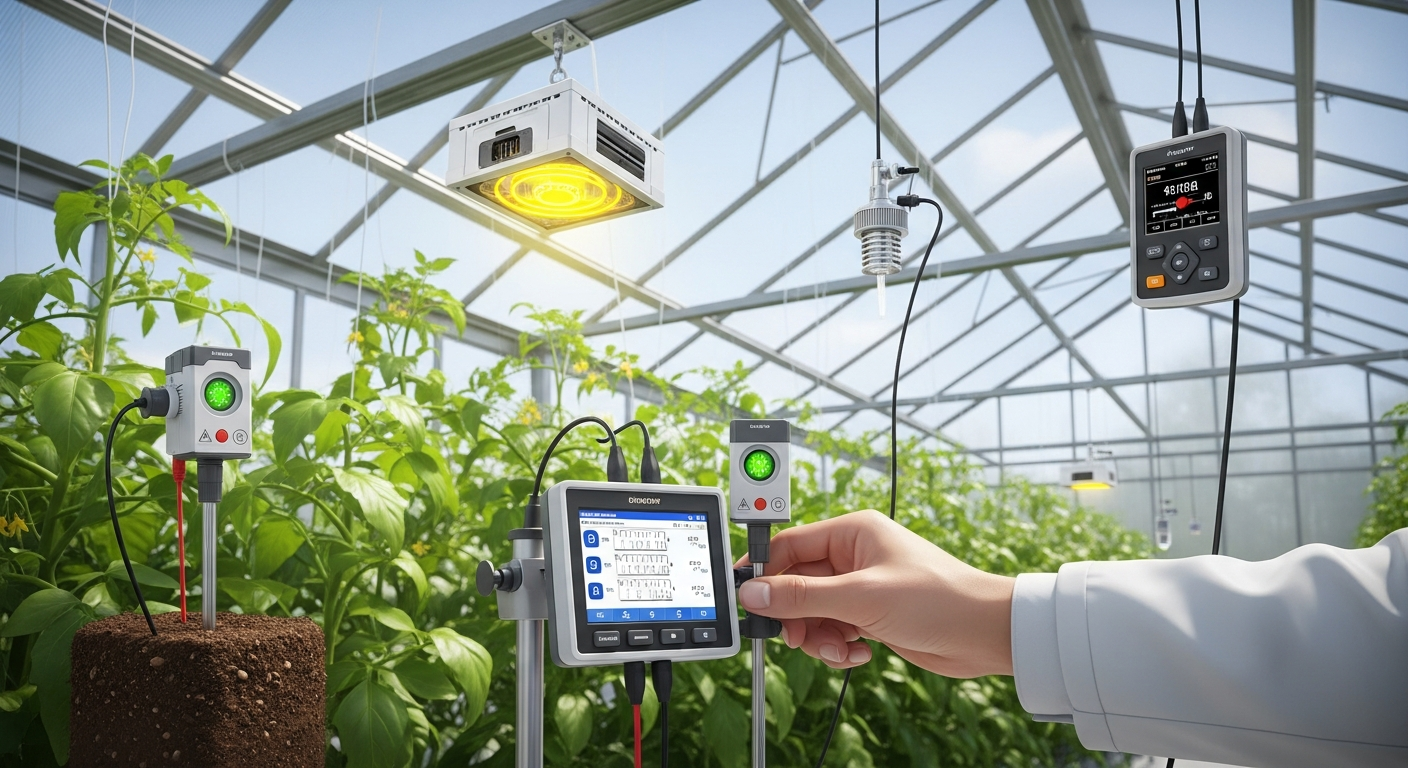
Consider the delicate balance required:
- Temperature: Influences metabolic rates, photosynthesis, respiration, and transpiration. Too high or too low can cause stress, slow growth, or even plant death.
- Relative Humidity (RH): Affects transpiration rates, nutrient uptake, and the proliferation of molds, fungi, and pests. High RH can lead to fungal diseases, while low RH can cause wilting and stunted growth.
- Carbon Dioxide (CO2): A vital component for photosynthesis. Optimal CO2 enrichment can significantly boost growth and yield, but incorrect levels (either too high or too low) can be wasteful or detrimental.
- Light Intensity (PAR): Photosynthetically Active Radiation is the energy source for plants. Insufficient light limits growth, while excessive or poorly managed light can cause stress or inefficient energy use.
- pH and EC: These parameters of the nutrient solution directly impact nutrient availability and uptake by plant roots. Incorrect pH can lock out essential nutrients, while improper EC can lead to nutrient deficiencies or toxicity.
Every decision made by an automated greenhouse system – when to open vents, fire heaters, activate foggers, or inject CO2 – is based on the data streamed from these sensors. If the sensors are providing inaccurate readings, the system will respond inappropriately, regardless of how advanced the control algorithms are. This is why accurate sensor data isn’t just a recommendation; it’s the bedrock of effective, precise greenhouse management. Without it, you are effectively flying blind, making costly decisions based on faulty information.
Unseen Threats: The Perils of Uncalibrated Sensors
Even the highest quality sensors are not immune to the passage of time and the harsh realities of a greenhouse environment. Over months and years of operation, sensors can experience what is known as sensor drift – a gradual change in their readings over time, causing them to deviate from the true value. This drift can be caused by various factors:
- Environmental Exposure: High humidity, temperature fluctuations, dust, nutrient solution splashes, and even pesticide residues can degrade sensor components.
- Aging of Components: Electronic components naturally degrade over time, affecting sensor performance.
- Contamination: pH probes can get fouled, CO2 sensors can accumulate dust on their optics, and humidity sensors can become saturated or damaged.
- Mechanical Stress: Vibrations or minor physical impacts can subtly alter sensor characteristics.
The consequences of relying on uncalibrated or drifting sensors are far-reaching and financially detrimental:
Suboptimal Growing Conditions
- If a temperature sensor reads 2°C higher than actual, your system might continuously cool, wasting energy, or activate heaters less frequently, leading to chronically low temperatures.
- An RH sensor reading too low might trigger humidifiers unnecessarily, increasing humidity to dangerous levels, fostering fungal growth, or wasting water and energy.
- An uncalibrated CO2 sensor could lead to under-enrichment (slowing growth) or over-enrichment (wasting expensive CO2).
Wasted Resources and Increased Operational Costs
When environmental controls respond to false readings, resources are inevitably wasted. Excess heating, cooling, humidification, dehumidification, CO2 injection, or even watering cycles directly translate into higher electricity, water, nutrient, and CO2 bills. This constant inefficiency erodes profit margins and undermines sustainability efforts.
Reduced Crop Yield and Quality
Plants subjected to chronic suboptimal conditions due to inaccurate sensor data will exhibit stress. This stress manifests as slower growth rates, reduced fruit set, smaller yields, lower quality produce, and increased susceptibility to pests and diseases. The economic impact of even a small reduction in yield or quality across a large greenhouse operation can be substantial.
Misguided Decision-Making
Growers often make critical adjustments to their strategies based on historical and real-time sensor data. If this data is flawed, long-term trends become unreliable, and short-term interventions are based on false premises. This can lead to persistent problems that are difficult to diagnose because the grower trusts the faulty sensor readings.
False Alarms or Missed Issues
Uncalibrated sensors can trigger unnecessary alarms, leading to alarm fatigue, or worse, fail to flag genuine environmental excursions that could be devastating to crops. This compromises the reliability of your entire monitoring and alert system, potentially leading to costly oversights.
In essence, uncalibrated sensors create a costly disconnect between your advanced greenhouse technology and the actual needs of your plants. This is why addressing sensor drift through regular, proper sensor calibration is not an expense, but a vital investment in the precision and profitability of your greenhouse.
Decoding Calibration: What It Is and How It Works
At its core, calibration is the process of comparing the readings of an instrument (your sensor) against a known, verifiable standard, and then making adjustments to ensure the instrument provides accurate measurements. It’s about bringing your sensor back into agreement with reality.
It’s important to distinguish between calibration and adjustment:
- Calibration: The act of comparing a sensor’s reading to a known standard. It tells you how much your sensor is off.
- Adjustment: The act of bringing the sensor’s reading back into agreement with the standard. This is often done after calibration reveals a discrepancy. Some sensors have built-in adjustment functions, while others may require replacement or professional servicing.
Types of Calibration
Depending on the sensor and the required precision, different calibration methods are employed:
- Single-Point Calibration: Compares the sensor reading to a single known standard. While simpler and faster, it only corrects for offset at that specific point.
- Multi-Point Calibration: Compares the sensor reading against two or more known standards (e.g., a low value and a high value). This allows for correction of both offset and span (slope), providing greater accuracy across the sensor’s measurement range. Many pH and EC sensors require multi-point calibration.
- Field Calibration: Performed directly in the greenhouse, often by the grower, using portable standards. It’s practical for routine checks.
- Laboratory Calibration: Performed by specialized technicians in a controlled environment with highly accurate, traceable reference standards. This offers the highest level of accuracy and is often required for critical measurements or for certifying sensor performance.
General Steps in Sensor Calibration
- Identify the Sensor and Parameter: Determine which sensor (e.g., temperature, humidity, pH) and the specific parameter it measures needs calibration.
- Acquire a Reliable Reference Standard: This is the known value against which your sensor will be compared. Examples include certified calibration gases for CO2, specific buffer solutions for pH, or precise humidity generators. The standard itself must be accurate and traceable to national or international standards.
- Prepare the Sensor: Clean the sensor thoroughly according to manufacturer guidelines. For pH probes, this might involve soaking. For others, a gentle wipe down.
- Compare Readings: Expose the sensor to the known standard and allow it to stabilize. Record the sensor’s reading and compare it to the standard’s value.
- Perform Adjustment (if necessary): If there’s a significant deviation, adjust the sensor’s reading until it matches the standard. Follow the manufacturer’s instructions for the specific sensor model. For sensors without manual adjustment, the deviation indicates the correction factor to apply or the need for replacement.
- Verify Calibration: After adjustment, it’s often good practice to re-test the sensor with the standard (or a different standard for multi-point) to ensure the adjustment was successful and accurate.
- Document: Record the date, sensor ID, standard used, “as found” reading, “as left” reading, and who performed the calibration. This documentation is crucial for tracking sensor performance over time and for troubleshooting.
Understanding this process empowers growers to maintain the integrity of their data, transforming their greenhouse into a truly controlled and predictable growing environment.
A Practical Guide to Sensor Calibration in Your Greenhouse
Implementing a routine sensor calibration schedule is paramount for maintaining the health and productivity of your greenhouse crops. Here’s a practical guide focusing on common greenhouse sensors and actionable advice:
Temperature Sensors (Thermocouples, RTDs, Thermistors)
- Calibration Standard: A high-precision, calibrated reference thermometer (digital or liquid-in-glass) that has been recently certified. Ice bath (0°C/32°F) can serve as a simple, accurate single-point standard.
- Frequency: At least quarterly, or monthly for critical zones. Annually for professional lab calibration.
- Tips:
- Place the reference thermometer and your greenhouse sensor side-by-side, ensuring both are exposed to the same air currents and conditions. Allow at least 15-30 minutes for stabilization.
- For an ice bath, immerse both sensors (avoiding electrical components) into a slurry of crushed ice and distilled water. The temperature should stabilize at 0°C.
- Compare readings. Many temperature sensors cannot be manually adjusted in the field; if there’s a significant discrepancy (e.g., >0.5°C), note the offset and apply it in your control software, or consider replacing the sensor.
- Ensure sensors are shielded from direct sunlight to avoid false high readings due to radiant heat.
Relative Humidity (RH) Sensors (Capacitive, Resistive)
- Calibration Standard: Saturated salt solutions, often available as calibration kits, create stable, known RH values within a sealed chamber.
- Frequency: Monthly to quarterly. RH sensors are prone to drift due to contamination and aging.
- Tips:
- Obtain a reputable saturated salt solution kit (e.g., 33% RH with magnesium chloride or 75% RH with sodium chloride).
- Place the sensor in the sealed chamber with the salt solution. Allow several hours (4-24 hours) for the humidity to stabilize.
- Compare the sensor reading to the known RH value of the salt solution. Adjust the sensor via its software or potentiometer if available. Many modern sensors are factory calibrated and require replacement if accuracy degrades beyond a set tolerance.
- Keep the sensor clean and free of dust or residues. Avoid touching the sensing element.
CO2 Sensors (NDIR – Non-Dispersive Infrared)
- Calibration Standard: Fresh air (approximately 400-420 ppm CO2, depending on location), or certified calibration gases of known CO2 concentration.
- Frequency: Monthly to quarterly. Annually for professional lab calibration with certified gas.
- Tips:
- “Fresh Air” Calibration: Expose the sensor to outdoor ambient air (away from exhaust fumes or breathing humans) for at least 20-30 minutes. Use a calm, wind-protected spot. Most NDIR sensors have an ABC (Automatic Baseline Correction) function that assumes the lowest CO2 reading over a period is ambient. This is useful, but manual fresh air calibration is more immediate and can correct for accumulated drift.
- Certified Gas Calibration: This is the most accurate method. Connect the sensor to a regulated flow of certified calibration gas (e.g., 400 ppm or 1000 ppm CO2). Follow manufacturer instructions for gas flow rates and stabilization time.
- Keep the sensor’s optical windows clean.
- Do not calibrate CO2 sensors in the greenhouse during operation, as CO2 levels will be elevated.
pH and EC Sensors (Electrodes)
- Calibration Standard: Certified pH buffer solutions (e.g., pH 4.01, 7.00, 10.00) and EC calibration solutions (e.g., 1.413 mS/cm, 2.76 mS/cm).
- Frequency: Weekly, or even daily for critical applications, as probes are prone to fouling and degradation.
- Tips:
- pH: Always perform a 2-point (or 3-point) calibration. Clean the electrode thoroughly with distilled water before and after each buffer. Ensure the temperature of the buffers is known and consistent. Replace electrodes regularly (every 6-12 months typically, depending on use). Store pH electrodes in appropriate storage solution, not distilled water.
- EC: Calibrate with at least one, preferably two, different EC standards. Clean the probe before calibration. Ensure there are no air bubbles in the calibration solution around the sensor.
- Always follow the specific instructions from the sensor and controller manufacturer.
PAR/Light Sensors (Quantum Sensors)
- Calibration Standard: A professionally calibrated reference PAR meter.
- Frequency: Annually. These sensors are generally very stable but can drift.
- Tips:
- Place your greenhouse PAR sensor and the reference PAR meter directly next to each other, ensuring they receive the exact same light intensity and angle.
- Take readings under different light conditions (e.g., cloudy, sunny, with supplemental lighting on).
- Most PAR sensors cannot be adjusted by the user and require sending back to the manufacturer or a specialized lab for recalibration or replacement if they show significant deviation.
- Keep the sensor’s optical dome clean and free of dust, water spots, or condensation.
General Best Practices for All Sensors:
- Document Everything: Keep a logbook or digital record of every calibration, including date, sensor ID, “as found” reading, “as left” reading, standard used, and technician. This helps identify trends and predict when sensors might need replacement.
- Follow Manufacturer Guidelines: Always refer to the sensor and control system manufacturer’s specific instructions for calibration procedures, recommended standards, and frequency.
- Use Quality Standards: Only use certified, fresh, and unexpired calibration solutions and gases. Expired or contaminated standards are useless.
- Handle with Care: Sensors are delicate instruments. Avoid rough handling, extreme temperatures, and chemical exposure that isn’t part of the normal operating environment.
By diligently following these practical steps, growers can ensure their environmental sensors provide the reliable data necessary for truly precise greenhouse management, maximizing efficiency and crop quality.
The ROI of Precision: Benefits Beyond Accuracy
Investing time, effort, and resources into regular sensor calibration for precise greenhouse management yields a significant return on investment that extends far beyond simply knowing your environmental parameters are accurate. This commitment to precision translates into tangible economic, operational, and environmental benefits:
Improved Crop Health and Yield Consistency
When sensors are calibrated, the greenhouse climate control system can maintain optimal conditions with precision. This leads to:
- Reduced Plant Stress: Plants grow in their ideal temperature, humidity, and CO2 ranges, minimizing stress and maximizing photosynthetic efficiency.
- Faster Growth Rates: Consistent optimal conditions encourage steady, robust growth, leading to shorter crop cycles and higher yields.
- Enhanced Crop Quality: Uniform growing conditions result in consistent size, color, texture, and nutritional value of produce, which commands better prices in the market.
- Predictable Production: Reliable data allows for more accurate forecasting of harvest times and quantities, improving supply chain management.
Optimized Resource Usage (Water, Energy, Nutrients, CO2)
This is perhaps one of the most immediate and significant financial benefits. Accurate sensor data prevents wasteful over-application or insufficient application of critical resources:
- Energy Savings: Heaters, coolers, and ventilation systems operate only when truly necessary, based on precise temperature and humidity readings, significantly reducing electricity or fuel consumption.
- Water Conservation: Irrigation systems respond accurately to actual plant needs and substrate moisture levels, preventing overwatering and reducing water usage.
- Nutrient Efficiency: Precise pH and EC measurements ensure nutrients are always available in the correct concentrations, preventing waste and ensuring optimal plant uptake.
- CO2 Efficiency: Targeted CO2 enrichment based on accurate sensor data avoids costly over-dosing, maximizing the return on your CO2 investment.
Reduced Pest and Disease Incidence
Many common greenhouse pests and diseases thrive under specific environmental conditions (e.g., high humidity for fungal pathogens, specific temperatures for insect reproduction). By maintaining tight control over these parameters through calibrated sensors, growers can proactively suppress ideal conditions for these threats. This reduces the need for costly and labor-intensive pest management interventions, including pesticides.
Enhanced Profitability and Sustainability
The cumulative effect of increased yield, improved quality, and reduced operational costs directly boosts the profitability of the greenhouse operation. Furthermore, optimized resource use contributes significantly to the sustainability goals of modern agriculture, reducing the environmental footprint and demonstrating responsible growing practices.
Data Integrity for Better Long-Term Decision Making and Growth Planning
Accurate historical data derived from calibrated sensors provides invaluable insights. Growers can analyze trends, correlate environmental conditions with crop performance, identify optimal setpoints, and refine their growing strategies over time. This data-driven approach fosters continuous improvement and empowers intelligent planning for future crop cycles and greenhouse expansions.
In essence, neglecting sensor calibration is akin to running a finely tuned machine with faulty gauges. While the machine might still operate, its efficiency, output, and longevity will be compromised. By prioritizing and implementing a robust sensor calibration program, greenhouse managers transform their operations from merely productive to truly optimized, sustainable, and highly profitable. It is the silent guardian of efficiency and the unsung hero of precision horticulture.
Conclusion: Elevating Greenhouse Management Through Calibration
In the dynamic and competitive landscape of modern horticulture, the quest for optimal plant growth, maximum yield, and sustainable practices is ceaseless. At the core of achieving these objectives in a controlled environment like a greenhouse lies an unwavering commitment to precision. As we’ve explored, the sophisticated automated systems that manage temperature, humidity, CO2, light, and nutrient delivery are only as effective as the data they receive. Without regular, meticulous sensor calibration, these systems operate on faulty information, leading to a cascade of negative consequences ranging from wasted resources and increased operational costs to compromised crop quality and reduced yields.
Sensor drift is an unavoidable reality, but its detrimental effects are entirely preventable. By understanding what calibration entails, recognizing the specific needs of various greenhouse sensors, and implementing a consistent calibration schedule, growers can ensure the integrity of their environmental data. This proactive approach transforms environmental sensors from potential liabilities into reliable, invaluable tools for informed decision-making.
The return on investment for diligent sensor calibration is multifaceted and profound. It manifests in healthier, more productive crops, significantly reduced resource consumption, lower incidence of pests and diseases, and ultimately, enhanced profitability and sustainability. It empowers growers with the confidence that their precise control strategies are indeed precise, fostering an environment where plants don’t just survive, but truly thrive.
Therefore, consider sensor calibration not as an optional chore, but as a fundamental pillar of modern greenhouse management. It is the unseen force that underpins accuracy, drives efficiency, and cultivates the conditions for consistent, exceptional growth. Prioritize calibration, and unlock the full potential of your greenhouse operation, ensuring a future of precision, productivity, and prosperity.