
In the evolving landscape of modern horticulture, the quest for optimal growing conditions within a greenhouse has always been paramount. Growers meticulously manage temperature, humidity, light, and CO2 to nurture plants to their fullest potential. However, relying solely on internal sensors, while effective to a degree, presents a crucial blind spot: the outside world. The dynamic, unpredictable forces of external weather profoundly influence internal greenhouse climates and resource demands. This is where the powerful synergy of integrating robust weather station data with central greenhouse hubs comes into play, transforming reactive management into a proactive, precision-driven operation. By bridging the gap between external environmental realities and internal climate control, growers can unlock unprecedented levels of efficiency, crop health, and yield optimization, heralding a new era of truly intelligent horticulture.
The Imperative for Integration: Why External Data Matters
Modern greenhouse operations strive for maximum efficiency and productivity, but without comprehensive external data, they often operate at a disadvantage. While internal sensors provide critical real-time feedback on the conditions within the controlled environment, they offer a limited perspective. The external environment isn’t just a backdrop; it’s an active, influential force that constantly interacts with the greenhouse structure and its internal climate systems.
Limitations of Internal-Only Monitoring
- Lag Time in Response: When a sudden cold front hits, or intense solar radiation peaks, internal sensors register changes only after they’ve begun affecting the internal climate. This reactive approach can lead to energy waste as systems overcompensate or crop stress before optimal conditions are restored.
- Incomplete Data Picture: Internal sensors can’t predict an impending storm, a sustained period of high winds, or a dramatic shift in outdoor humidity. These external factors dictate ventilation strategies, heating/cooling loads, and even pest/disease risks.
- Inefficient Resource Use: Without external context, automated systems might irrigate based purely on soil moisture, unaware of an impending rainfall that could make it unnecessary. Similarly, supplemental lighting might activate when natural light levels are about to increase significantly due to clearing skies, leading to energy waste.
The Transformative Benefits of Weather Station Integration
Integrating weather station data with your central greenhouse hub fundamentally changes this dynamic, enabling a paradigm shift from reactive to proactive climate management and precision agriculture.
- Enhanced Climate Control Accuracy: External temperature, humidity, wind speed and direction, solar radiation, and precipitation data allow the greenhouse hub to anticipate and preemptively adjust internal climate controls. For instance, knowing that external temperatures are rapidly dropping means the heating system can be pre-warmed, preventing a sudden dip inside and reducing the energy needed to recover.
- Optimized Resource Management:
- Energy Efficiency: By combining internal and external temperature data, along with solar radiation, the hub can intelligently manage heating, cooling, and ventilation. On a bright, cold day, passive solar gain can be maximized, delaying or reducing heating requirements. Predicting high winds can lead to cautious ventilation to prevent heat loss.
- Water Conservation: Rain gauges and forecasted precipitation directly inform automated irrigation schedules. Why water if a significant rainfall event is expected in the next few hours? Similarly, external humidity can help determine optimal misting strategies.
- CO2 Management: External wind data can influence when and how much CO2 enrichment is released, ensuring it’s not immediately lost due to aggressive ventilation during high winds.
- Improved Crop Health & Yields: Stable, optimized environments reduce plant stress, leading to stronger growth, fewer physiological disorders, and higher-quality yields. Proactive adjustments based on external data help maintain these ideal conditions consistently.
- Proactive Pest & Disease Management: Many pests and diseases thrive under specific environmental conditions (e.g., high humidity and moderate temperatures for fungal diseases). Integrating external weather patterns (like prolonged rainfall leading to high humidity) allows for predictive modeling and early intervention, such as preventative fungicide application or targeted ventilation.
- Risk Mitigation: Advance warning of extreme weather events (heavy snow, high winds, severe thunderstorms) allows growers to take preventative measures, such as deploying reinforced shade nets, ensuring all vents are securely closed, or adjusting structural supports, protecting both crops and infrastructure.
In essence, external weather data provides the foresight necessary for truly intelligent greenhouse management, transforming a controlled environment into a responsive, optimized ecosystem.
Core Components & Data Streams for Seamless Integration
Achieving successful integration of external weather data with your central greenhouse hub requires a clear understanding of the key hardware, software, and communication protocols involved. Each component plays a vital role in collecting, transmitting, processing, and acting upon environmental information.
The Weather Station: Your Eyes on the Outside World
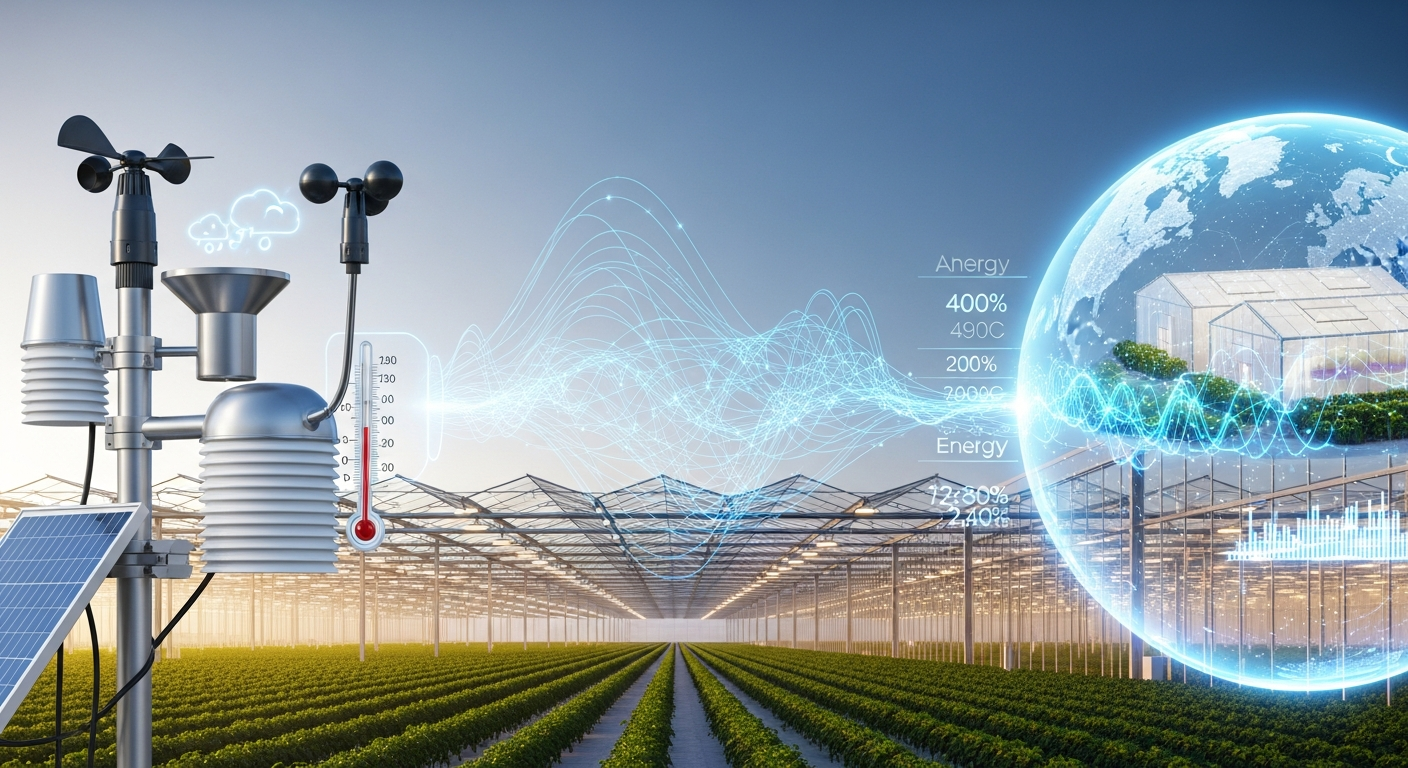
A weather station is the primary data source for external conditions. These range from basic residential models to sophisticated, professional-grade agricultural systems. Key sensors typically include:
- Air Temperature: Essential for determining heating/cooling loads and ventilation needs.
- Relative Humidity: Crucial for understanding dew point, evaporative cooling potential, and disease risk.
- Wind Speed and Direction: Informs ventilation strategies, structural stress, and potential heat loss. An anemometer measures speed, while a wind vane determines direction.
- Solar Radiation (Pyranometer): Measures the intensity of sunlight, vital for managing shade screens, supplemental lighting, and understanding photosynthetic activity.
- Rain Gauge: Quantifies precipitation, directly influencing irrigation schedules and humidity levels.
- Barometric Pressure: Can indicate approaching weather fronts and complement other data for more accurate forecasts.
- UV Index (Optional): Useful for specific crops or pest management strategies.
When selecting a weather station, consider its durability, sensor accuracy, maintenance requirements, and, critically, its ability to communicate data to your central hub.
The Central Greenhouse Hub: The Brain of Your Operation
The central greenhouse hub is the control center for your entire operation. It’s typically a combination of hardware and software designed to:
- Collect Data: Receive inputs from both internal greenhouse sensors (temperature, humidity, CO2, soil moisture, light) and the external weather station.
- Process & Analyze Data: Interpret incoming data, compare it against predefined setpoints and rules, and execute algorithms.
- Control Actuators: Send commands to various greenhouse components like ventilation fans, louvers, heating systems, cooling pads, shade screens, irrigation pumps, and supplemental lights.
- Provide User Interface: Offer a dashboard or software platform for growers to monitor conditions, adjust settings, review historical data, and receive alerts.
Modern hubs are often internet-enabled (IoT in agriculture), allowing for remote monitoring and control via computers or mobile devices.
Communication Protocols: Bridging the Data Gap
For weather station data to be useful, it must reliably reach the central greenhouse hub. Various communication methods facilitate this sensor data integration:
- Wired Connections:
- Ethernet: Offers high bandwidth and reliability over shorter distances.
- RS-485/Modbus: A common industrial standard for robust, long-distance communication, especially for multiple sensors on a single bus.
- Wireless Connections:
- Wi-Fi: Convenient for shorter distances and existing network infrastructure, but can be prone to interference in busy environments.
- LoRa/LoRaWAN: Ideal for long-range, low-power data transmission, suitable for large greenhouse complexes where the weather station might be some distance away.
- Cellular (4G/5G): Provides connectivity in remote locations without Wi-Fi, often requiring a SIM card and data plan.
- Zigbee/Bluetooth: Best for short-range, low-power applications, though less common for primary weather station links to a central hub due to range limitations.
- APIs (Application Programming Interfaces): Many modern weather stations and greenhouse hubs offer APIs. This allows different software systems to talk to each other directly, pulling or pushing data in a structured format (e.g., JSON, XML). This is critical for seamless greenhouse management software integration.
Data Streams: The Information Flow
The integration creates a powerful combined data stream:
- External Data: Raw readings from the weather station (temperature, humidity, wind, solar radiation, etc.).
- Internal Data: Real-time conditions inside the greenhouse from various sensors.
- Historical Data: Stored records of both internal and external conditions, crucial for trend analysis, troubleshooting, and refining automation rules.
- Forecast Data: Some advanced hubs can also integrate third-party weather forecast data, enabling truly predictive analytics greenhouse operations.
The synergy of these data streams empowers the central hub to make informed, timely decisions that optimize the growing environment, leading to more robust crops and more sustainable operations.
The Integration Process: Steps to Connect Your World
Successfully integrating a weather station with a central greenhouse hub involves several practical steps, ranging from hardware selection to software configuration and ongoing calibration. A systematic approach ensures reliability, accuracy, and maximum benefit.
Step 1: Needs Assessment and Hardware Selection
Before purchasing any equipment, define your objectives. What specific problems are you trying to solve? Which external environmental factors are most critical for your crops?
- Identify Key Parameters: Determine which weather station sensors are essential (e.g., if wind is a major factor for ventilation, ensure accurate wind speed/direction).
- Compatibility Check: Crucially, ensure the chosen weather station is compatible with your existing or planned central greenhouse hub. Check for supported communication protocols (e.g., Wi-Fi, LoRa, Modbus, API integration). Many manufacturers design their systems to be interoperable, but always confirm.
- Durability and Accuracy: Invest in a weather station built for agricultural environments, capable of withstanding harsh weather conditions and providing consistent, accurate data.
- Scalability: Consider future expansion. Can the system accommodate additional sensors or integrate with other smart farming technologies later?
Practical Tip: Research reputable manufacturers known for agricultural weather stations and robust greenhouse control systems. Reading reviews and seeking recommendations from other growers can be invaluable.
Step 2: Installation and Physical Setup
Proper physical installation is vital for accurate data collection.
- Weather Station Placement: Install the weather station in an open area, away from obstructions (buildings, trees, large equipment) that could interfere with wind, rain, or solar radiation readings. Ensure it’s mounted securely at an appropriate height according to manufacturer guidelines.
- Sensor Connection: Connect the weather station sensors to its data logger or transmitter. Ensure all connections are secure and weatherproof.
- Power Supply: Provide reliable power to the weather station (solar power with battery backup is common for remote installations) and the central greenhouse hub.
Step 3: Data Communication Setup
This step establishes the data link between the weather station and the hub.
- Network Configuration: If using Wi-Fi, connect both the weather station’s transmitter and the greenhouse hub to the same network. For LoRaWAN, ensure you have a gateway in range. For wired connections, run appropriate cabling.
- API/Software Integration: If your systems use APIs, you’ll need to configure the hub’s software to pull data from the weather station’s API endpoint (or vice-versa). This often involves entering API keys or credentials provided by the weather station manufacturer.
- Data Protocol Mapping: In some cases, you might need to map specific data points (e.g., “outdoor_temp” from the weather station to “external_temperature” in the hub’s software).
Practical Tip: Perform thorough connectivity tests after initial setup. Verify that data packets are being received consistently and without errors by the central hub.
Step 4: Software Configuration and Rule-Setting
Once data is flowing, configure the central hub’s software to utilize this new information effectively.
- Define Setpoints and Automation Rules: This is where the magic happens. Program the hub to make intelligent decisions based on combined internal and external data.
- Example 1 (Ventilation): “IF external wind speed > 15 mph AND internal temperature > 25°C, THEN open vents to 30% only on leeward side.” (Rather than fully opening all vents and losing too much heat).
- Example 2 (Heating/Cooling): “IF external temperature < 5°C AND internal temperature < 18°C, THEN activate heating. BUT, if external solar radiation > 500 W/m² AND internal temperature is rising, THEN delay heating or activate cooling instead.”
- Example 3 (Irrigation): “IF soil moisture < X% AND no precipitation forecasted in the next 12 hours, THEN initiate automated irrigation.”
- Example 4 (Shade Screens): “IF external solar radiation > 800 W/m² AND internal temperature > 28°C, THEN deploy shade screens.”
- Alerts and Notifications: Set up alerts for critical thresholds (e.g., “external wind speed exceeding safe limits,” “unexpected temperature drop”).
- Data Logging and Analysis: Ensure the hub is logging all incoming data, both internal and external. This historical data is crucial for trend analysis, performance evaluation, and refining your rules over time.
Step 5: Calibration and Ongoing Maintenance
Integration is not a one-time task; it requires continuous attention.
- Initial Calibration: Compare weather station readings with other reliable sources (e.g., local weather forecasts, another known accurate thermometer) to ensure accuracy. Adjust any offset if necessary.
- Regular Checks: Periodically verify sensor accuracy, especially after extreme weather events. Clean rain gauges, anemometers, and solar radiation sensors to prevent fouling.
- Software Updates: Keep your central hub’s software and weather station firmware updated to benefit from new features, bug fixes, and security enhancements.
By following these steps, growers can confidently integrate weather station data into their central greenhouse hub, paving the way for truly intelligent and responsive greenhouse management.
Advanced Applications and Unleashing Predictive Power
Beyond basic automation, the true potential of integrating weather station data with your central greenhouse hub lies in its capacity for advanced applications and predictive intelligence. This moves operations from reactive management to proactive optimization, resulting in significant gains in efficiency, crop quality, and sustainability.
Predictive Climate Control and Energy Efficiency Maximization
One of the most powerful applications is using forecasted weather data to anticipate future climate control needs. Instead of reacting to current conditions, the system can predict and prepare.
- Anticipatory Heating/Cooling: If a significant temperature drop is forecasted overnight, the system can begin pre-heating the greenhouse an hour or two in advance, maintaining a stable temperature without an energy-intensive spike. Conversely, predicting a heatwave allows for gradual pre-cooling or earlier deployment of shade. This minimizes energy consumption by preventing extreme temperature swings and reducing the load on systems.
- Smart Ventilation Strategies: Integrating forecasted wind speed and direction with internal CO2 levels and temperature allows for optimal natural ventilation. The system can decide which vents to open and to what degree, maximizing air exchange while minimizing heat loss or preventing drafts that could stress plants. This is crucial for both temperature regulation and replenishing CO2 for photosynthesis, leading to yield improvement.
- Optimized Supplemental Lighting: By predicting cloud cover and solar radiation, the hub can dynamically adjust supplemental lighting. On days forecasted to be dim, lights can be activated earlier or for longer, ensuring consistent DLI (Daily Light Integral). If bright spells are expected, lighting can be reduced, saving energy without compromising plant growth.
Practical Tip: Leverage machine learning algorithms if your greenhouse hub supports them. These can analyze historical data from both your weather station and internal sensors to continually refine predictive models, learning the unique thermal properties of your specific greenhouse.
Dynamic Resource Allocation for Precision Growing
External data empowers hyper-specific resource application, minimizing waste and maximizing effectiveness.
- Intelligent Irrigation: Combining current soil moisture, evapotranspiration rates (calculated from temperature, humidity, and solar radiation), and forecasted precipitation allows for highly precise automated irrigation. Why water if a storm is coming? Conversely, an upcoming hot, dry period might trigger a pre-emptive watering cycle.
- Targeted CO2 Enrichment: External wind speed dictates how effectively CO2 remains within the greenhouse. On very windy days, the system can reduce CO2 injection to prevent it from being immediately lost through ventilation, or modify ventilation patterns to retain it, improving CO2 use efficiency.
- Nutrient Management: While less direct, extreme external weather conditions can influence plant stress and nutrient uptake. For example, prolonged periods of high light and temperature might warrant slight adjustments to nutrient delivery to support increased metabolic demands.
Integrated Pest & Disease Management (IPM)
This is arguably one of the most impactful advanced applications. Many pests and diseases have specific environmental triggers. Weather station data, combined with internal greenhouse conditions, can create powerful predictive models for early warning and prevention, greatly aiding disease prevention greenhouse strategies.
- Disease Risk Modeling: Specific combinations of temperature, relative humidity, and leaf wetness duration (often inferred from high humidity and lack of air movement) are conducive to fungal diseases like Botrytis or powdery mildew. The system can monitor these conditions externally and internally, issuing alerts or automatically triggering preventative measures like increased ventilation or targeted heating to reduce humidity, before symptoms even appear.
- Pest Activity Prediction: Some pests are more active or reproduce faster under certain temperature ranges or after specific weather events. Monitoring external temperatures can help predict the emergence of certain insect populations, guiding early scouting and biological control releases.
Practical Tip: Collaborate with agricultural extension services or plant pathologists to understand the specific environmental triggers for common diseases and pests affecting your crops. Configure your hub with these thresholds for early warning.
Long-term Planning and Data-Driven Decision Making
The wealth of historical data collected from both external and internal sources provides invaluable insights for strategic decision-making.
- Crop Scheduling: Analyze how specific weather patterns influenced past crop cycles to refine future planting and harvesting schedules.
- Greenhouse Performance Review: Evaluate the efficiency of your climate control systems over time under varying external conditions. Identify areas for improvement in energy use, water use, and environmental stability.
- Strategic Investments: Data can justify investments in new technologies (e.g., more efficient heating, advanced shade systems) by demonstrating the ROI based on quantifiable savings and yield improvements.
By leveraging the full capabilities of weather station integration, growers can move towards truly autonomous and intelligent greenhouses, significantly boosting productivity, reducing environmental impact, and securing a sustainable future for their operations.
Conclusion: The Future is Integrated
The journey towards optimized greenhouse management culminates in the intelligent integration of external weather station data with a sophisticated central greenhouse hub. This powerful synergy transcends basic automation, ushering in an era of true precision agriculture where every environmental variable, both inside and outside the controlled environment, is meticulously monitored, analyzed, and acted upon. From ensuring robust greenhouse climate control and maximizing energy efficiency greenhouses to enabling proactive pest and disease prevention greenhouse strategies, the benefits are profound and far-reaching.
By embracing weather station integration, growers gain the invaluable foresight to anticipate environmental shifts, dynamically allocate resources, and maintain consistently ideal growing conditions. This leads directly to healthier crops, superior yields, reduced operational costs, and a significantly smaller environmental footprint. The transition to such a data-driven approach positions greenhouses not just as structures, but as intelligent, responsive ecosystems, ready to adapt to the unpredictable forces of nature and ensure sustainable profitability.
As the agricultural sector continues to evolve, the distinction between internal and external climate control will blur further. The future of horticulture lies in fully integrated systems that empower growers with actionable intelligence, transforming the art of growing into a data-optimized science. Embracing this technology today is not merely an upgrade; it is an investment in the resilience, efficiency, and success of tomorrow’s food production.